Tracking Azelaic Acid defense signal to Boost Plant Disease Resistance
Professor Jean Greenberg and Dr. Nicolás Cecchini describe methods that use isotope-labeled azelaic acid to trace how this defense signal moves through Arabidopsis plants and enters leaf tissue.


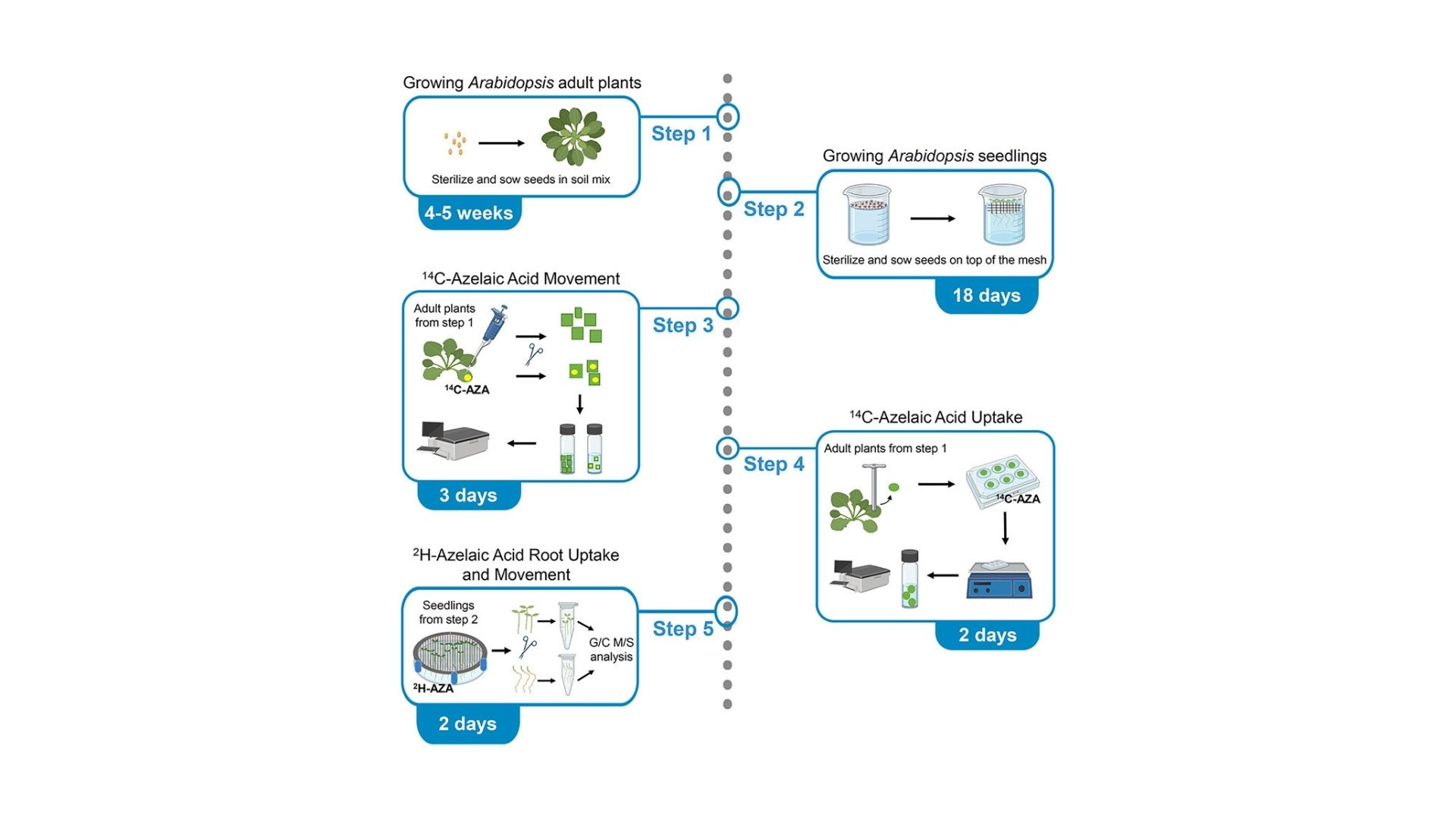
Scientists have developed a protocol for analyzing the movement and uptake of isotopically labeled azelaic acid in the model plant Arabidopsis thaliana, providing valuable insights into plant immune responses. This research is particularly significant for understanding how plants trigger systemic resistance against pathogens. The protocol, detailed by Dr. Nicolás Cecchini, Dr. Suruchi Roychoudhry, and Professor Jean Greenberg, focuses on studying the defense signal azelaic acid, a molecule that travels within the plant, triggering systemic resistance in tissues distant from the site of infection.
Professor Jean Greenberg from the University of Chicago and Dr. Nicolás Cecchini from the University of Córdoba spearheaded this work, which was published in the STAR Protocols journal. The researchers devised methods to measure azelaic acid movement from leaves to other parts of the plant and its uptake into leaf discs. “Understanding the generation, movement, uptake, and perception of mobile defense signals is key for unraveling the systemic resistance programs in flowering plants against pathogens,” said Professor Greenberg, explaining the rationale behind their study.
The team utilized radiolabeled azelaic acid, a version of azelaic acid labeled with carbon-14, to trace its movement within the plant. This compound was applied to a single leaf, and the researchers tracked its travel to both aerial and root tissues, providing critical information on how plants mobilize their defense signals. One notable result was the movement of azelaic acid from the treated leaf to distal tissues, offering insight into how the plant coordinates its immune response across various organs. Additionally, a control experiment using radiolabeled sucrose helped distinguish azelaic acid-specific movement from general transport issues in the plant’s phloematic system.
The researchers extended the study by analyzing azelaic acid uptake into leaf discs, where they applied the radiolabeled azelaic acid and observed its absorption into the tissue. They further explored the potential for root-to-shoot transport using deuterium-labeled azelaic acid, a version of azelaic acid labeled with deuterium. These methods open up new avenues for investigating how plants mobilize defense signals from roots to shoots, thus providing comprehensive insights into their immune systems.
The use of isotopically labeled azelaic acid has several advantages, particularly its high sensitivity in detecting even small quantities of the molecule moving within the plant. However, as Dr. Cecchini noted, there are challenges associated with using radioactive materials. “We can trace the movement of radiolabeled molecules, but specialized techniques, such as gas chromatography-mass spectrometry (GC-MS), are needed to confirm whether azelaic acid remains intact or has been converted into another form during transport,” he explained.
The study’s findings have profound implications for plant biology, as they advance the understanding of how plants manage to develop long-lasting resistance against pathogens. Systemic resistance, a type of plant immune response, requires signals that move from one part of the plant to another. Azelaic acid plays a crucial role in this process by priming the plant for faster and more effective responses when facing subsequent infections.
Looking forward, these protocols are likely to be adapted for studying other plant species and defense signals. The researchers suggest that their methods could be employed to investigate different small molecules involved in plant immunity, offering a robust toolset for future studies on systemic plant resistance.
About the researchers

Jean T. Greenberg
Jean T. Greenberg: I have been a Professor in the Department of Molecular Genetics and Cell Biology at the University of Chicago since 1997.… I earned degrees at Barnard College (BA, Biochemistry, magna cum laude), and Harvard University (PhD, Biophysics) and was a National Science Foundation-supported postdoctoral fellow in the department of Molecular Biology at Massachusetts General Hospital/Harvard University. I have authored 76 peer-reviewed publications and have three active patents. Together my work has received over 14,000 google scholar citations, has an h-index of 51 and an i10-index of 71. For many years, I was senior editor for The Plant Cell. My honors include being a Pew Biomedical Scholar and a Fellow of the American Society for Plant Biology. Recently, I was elected to be the next president of the International Society for Molecular Plant-Microbe Interactions. My laboratory’s contributions include: (1) Discovering and characterizing the mechanism of action of type III virulence effectors from the pathogen Pseudomonas syringae. (2) Identifying a novel plant systemic defense priming signal (azelaic acid, AZA) now used commercially to boost plant health. (3) Discovering genes needed for the action and systemic movement of the AZA and showing that these genes (AZI1 and EARLI1) and others in the same family are also needed for growth and/or immune responses to the plant growth promoting bacteria P. simiae and/or colonization by this strain. Signaling proteins that impact the intracellular trafficking of AZI1 and EARLI1 are needed for multiple responses stimulated by P. simiae and AZA. (4) Studying metabolite and microbial peptide signal movement to establish their systemic movement and effects. (5) Discovering plant proteins important for basal and systemic disease resistance and cell death control. jgreenbe@uchicago.edu https://profiles.uchicago.edu/profiles/display/37089

Nicolás M. Cecchini
Nicolás M. Cecchini: I obtained my Ph.D. in Chemical Sciences from National University of Córdoba, Argentina. My doctoral work elucidated a key role of the proline metabolism in controlling cell death during plant infections (Cecchini et al., 2011a, 2011b). Following my PhD, I did a postdoctoral training under the mentorship of Dr. Jean T.… Greenberg at The University of Chicago, US, where I investigated the mechanisms underlying the immune memory or priming. Particularly, the role(s) of the amino-transferase ALD1 and the lipid transfer protein (LTP) AZI1 and related proteins (Cecchini et al., 2015a, 2015b, 2019). As an independent researcher back in Argentina, I continued exploring the plastids targeting mechanism of AZI1 (Cecchini et al., 2020), and initiate studies on the alternative splicing-driven subnuclear localization of a DNA-repair/epigenetic factor MBD4L (Cecchini et al., 2022). These studies led me to focus my current research on an NLR-type immune receptor targeted to plastids, and the changes on chromatin and alternative splicing as mechanisms for establishing a primed state (Miranda et al., 2023; Peppino et al., 2024, in prep.).Centro de Investigaciones en Química Biológica de Córdoba (CIQUIBIC-CONICET) | Depto. Química Biológica, FCQ-UNC.Av. Haya de la Torre s/n - Ciudad Universitaria | Universidad Nacional de Córdoba | CP. X5000HUA - Córdoba - República Argentina | TEL: +54 351 5353855.ORCID | Google Scholar | CIQUIBIC

Suruchi Roychoudhry
Suruchi Roychoudhry: I completed my undergraduate degree (BSc. Biotechnology) from India, and my MSc in Molecular Biology from Sussex University. I then began my PhD in the lab of Prof.… Stefan Kepinski in 2009 at the University of Leeds in Plant Developmental Biology exploring the role of the plant hormone auxin in regulating oblique growth patterns in flowering plants. My PhD findings lead to commercialisation of my research and the filing of a US patent (Modified Plant Cell) which further supported a short postdoctoral project continuing in the lab of Prof. Kepinski performing some proof-of-concept work. Next, I moved to the lab of Prof. Jean Greenberg at the University of Chicago (Chicago, USA) to work on the molecular mechanisms investigating systemic plant immunity in 2015. I then moved back to Leeds in 2016, and following a period of parental leave and returning to work part-time subsequently, I am currently employed as a senior research fellow within the Centre for Plant Sciences at the University of Leeds investigating the mechanisms underpinning angle-dependent gravitropic response in Arabidopsis roots while simultaneously applying for (and being rejected from!) independent fellowship positions. Twitter: @SuruchiRoy1 Email: S.Roychoudhry@leeds.ac.uk
Journal reference
Roychoudhry, Suruchi, Jean T. Greenberg, and Nicolás M. Cecchini. “Protocol for analyzing the movement and uptake of isotopically labeled signaling molecule azelaic acid in Arabidopsis.” STAR Protocols (2024). DOI: https://doi.org/10.1016/j.xpro.2024.102944