Traffic Crashes Are Stealing Your Time and Money. Here’s How
Professor Becky Loo and Ting Lian used taxi GPS data to measure crash-caused traffic delays in Hong Kong, finding road networks and urban surroundings explain delays better than crash details.


Traffic congestion due to road crashes is a widely recognized issue, yet its full economic impact is often underestimated. A new study by Professor Becky Loo and Ting Lian from The University of Hong Kong sheds light on the cost of travel delays caused by traffic crashes. The research, published in Communications in Transportation Research, introduces a new method for measuring these delays using taxi Global Positioning System data, a navigation technology that tracks vehicle locations, and open-source spatial datasets.
Professor Loo and Lian analyzed travel delays by comparing post-crash travel speeds with typical speeds on affected road segments. Their study incorporated a statistical analysis method, a way to study data patterns and relationships, considering various factors such as crash characteristics, road network features, such as intersections, lane width, and traffic flow patterns, and urban surroundings. “The findings show that crash characteristics alone inadequately explain variations in delays,” explained Professor Loo. “Only after integrating factors related to urban infrastructure and dynamic road conditions do we see a clearer picture of how delays unfold.”
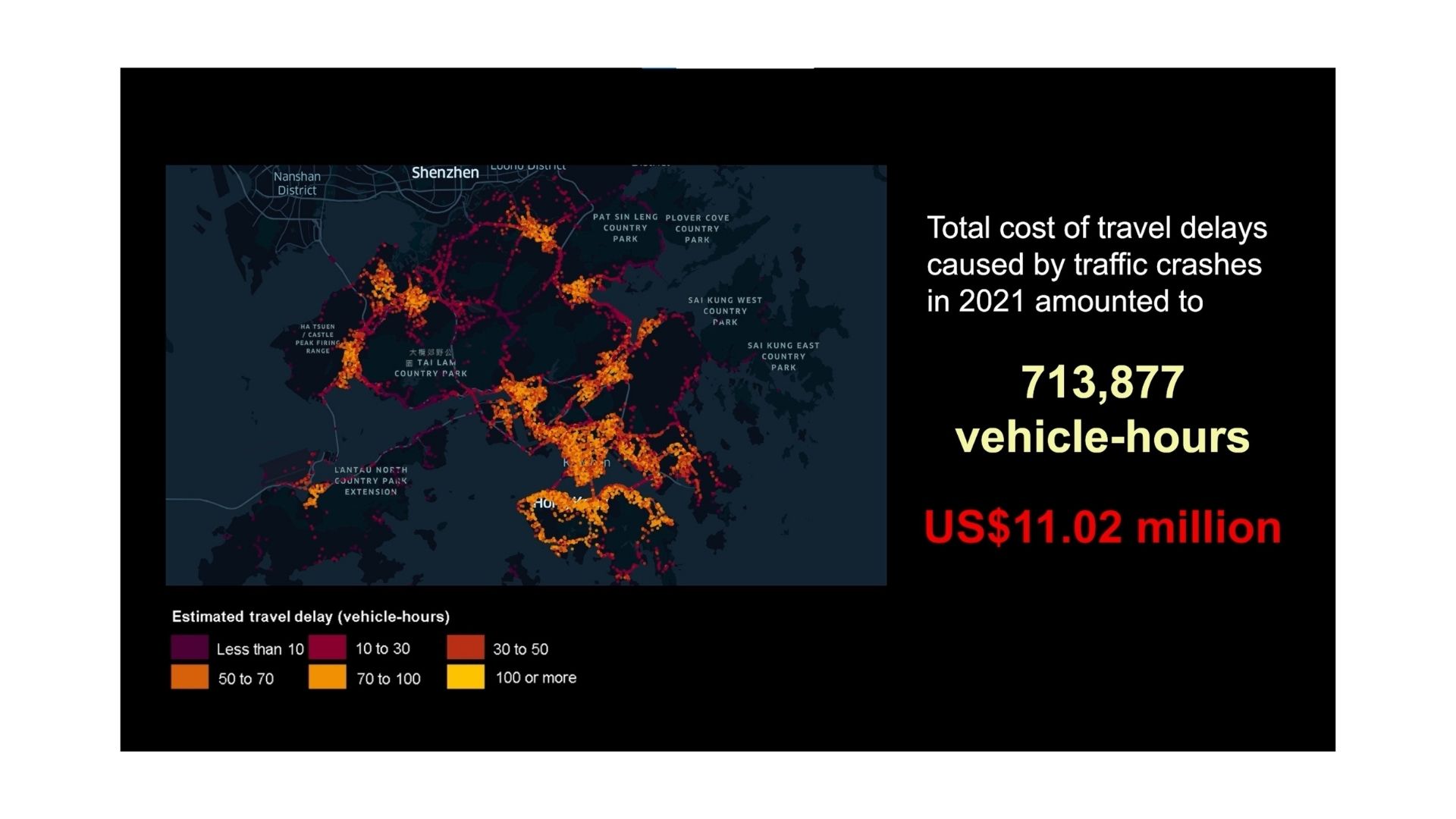
The study estimates that in 2021, traffic crashes in Hong Kong resulted in a total delay of 713,877 vehicle-hours. This corresponds to an economic loss of approximately 11.02 million United States dollars, referring to the financial damage caused by wasted time and fuel due to congestion, showing the considerable financial impact of crash-induced congestion. The researchers stress that delays extend beyond the immediate crash site, often affecting upstream road segments for distances up to one kilometer.
Professor Loo and her team found that factors such as road type, surrounding commercial activity, and traffic speed influence the magnitude of travel delays. Interestingly, the study reveals that busy city areas with well-connected roads experience longer delays. Moreover, pedestrian volume near crash sites was also linked to greater congestion, emphasizing the need for better traffic management strategies, which include measures like signal timing adjustments and alternate route planning to ease congestion in densely populated areas.
Beyond quantifying delays, the study offers a clear method for policymakers to devise targeted strategies for mitigating traffic congestion. “Our model allows urban planners to identify hotspots where crashes lead to the greatest delays and implement countermeasures accordingly,” Lian noted. By improving emergency response times and optimizing traffic flow in critical areas, authorities can reduce the ripple effects of road crashes on urban mobility.
The findings of Professor Loo and Lian’s study underscore the broader societal impact of road crashes, extending beyond injuries and fatalities to economic and infrastructural consequences. As cities continue to grapple with traffic congestion, integrating information based on real-world data into transport planning could pave the way for more efficient and resilient urban road networks.
About the researchers

Becky P.Y. Loo
Becky P.Y. Loo is Professor of Geography at the University of Hong Kong. She is a Fellow of the Academy of Social Sciences, United Kingdom. She has been a Chang Jiang Chair Professor of the Ministry of Education, China.… Becky holds an Honorary Professorship at the Department of Civil, Environmental and Geomatic Engineering, University College London (UCL), UK. She also holds an Honorary Professorship at School of Economics and Management, Beijing Jiaotong University China. Her core research interests are i) transit, walkability and urban form; ii) road safety and spatial analysis; iii) sustainability and transport decarbonization; and iv) smart cities. She is Founding Co-Editor-in-Chief of Travel Behaviour and Society. Becky has a proven track record in international research collaboration, research assessments, quality assurance and leadership as a former Head of Department, Associate Dean of Faculty and University-level Institute Director. With her expertise and solid contributions to the local society, she has been conferred a Justice of Peace (JP) by the Hong Kong Special Administrative Region Government. Becky is committed to fostering people-oriented and place-based interdisciplinary research. Her curriculum vitae is available at www.bpyloo.hku.hk.

Ting Lian
Ting Lian is a PhD student in the Department of Geography at The University of Hong Kong. Her research centers on urban transport, with a focus on improving the efficiency and resilience of transport systems while prioritizing the convenience, safety, and equity of diverse user groups.… With a strong background in Geographic Information Systems (GIS), Ting combines spatial analysis, traditional transportation theories, and advanced methodologies to tackle pressing urban transport challenges. Her work aims to inform smarter transport management and contribute to more inclusive and sustainable urban planning strategies, fostering stronger connections between people and places.
Journal reference
Ting Lian, Becky P.Y. Loo. “Cost of travel delays caused by traffic crashes.” Communications in Transportation Research, 2024. DOI: https://doi.org/10.1016/j.commtr.2024.100124