A machine learning model discovers that ~60% of Americans are confused about climate risk and ambivalent about supporting climate policy
Professor Asim Zia's team applied machine learning to long-running US survey data and found most Americans are lukewarm, confused about climate risk and ambivalent about climate policy.


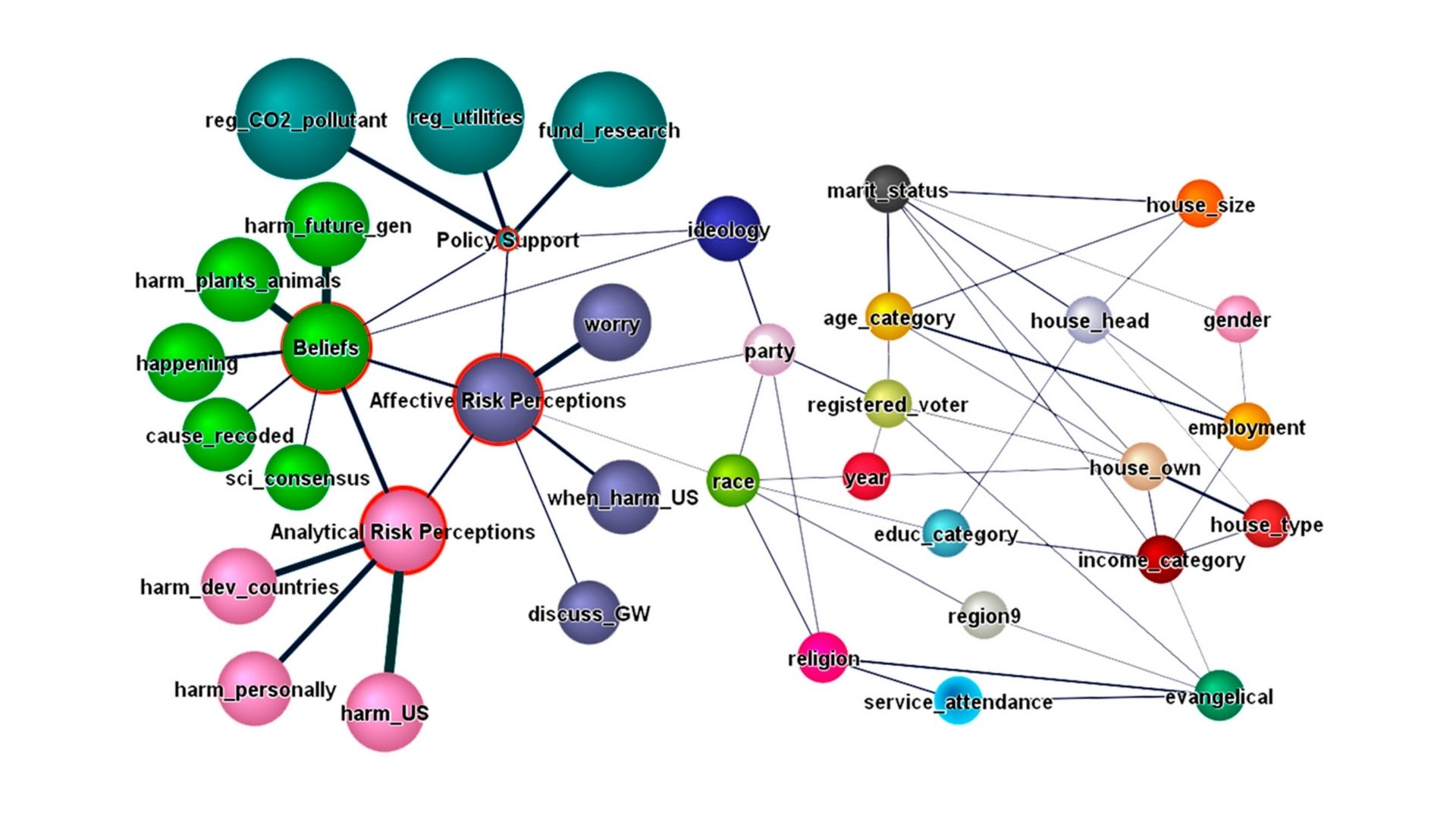
Understanding public support for climate policies is essential in shaping effective strategies to reduce climate change effects. However, predicting policy support has long been challenging because many factors influence public opinion. An interdisciplinary team of researchers, led by Professor Asim Zia from the University of Vermont, including Professor Katherine Lacasse from Rhode Island College, Professor Nina Fefferman and Professor Louis Gross from the University of Tennessee, and Professor Brian Beckage from the University of Vermont, have developed a new machine-learning approach to better understand these complexities. Their study, published in the peer-reviewed journal Sustainability, introduces a method called a probabilistic structural equation model, a statistical method that examines relationships between different factors by considering covarying probabilities and uncertainties, which helps analyze how different factors—such as people’s concerns about climate change, their beliefs, political views, race and demographic backgrounds—affect their support for climate policies.
Unlike older methods that rely on assumptions about which factors are most important, this new approach uses machine learning, a type of artificial intelligence that allows computers to find patterns in data and improve predictions without being explicitly programmed, to find patterns in large sets of data. “By using unsupervised machine learning techniques, we let the data itself show us the connections between different factors, removing biases that come from human guesswork,” explained Professor Zia. The study uses data from a long-term survey called “Climate Change in the American Mind,” which spans more than a decade and includes responses from a nationally representative cross-section of people. This new method makes predictions with much greater accuracy than traditional statistical approaches.
One of the study’s most surprising findings is the discovery of a previously unrecognized group of “lukewarm supporters,” who make up most of the United States population. Unlike strong supporters or firm opponents of climate policies, these individuals are confused about climate risk and ambivalent about supporting or opposing climate policy action. The research shows that people do not think about climate risk in a single way. Instead, the study separates risk perception into two types: analytical (logical assessment) and affective (emotional response). “We found that emotions, such as worry, play a bigger role in shaping policy support than purely logical assessments of climate risk,” noted Professor Zia. Further he noted that “both emotional and analytical messaging can be used to persuade 60% confused, mostly moderate, ambivalent public to support collective action.”
The study of Professor Zia and his colleagues also confirms that political views and beliefs about climate science strongly affect policy support. People who trust the scientific consensus, the general agreement among experts based on a large body of evidence, on climate change are more likely to support climate policies, while those who do not tend to oppose them. However, the machine-learning model shows that political identity, a person’s association with certain political beliefs or parties that shape their views on issues, alone does not fully determine people’s views. By also considering factors like risk perceptions, race and demographic background, the model provides a deeper understanding of how different groups react to climate policies.
These findings have important implications for policymakers and those working to increase public support for climate action. Understanding the different categories of policy supporters allows for more effective communication strategies. For example, appealing to lukewarm supporters with messages that connect emotionally, rather than focusing only on scientific facts, may be more effective. The study also emphasizes the need to include public opinion trends in climate policy planning, ensuring that policies reflect changing attitudes over time.
By using machine learning, this research offers a new way to understand what drives public support for climate policies. It provides a data-based approach to tackling one of the biggest challenges in climate communication: reducing political divisions and encouraging broader agreement on the need for climate action.
About the researchers

Asim Zia
Asim Zia's research, teaching and outreach activities focus on advancing the sustainability and resilience of integrated socio-environmental systems. Asim Zia is serving as a Professor of Public Policy and Computer Science in the Department of Community Development and Applied Economics, with a secondary appointment in the Department of Computer Science, at the University of Vermont (UVM).… He is Director of both the Institute for Environmental Diplomacy and Security (IEDS), and Ph.D. program in Sustainable Development Policy, Economics and Governance at the University of Vermont.
Journal reference
Zia, A., Lacasse, K., Fefferman, N.H., Gross, L.J., & Beckage, B. “Machine Learning a Probabilistic Structural Equation Model to Explain the Impact of Climate Risk Perceptions on Policy Support.” Sustainability, 2024, 16, 10292. DOI: https://doi.org/10.3390/su162310292