Spiders Without Eyes Now Spin Red Silk Thanks to Gene Hack
Professor Thomas Scheibel and Edgardo Santiago-Rivera used CRISPR gene editing in spiders, switching off an eye-development gene in some offspring and adding a red fluorescent protein to silk in others.


Spiders, with their intricate webs and special biological features, have always intrigued scientists. However, their complex genetic makeup has made it difficult to use modern DNA-editing tools on them—until now. For the first time, researchers have successfully applied a gene-editing method known as CRISPR-Cas9—a tool that works like molecular scissors to cut and modify DNA—to spiders. This achievement not only sheds light on how spiders develop but also shows new possibilities for creating customized spider silk.
Edgardo Santiago-Rivera and Professor Thomas Scheibel from the University of Bayreuth led the research, using the cobweb spider Parasteatoda tepidariorum, a commonly used model spider in biology labs. They accomplished two important goals: changing how spider eyes form and adding new traits to the silk that spiders spin. Their findings appear in the peer-reviewed journal, Angewandte Chemie International Edition.
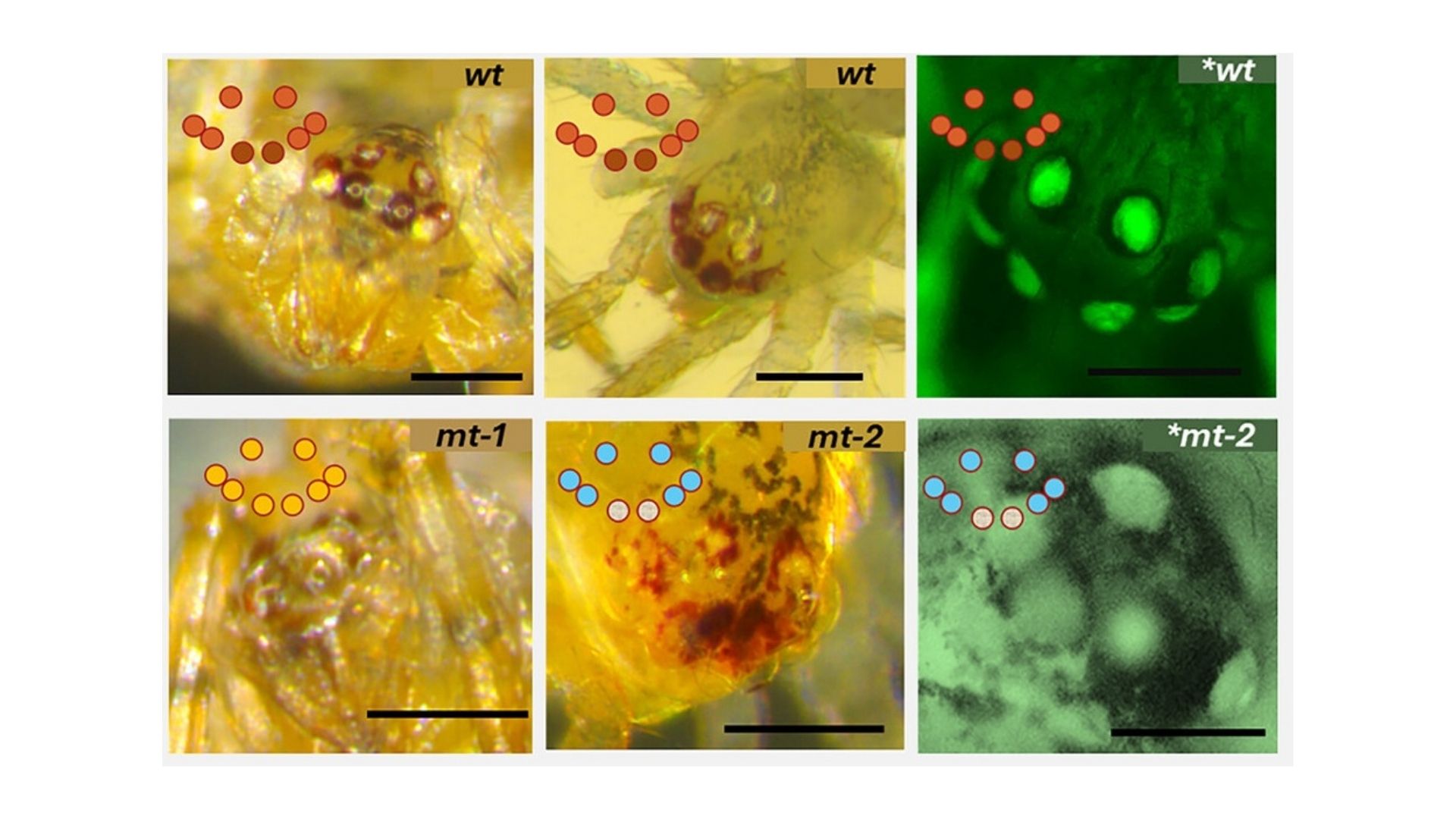
In one part of the experiment, Santiago-Rivera and Professor Scheibel turned off a gene called sine oculis, which is essential for forming spider eyes. When this gene was switched off, some young spiders were born without eyes or with abnormal eye shapes. The extent of these changes varied, but in some cases, the spiders had no eyes at all—clearly showing how important this gene is. In a second part of the study, the scientists inserted a gene for a red-glowing protein—commonly used in labs to track gene activity—into the spider’s silk-producing gene. This caused the spiders to produce glowing red silk threads, proving that the new gene had been successfully added without interfering with how the silk was made.
The glow in the silk showed that spider silk genes could be altered to include new features. Even with this change, the silk kept its usual strength and flexibility. “The generated mutant silk revealed red fluorescence,” explained Professor Scheibel, pointing out how remarkable it is that the silk remained unchanged in function despite the new gene.
The study also confirmed that sine oculis is absolutely necessary for eye formation. When this gene was edited, the spiders showed a range of effects, from slightly misshapen eyes to no eyes at all. Interestingly, in all cases, the lens—the transparent part of the eye that focuses light—still developed, suggesting it forms in a different way from other parts of the eye. This finding gives scientists a new way to study how spiders create their complex visual systems. As Santiago-Rivera put it, “The CRISPR-KO—short for knock-out or turning off a gene—impacted the development of all eyes of the respective spider, supporting the previously described role of sine oculis.”
Beyond learning how spiders grow, this study opened new doors in materials science, the study of how materials behave and how they can be designed. Spider silk is already famous for being incredibly strong and stretchy. Now that scientists can change its properties by editing genes, they can imagine making silk that glows, responds to heat, or carries other built-in features. This research connects biology and materials science in a creative and promising way.
The impact of Santiago-Rivera and Professor Scheibel’s work could reach well beyond spiders. By solving the problems of editing spider genes, the team has made it easier for other scientists to study and modify animals that haven’t been easy to work with before. Their method for gene editing might now serve as a helpful example for experiments involving unusual organisms. This could lead to new discoveries in evolution and the development of high-tech materials.
About the researchers

Edgardo Santiago-Rivera
Edgardo Santiago-Rivera is a rising scientist whose research bridges developmental biology and biotechnology. His work focuses on gene regulation and the molecular mechanisms that guide the formation of complex traits in non-traditional model organisms.… At the University of Bayreuth, he played a central role in pioneering CRISPR-based gene editing in spiders—an area previously untouched due to technical challenges. Santiago-Rivera's interest lies in exploring how genes shape physical traits like vision and silk production, contributing to both basic science and applied bioengineering. His innovative use of fluorescent markers in spider silk has opened new paths in materials science, with implications for wearable tech, sensors, and bio-inspired materials. With a keen interest in both genetic development and applied biomaterials, Santiago-Rivera continues to push boundaries in experimental biology.

Professor Thomas Scheibel
Professor Thomas Scheibel is an internationally recognized expert in biomaterials and synthetic biology. Based at the University of Bayreuth in Germany, he has made significant contributions to the study of protein-based materials, particularly spider silk.… Known for bridging biology with engineering, Scheibel's research explores how natural materials can be modified or replicated for innovative uses in medicine, textiles, and technology. He led the first successful attempt to genetically edit spider silk-producing genes, enabling spiders to spin glowing silk—a milestone in functional biomaterials. With multiple affiliations across Bayreuth’s leading research centers, he is a key figure in advancing bioengineering tools and sustainable materials. His work combines deep biological understanding with real-world application, aiming to create novel materials that are both high-performing and environmentally friendly.
Journal reference
Santiago-Rivera E., Scheibel T. “Spider Eye Development Editing and Silk Fiber Engineering Using CRISPR-Cas.” Angewandte Chemie International Edition, 2025. DOI: https://doi.org/10.1002/anie.202502068