Everyday water turns powerful when dyes gain surprising new ability
Professor Santiago de la Moya and Dr. Jorge Bañuelos's team found a simple chemical swap that makes bright BODIPY dyes dissolve in water while keeping their glow, enabling water-based dye lasers.


Chemists have revealed a new way to make one of the most widely used families of colorful organic dyes dissolve in water, opening up fresh opportunities in eco-friendly chemistry and advanced light-based technologies. The work tackles a long-standing problem: although boron dipyrromethenes (BODIPYs), a class of fluorescent organic dyes known for their intense brightness, are praised for their glow and flexibility, they do not mix well with water. This has limited their use in important areas such as medical imaging, biological research, and safer environmental chemical methods and technologies.
For this discovery, researchers Dr. Jorge Bañuelos and Professor Santiago de la Moya led a multidisciplinary team from Universidad Complutense de Madrid, Universidad del País Vasco, Consejo Superior de Investigaciones Científicas, and Instituto de Investigación Biomédica Hospital Doce de Octubre. Their results were published in the journal Chemical Science.
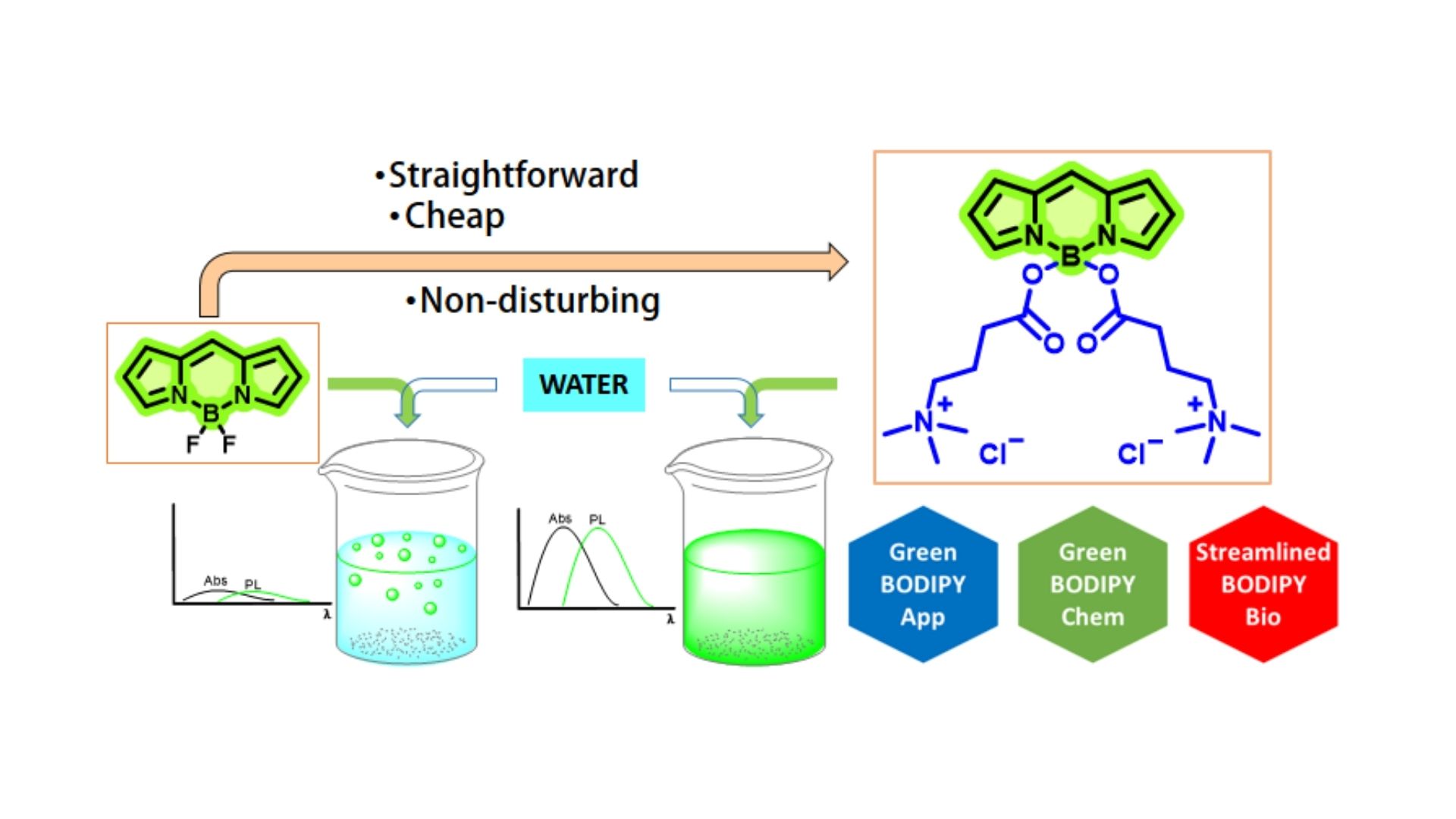
Dr. Bañuelos and Professor de la Moya developed a straightforward process that changes the usual water-repelling boron dipyrromethenes into water-friendly forms. They did this by swapping the dye’s fluorine atoms with groups that attract water. What is remarkable is that this change preserves the dyes’ bright and glowing qualities, something earlier methods often failed to achieve. Professor de la Moya explained: “We present a straightforward general chemical modification aimed at converting conventional hydrophobic boron dipyrromethenes into highly hydrophilic variants, thus enabling their efficient solubilization in water with minimal disruption to the dye’s inherent photophysics”. Hydrophobic means resisting water, while hydrophilic refers to substances that can easily dissolve in water.
Dr. Bañuelos and Professor de la Moya’s team demonstrated that this method works for a variety of BODIPY dye structures. The treated dyes not only dissolved in water easily but also remained bright and stable. In the past, these dyes would clump together in water and lose their shine. Tests further confirmed that the improved versions preferred water over oil-like (organic solvent) environments, a dramatic shift in behavior. This change was measured by partition values, which show whether a substance favors water or oily surroundings.
What makes this especially exciting is how many uses become possible. The water-ready dyes were tested in three areas: greener BODIPY transformations carried out in water, dye lasers using water as the active medium, and live-cell studies where glowing organic labels and probes are essential. Lasers in this context refer to highly focused beams of light used in technology and medicine. In one experiment, the scientists demonstrated that these dyes could power dye-laser beams in pure water, something never achieved before with this family of compounds. As Dr. Bañuelos noted, “the studied derivatives are, to the best of our knowledge, the first boron dipyrromethene dyes enabling highly efficient and photostable laser emission in pure water”. Photostable means the dyes can keep glowing even when exposed to severe lighting conditions for long periods.
The usefulness goes beyond physics and chemistry. In biology, bright organic probes are essential for tracking activity in living cells. Probes are chemical markers that help scientists see inside cells under a microscope. The researchers showed that their new dyes could mark cells directly in pure water without the need for potentially toxic additives. They remained safe for cells and performed strongly, making them promising candidates for advancing medical imaging and diagnostic tools.
Progress like this demonstrates how science can combine performance with responsibility. By removing the need for harmful solvents, which are chemical liquids used to dissolve substances, and ensuring compatibility with living systems, the new approach connects powerful materials with environmentally mindful practices. Dr. Bañuelos and Professor de la Moya concluded that their strategy “should expand the optimal use of these tunable dyes in applications requiring water or highly hydrophilic media, particularly in the field of biological photonics”. Biological photonics refers to the use of light-based tools for biology and medicine.
About the researchers

Santiago de la Moya
Santiago de la Moya is Professor of Organic Chemistry at Complutense University of Madrid (UCM), where he currently heads both the Department of Organic Chemistry and the Organic Dyes for Photonic Materials research group.… His expertise covers organic reaction mechanisms, molecular chirality, and applied organic synthesis, with a strong focus on small-molecule organic dyes, particularly BODIPY derivatives. His current scientific interests center on the design and development of multifunctional organic dyes and dye-based materials for advanced and emerging applications in energy and health. He has authored over 130 peer-reviewed scientific articles and has made significant contributions to BODIPY chemistry and photonic materials, especially in the development of cost-effective emitters of circularly polarized light based on simple organic molecules. He introduced the concept of CPL-SOMs (Simple Organic Molecules enabling circularly polarized luminescence) in 2015, now widely recognized in the field. His translational research has led to several patents in BODIPY-based chemistry and materials. Dr. de la Moya earned his PhD in Organic Chemistry from UCM in 1994 under the supervision of Professors A. G. Martínez, E. Teso, and A. Fraile, working as an FPU fellow on the stereocontrolled chemistry of norbornane derivatives of natural products. From 1994 to 1996, he conducted postdoctoral research in supramolecular chemistry with Prof. F. Vögtle at the University of Bonn, first as an EU-funded fellow and later as a research associate. In 1997, he was a visiting scholar at the University of California, Berkeley, as a Gregorio del Amo fellow, training in combinatorial chemistry with Prof. P. Bartlett. He joined UCM as Assistant Professor in 1996, became Associate Professor in 2002, and Full Professor in 2017.

Jorge Bañuelos
Jorge Bañuelos is a Senior Lecturer of Physical Chemistry at Basque Country University (EHU), where he belongs to Lumimats research group. His expertise area covers molecular spectroscopy, computational chemistry, electrochemistry and materials chemistry, with particular interest in the photonic properties of organic dyes known as BODIPY.… His main research activity focuses on understanding the photophysical properties of multifunctional organic dyes applied in energy (light harvesters and lasers) and health (sensors and probes). He has authored over 150 peer-reviewed and indexed publications. His most notable scientific contributions are related to BODIPY-based fluorophores and materials for selective staining and treatment of cancer cells by bioimaging-guided photodynamic therapy, and emitters endowed with circularly polarized luminescence for solid-state lighting, respectively. To transfer research results to industry, he has licensed a patent in BODIPY-based chemistry for biophotonics. In recognition of his research impact, Dr. Bañuelos has been included in the Stanford ranking among the top 2% of the most cited researchers worldwide in 2020, 2021 and 2022, and in the senior list for the last five years in 2023. Dr. Bañuelos obtained his PhD degree, awarded with the doctorate extraordinary prize, in 2004 working as an EHU fellow on the photophysical characterization of BODIPYs as photoactive media of tunable lasers. To reinforce his background in materials chemistry, he spent six months in 2006 with Prof. G. Calzaferri’s group at Bern University, learning about dye-doped porous nanomaterials as photosensitizers of solar cells. He secured his current position in 2011 at EHU after a seven-year period as Assistant Lecturer.
Journal reference
Schad C., Ray C., Díaz-Norambuena C., Serrano-Buitrago S., Moreno F., Maroto B.L., García-Moreno I., Muñoz-Úbeda M., López-Montero I., Bañuelos J., de la Moya S. “Water-soluble BODIPY dyes: a novel approach for their sustainable chemistry and applied photonics”. Chemical Science, 2025; Volume 16. DOI: https://doi.org/10.1039/d5sc01295c