Catheter Inside a Catheter Helps Doctors Enter Hard-to-Reach Heart Arteries
Dr. Nobuo Ishiguro's team describes how a slim, extra-long diagnostic catheter slid inside the guiding catheter helped doctors reach heart arteries that standard catheters could not enter.


Blocked or narrowed coronary arteries, the vessels that feed the heart muscle, are commonly treated by threading thin tubes from the wrist or groin to the heart, where tiny balloons and metal mesh tubes called stents reopen the vessel. The procedure begins by seating a guiding catheter, a hollow tube that channels the other tools, at the artery’s opening. In rare cases this is very hard, for example when an artery branches from an unusual spot on the aorta, the main artery leaving the heart, or when an artificial valve delivered by catheter sits in the way. Doctors may then try catheter after catheter, using more contrast dye and radiation and, during a heart attack, losing valuable time.
Dr. Nobuo Ishiguro, Dr. Akimitsu Tanaka, Dr. Kohei Kitamura, Dr. Miyabi Ishikawa, Dr. Teppei Funasaka, Dr. Mami Fukujyu, Dr. Takeshi Mori, Dr. Makito Kaneshiro, Dr. Miyuki Ando and Dr. Kazuo Kato from Nagoya Tokushukai General Hospital in Japan describe a simple way around this problem. Describing a small series of patients, Dr. Ishiguro’s team shows how a slim, extra-long diagnostic catheter slid inside the guiding catheter can steer it toward arteries that standard catheters failed to reach. The work is published in the peer-reviewed journal, JACC: Case Reports.
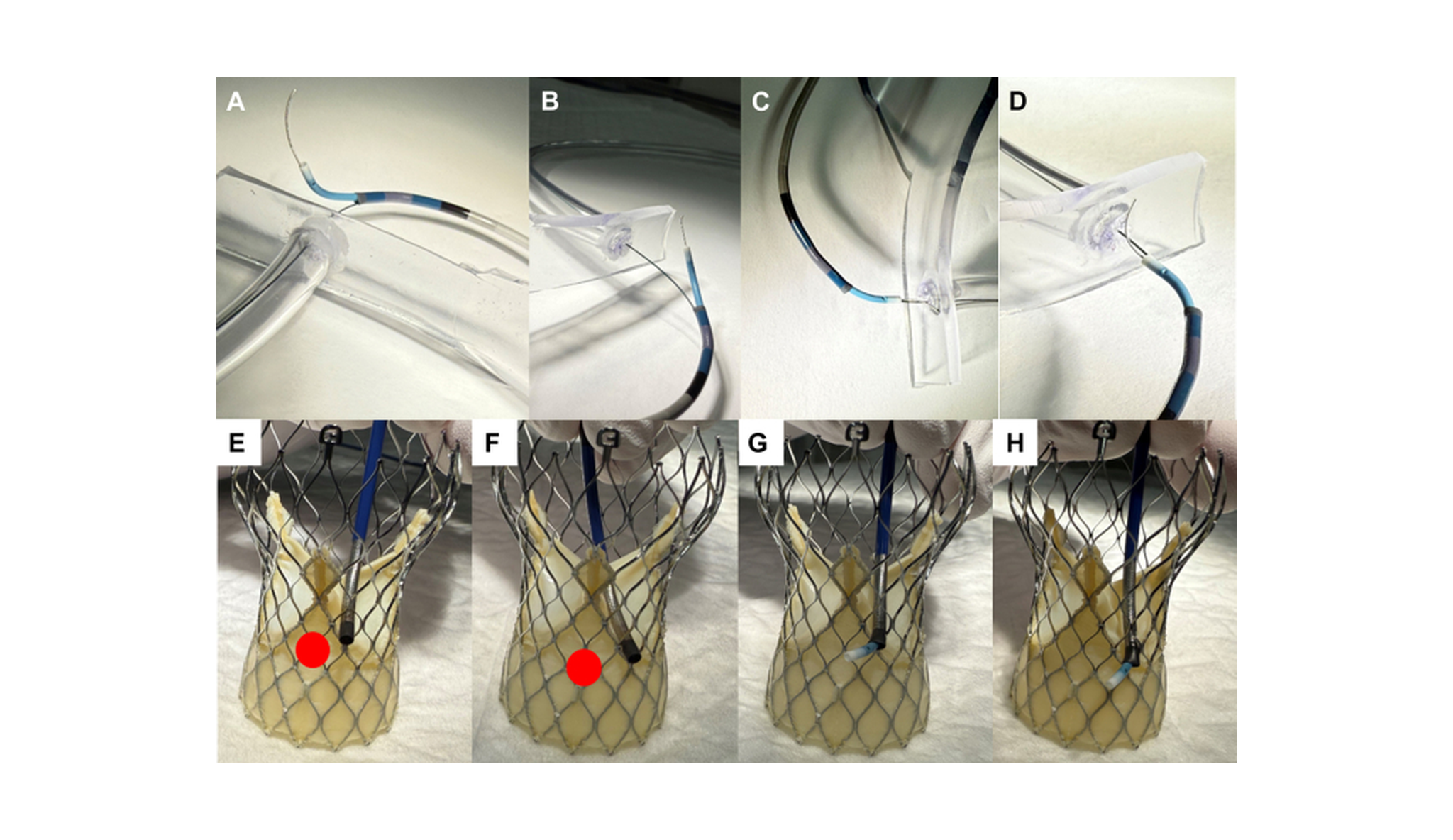
The inner catheter is long enough to pass through the guiding catheter and out beyond its end, where its standard curved tip gives the pair a twisting bend that points in a new direction. Doctors can use this bent tip to aim a guidewire, the fine wire along which balloons and stents travel, into a hard-to-reach artery, or to hook the artery opening and slide the guiding catheter in after it. Dr. Ishiguro’s team also recreated each situation in a model of the coronary arteries.
Most of the patients had arteries arising from unusual places. In those admitted with heart attacks, the right coronary artery branched from the left side of the aorta, and neither standard catheters nor a bent guidewire could enter it. With the inner catheter in place, a wire passed into the hidden artery and a stent was placed with excellent results. In the patient whose unusual anatomy was not known in advance, a heart scan was needed to find the artery, and his treatment used much more contrast dye than when the anatomy was known. Dr. Ishiguro’s team advises considering such a scan, even in emergencies, whenever this anatomy is suspected and targeted X-ray imaging fails. In another patient, the main arteries on the left side of the heart opened separately, and the inner catheter redirected a wire into the narrowed one that the guiding catheter could not enter.
The final patient, an elderly man, had a stent in his right coronary artery and a replacement aortic valve delivered by catheter. When the stented artery became blocked, the valve’s diamond-shaped metal frame stood between the guiding catheter and the artery opening. With the inner catheter inserted, the combined tip hooked the opening through a gap in the frame, the guiding catheter followed, and the blockage was reopened with a medicine-coated balloon.
The wire reached its target in every case, and all of the patients stayed well during follow-up lasting from months to years. “Although custom-shaped or steam-deformed catheters can aid engagement, they may not be readily available or consistently reliable,” explained Dr. Ishiguro. His approach relies instead on a standard diagnostic catheter.
Dr. Ishiguro’s report presents a practical technique rather than results from a large trial, offering doctors an option when the usual tools fail. “Its use may improve procedural success, reduce contrast volume, and enhance wire control without the need for custom-shaped guiding catheters,” he said. Dr. Ishiguro’s team sees particular value for people with unusually placed coronary arteries and those with catheter-delivered replacement valves. “The catheter demonstrates high versatility, with the novel technique proving effective in cases where standard guiding catheter engagement is challenging,” he added.
About the researchers

Dr. Nobuo Ishiguro
Dr. Nobuo Ishiguro is a graduate of Hamamatsu University School of Medicine in Japan in 2014. After mastering his specialty in Nagoya Tokushukai General Hospital, he is currently Chief of the Department of Cardiology at Nagoya Tokushukai General Hospital.

Dr. Akimitsu Tanaka
Dr. Akimitsu Tanaka graduated from Gifu University in Japan in 2005. He currently works as Director of the Department of Cardiology and Heart Center Chief at Nagoya Tokushukai General Hospital.

Dr. Kazuo Kato
Dr. Kazuo Kato received his doctoral degree from the Graduate School of Medicine, Fujita Health University, Aichi, Japan, in 1992, and currently serves as Director of the Department of Cardiology and Hospital Director at Nagoya Tokushukai General Hospital, Aichi, Japan. His primary clinical and academic interest is in cardiac arrhythmias, with a particular focus on catheter ablation and contemporary arrhythmia management.
Journal reference
Ishiguro N, Tanaka A, Kitamura K, Ishikawa M, Funasaka T, Fukujyu M, Mori T, Kaneshiro M, Ando M, Kato K. Efficacy of Novel Techniques Using a 4-F, 130-cm JR4.0 Catheter for Challenging Guiding Catheter Engagement. JACC: Case Reports. 2025; 30:105483. DOI: https://doi.org/10.1016/j.jaccas.2025.105483