Years of Higher Weight Linked to Faster Decline in Memory and Thinking
Drawing on more than two decades of national survey data, Dr. Suhang Song's team found that a higher long-term average body mass index was linked with faster declines in memory and thinking in middle-aged and older Americans.
Read the original paper
Dementia is one of the greatest health challenges facing aging societies. In the United States, Alzheimer’s disease and related dementias have become a leading cause of death, and the number of older adults living with them is expected to rise sharply. With no cure available, scientists are searching for risk factors that people can change. Body mass index, a measure of weight relative to height, is one candidate, since higher values have been linked to poorer thinking skills. Yet many studies rely on a single measurement, or on the change between two checkups, which misses how excess weight builds up over many years. No study had pinpointed when weight is most closely tied to later decline.
Dr. Suhang Song, together with Meng Hsuan Sung, Professor Zhuo Chen, Professor Janani Rajbhandari-Thapa, Grace Bagwell Adams, Professor Mahmud Khan, Professor Ye Shen and Professor Xiao Song from the University of Georgia, Qianhui Xu from New York University and Xia Song from the Fifth People’s Hospital of Jinan in China, compared long-term body weight in middle-aged and older Americans with how quickly their memory and thinking declined, using national survey data spanning more than two decades. Professor Chen is also affiliated with the University of Nottingham Ningbo China. The work is published in the peer-reviewed journal, Journal of Neurology.
Dr. Suhang Song’s study drew on the Health and Retirement Study, a long-running national survey of middle-aged and older Americans run by the University of Michigan. Several thousand participants whose memory and thinking were healthy at the start were included. For each, the team calculated a cumulative average body mass index, which combines all of a person’s weight-for-height readings over time and so reflects long-term weight rather than a single snapshot. Memory was tested by recalling a list of words, and executive function, the mental skills used for planning, reasoning and decision-making, with simple counting and subtraction tasks. Statistical models then followed each person’s scores, allowing for age, gender, education, smoking, depression, long-term illnesses and other factors.
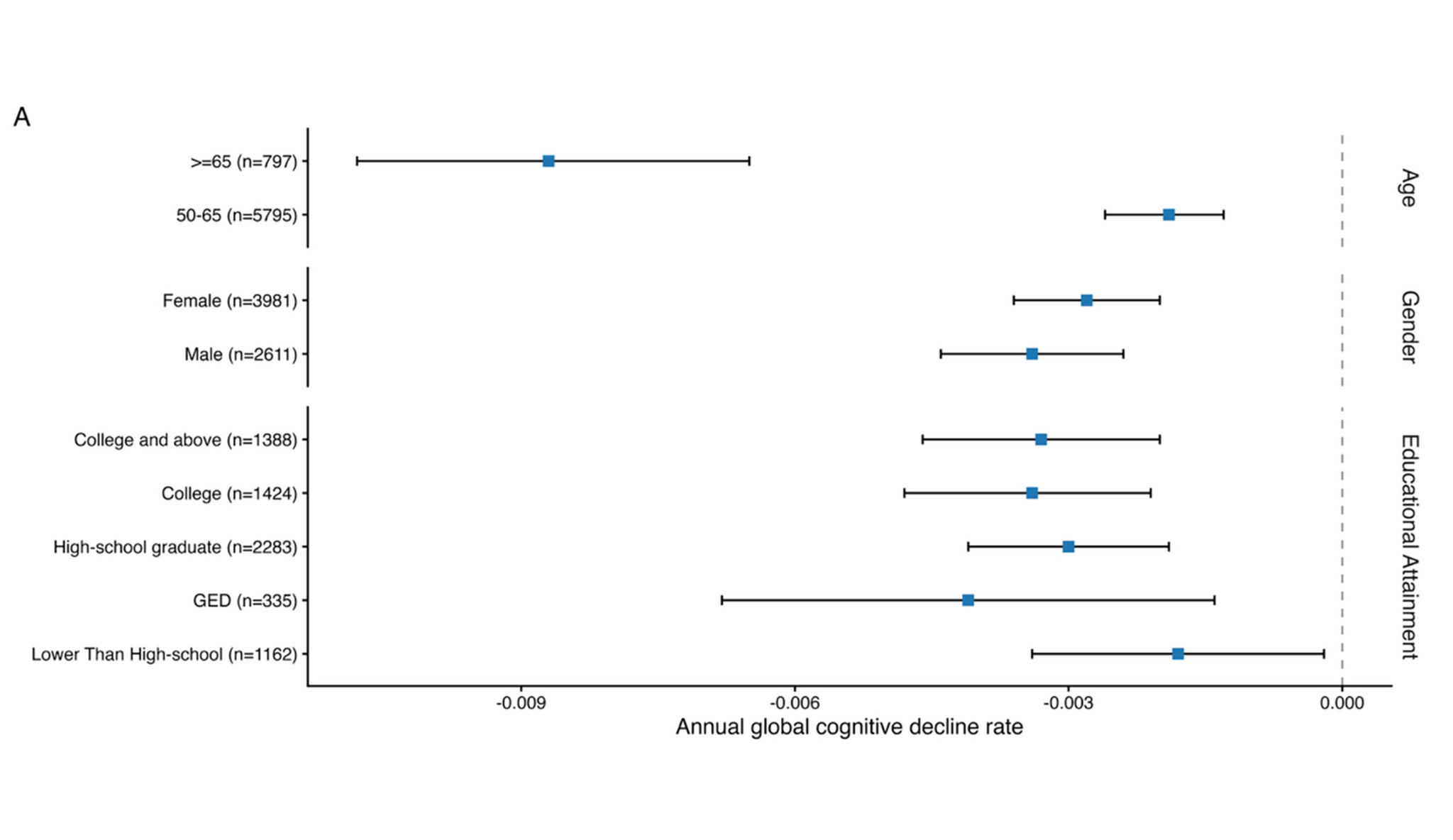
Dr. Suhang Song’s findings show that people with a higher cumulative average body mass index had significantly faster declines in overall thinking ability, memory and executive function. The link held when people with long-term illnesses at the start were left out, and when the analysis allowed for participants who died or dropped out. It was similar for men and women and across education levels, but significantly stronger among participants who were already older when the study began. “Our findings highlight the potential relevance of weight management in older populations in relation to cognitive health,” said Dr. Suhang Song.
Timing proved especially revealing. By comparing weight measured over different stretches of years with decline at different points afterwards, Dr. Suhang Song’s team found that the link was strongest when thinking skills were assessed about eight years later. “Although the estimated associations are modest in magnitude, they are statistically significant and consistent across multiple models, supporting the robustness of the findings,” explained Dr. Suhang Song.
Because the study observed people rather than testing a treatment, it shows an association and cannot prove that higher weight causes cognitive decline, nor that losing weight would protect thinking skills. Height and weight were self-reported, body mass index cannot tell fat from muscle, missing data mean the results apply mainly to people similar to those studied, and factors such as physical activity could not be taken into account.
Dr. Suhang Song’s research supports looking at weight across many years, rather than a single reading, when assessing cognitive risk in clinical care and public health planning. Understanding the biology behind the link is the next step; earlier work suggests it may involve inflammation and changes in blood flow to the brain. “Further research is warranted to investigate the biological mechanisms underlying the observed associations between cumulative body mass index and cognitive decline and to inform future intervention studies,” Dr. Suhang Song added.
Journal reference
Xu Q., Sung M.H., Chen Z., Rajbhandari-Thapa J., Adams G.B., Khan M.M., Shen Y., Song X., Song X., Song S. Association between cumulative average BMI and cognitive decline: a 24-year cohort study. Journal of Neurology. 2026; 273:166. DOI: https://doi.org/10.1007/s00415-026-13696-2
Funding: This work was supported by the National Center for Advancing Translational Sciences of the National Institutes of Health under Award No. UL1TR002378.