Women on Both Fasting Plans Lost Weight, but Weekly Fasting Pulled Ahead
Professor YoonJu Song's trial found that eating within a daily time window and fasting on two days a week both helped women lose weight and fat, with the weekly plan pulling ahead in later weeks.
Read the original paper
Limiting when people eat, rather than only what they eat, has become a popular way to manage weight, and many studies link this approach, known as intermittent fasting, to better weight and metabolic health. Some people eat only within a set window of hours each day, while others eat normally on most days and cut back sharply on two days a week. These schedules may differ in how well they work and how easy they are to keep up, yet they have rarely been compared directly, and little is known about how the response to each unfolds week by week.
Professor YoonJu Song, Hyunji Kim, WonYoung Yun and Jihye Han from The Catholic University of Korea carried out what they describe as the first trial to directly compare these two popular fasting schedules by assigning people to them at random. The work is published in the peer-reviewed journal, Obesity.
Professor Song’s team recruited adult women with overweight or obesity, tracked their usual habits for a short period and gave each woman personal nutrition advice. The women were then assigned by chance to one schedule for a month. On the daily schedule, each woman ate within a fixed window she had chosen and fasted for the rest of the day. On the weekly schedule, women ate freely on most days, but on two separate days each week ate only a delivered, ready-made, low-calorie meal package designed to mimic fasting while supplying essential nutrients. Neither group was told to cut calories. Weekly visits measured weight, fat, muscle, waist size and blood pressure, while the women logged meals on phone apps and wore a skin sensor tracking blood sugar at the start and end.
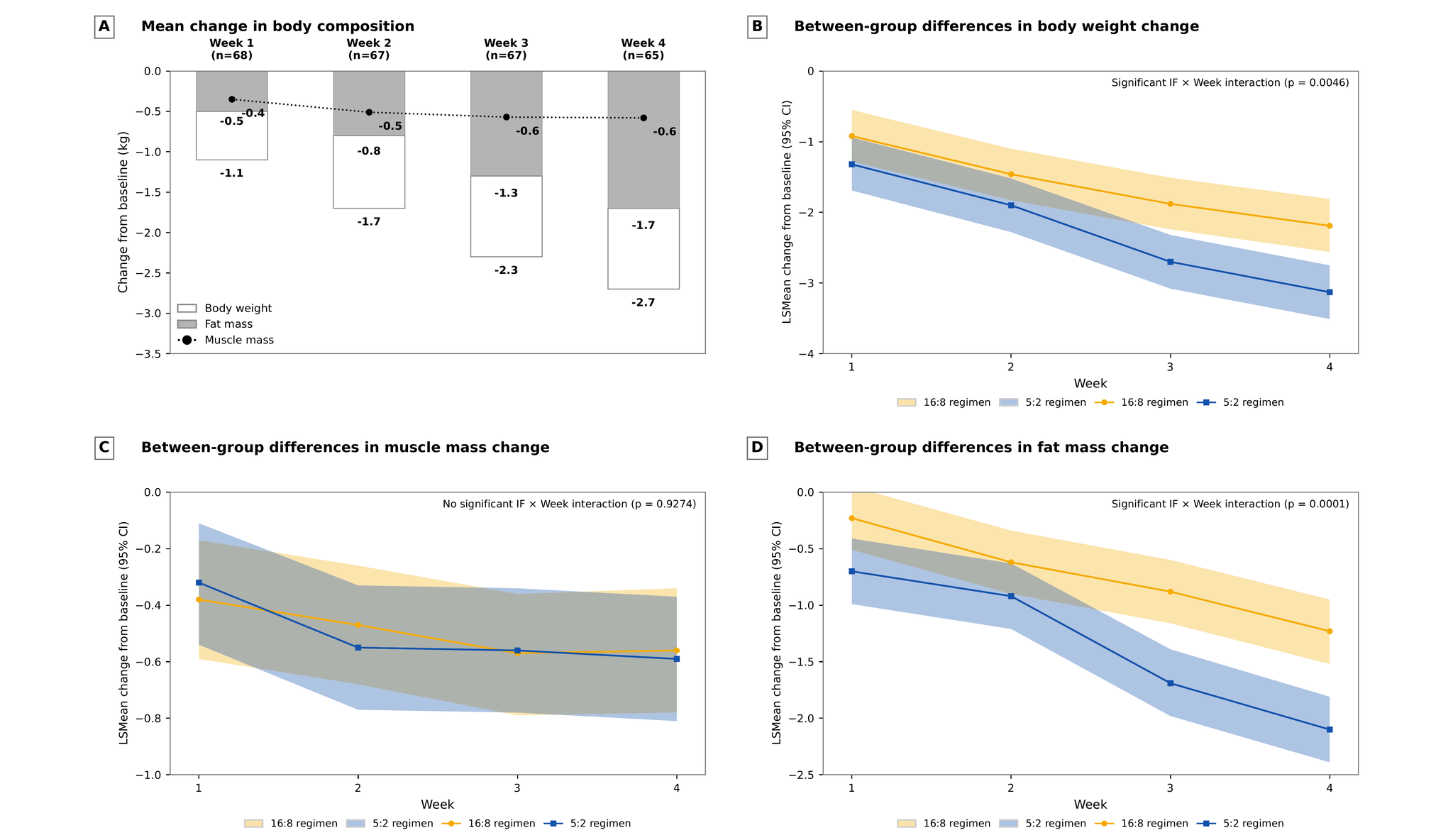
Both schedules worked. Women in both groups lost weight steadily, mostly as fat, with a smaller and similar loss of muscle. Waist size and blood pressure also fell significantly, with no difference between the schedules. Both groups ate within a shorter part of the day, especially on the daily schedule, and took in markedly fewer calories, by similar amounts. Average blood sugar and the time spent with high blood sugar fell in both groups, though the daily schedule lowered peak readings more and the weekly schedule lowered the lowest readings more. No serious side effects were reported.
The main difference lay in timing. As the month went on, the weekly schedule pulled ahead, with significantly greater losses of weight and fat in the later weeks. This gap was unlikely to come from a handful of women losing unusually large amounts, and fasting days did not lead to overeating, since women ate no more after a fasting day than on other ordinary days. “Together, these findings suggest that, in addition to overall magnitude of effect, temporal response patterns may be an important consideration when evaluating intermittent fasting regimens,” explained Professor Song.
Professor Song’s team suggests that these different early paths could shape people’s motivation to keep going, although motivation was not measured. Habits may matter too. On the weekly schedule, the daily eating window shrank only modestly, which may reflect late waking and breakfast skipping, both common among Korean adults. “Characterizing early behavioral and metabolic responses may help inform the selection and implementation of intermittent fasting regimens within broader weight-management strategies,” said Professor Song.
The trial focused on otherwise metabolically healthy women over a short period. Whether these early patterns predict how well people stay with each schedule over the long term, and whether they hold for men or for people with heart or metabolic disease, are questions for future studies.
Professor Song’s findings show that both schedules helped women lose weight and fat and improved several health measures within a month, with the weekly schedule pulling ahead over time. “These findings support a more individualized approach to intermittent fasting, recognizing that regimens may differ in how responses evolve over time despite similar overall effectiveness,” Professor Song concluded.
Journal reference
Kim H., Yun W., Han J., Song Y. Daily 16:8 Versus Weekly 5:2 Intermittent Fasting for Weight Loss and Metabolic Health: A Randomized Controlled Trial. Obesity. 2026; oby.70322. DOI: https://doi.org/10.1002/oby.70322
Funding: This study was supported by a National Research Foundation of Korea grant funded by the Korean government. The researchers declare no conflicts of interest. Trial registration: Clinical Research Information Service KCT0010806.