Revolutionizing Heart Health: Gene’s Role in Irregular Heartbeats
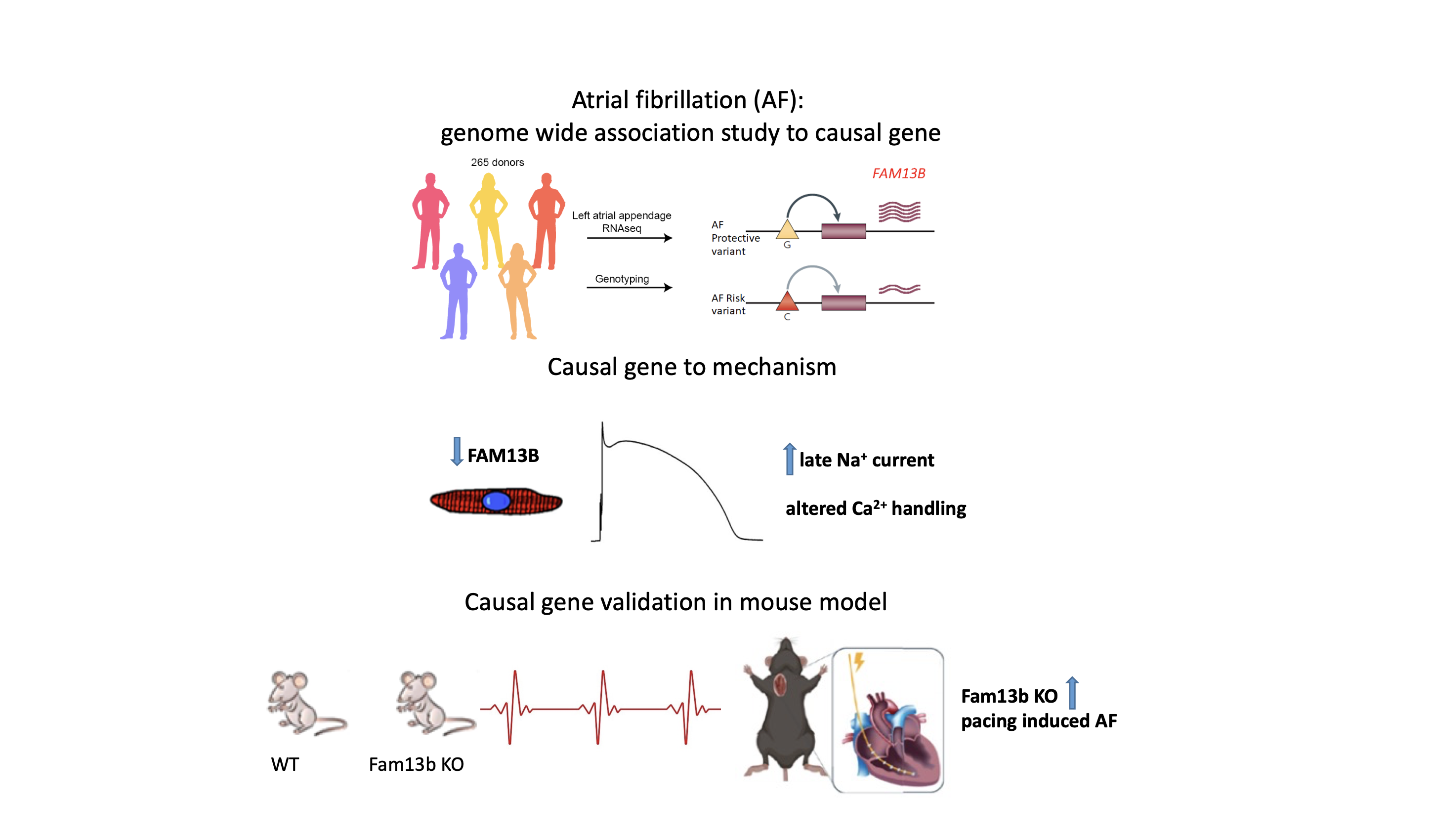
Professor Jonathan Smith's team found that a common atrial fibrillation risk variant lowers activity of the FAM13B gene, altering heart cells' electrical signalling and calcium handling.


An enigmatic heart condition, atrial fibrillation (AF), affects millions globally and presents a complex puzzle. This condition causes irregular heartbeats, leading to decreased heart function and greatly increases the risk for stroke. While it is known that AF has a strong genetic component, the mechanism by which common genetic variants increase one’s risk for AF has remained elusive. Recent studies have started to unravel how common genetic factors influence AF, setting the stage for innovative research to explain these mysteries.
In a pivotal study, Professor Jonathan Smith and Dr. Mina K. Chung from Cleveland Clinic, along with their collaborative team and pivotal contributions from, Gregory Tchou and Dr. Daniela Ponce-Balbuena, have made significant progress in understanding the genetic basis of atrial fibrillation, the most common irregular heartbeat. Their research highlights the crucial role of a gene, FAM13B, in increasing the likelihood of developing this condition, paving the way for new, personalized treatments.
Professor Smith shares, “Although many rare AF-causing genetic variants change a protein’s structure, most of the common variants associated with AF risk do not change a protein’s structure, but instead regulate the expression of a nearby gene, and thus the amount of the protein produced. We identified the common variant that regulates the level of a gene called FAM13B, with the AF-risk allele leading to decreased expression. We found that the protein encoded by this particular gene plays a key role in heart function, thus, less expression leads to increased susceptibility to atrial fibrillation. When the expression of this gene is reduced, it leads to changes in heart cells, affecting their electrical signaling and calcium handling, essential for a regular heartbeat.” This insight marks a major advancement in understanding this complex heart condition.
Their study focused on how changes in this gene’s expression impact the heart’s electrical signaling and calcium processing, crucial for maintaining a steady heartbeat. The team employed advanced gene-editing techniques, particularly CRISPR-Cas9, to specifically alter this gene in human stem cells, which they subsequently differentiated into cardiomyocytes. This innovative approach allowed for detailed study of the gene’s effects on heart function.
Additionally, they conducted studies to examine the electrical activity in heart cells with reduced gene activity. Using a technique known as patch clamp, they studied isolated heart cells with decreased gene activity. These studies were crucial in illustrating how changes in the gene affect the heart’s electrical signal conduction.
Moreover, the team investigated how these gene alterations influenced calcium signaling within heart cells. They used a system called IonOptix to measure calcium levels in cells after reducing the gene’s activity, further exploring its role in heart function.
In an essential part of their research, Professors Smith and Ponce-Balbuena studied mice genetically engineered to lack the FAM13B gene. “These mice showed increased durations in certain heart wave patterns and were more prone to heart rhythm issues compared to normal mice,” Professor Smith noted. This finding emphasized the gene’s vital role in maintaining normal heart rhythms.
Their findings collectively illuminate the critical role of FAM13B in atrial fibrillation. By identifying this gene whose expression level can alter heart function and demonstrating its impact on the heart, Professor Smith and colleagues have greatly advanced our understanding of AF’s genetic basis. Their work opens new avenues for developing targeted treatments, potentially transforming how this common heart condition is managed.
Journal Reference:
Tchou G, Ponce-Balbuena D, Liu N, Gore-Panter S, Hsu J, Liu F, Opoku E, Brubaker G, Schumacher SM, Moravec CS, Barnard J, Van Wagoner DR, Chung MK, Smith JD. Decreased FAM13B Expression Increases Atrial Fibrillation Susceptibility by Regulating Sodium Current and Calcium Handling. JACC Basic Transl Sci. 2023 Jul 26;8(10):1357-1378. doi: https://doi.org/10.1016/j.rineng.2023.101425
About the researchers

Jonathan Smith, PhD
Jonathan Smith, PhD, is Professor and Chair of the Molecular Medicine Department of the Cleveland Clinic Lerner College of Medicine of Case Western Reserve University. He is also the director of the Molecular Medicine PhD training program. At the Cleveland Clinic Lerner Research Institute, Dr.… Smith is Staff in the Department of Cardiovascular & Metabolic Sciences, where he holds the Geoffrey Gund Endowed Chair for Cardiovascular Research. Dr. Smith received his Bachelor degree in Biology at the University of California, Santa Cruz, and his PhD degree in Cellular and Developmental Biology at Harvard University, Division of Medical Sciences. He performed postdoctoral research at Rockefeller University in the laboratory of Jan Breslow, studying apolipoprotein gene expression, lipoprotein metabolism, and mouse models of atherosclerosis. Dr. Smith rose up the ranks to Assistant and Associate Professor at Rockefeller, and joined the Lerner Research Institute in 2002. He has received career awards and career recognition awards from the NIH and the American Heart Association, as well as Excellence in Education awards from the Lerner Research Institute. He has published close to 200 peer reviewed original research papers, and additional reviews and editorials. Dr. Smith’s research is currently funded by two NIH R01 grants, and one program project grant led by Dr. Mina Chung. He is also the principal investigator for a T32 training grant supporting trainees in the Molecular Medicine PhD program. Dr. Smith has trained numerous PhD students, postdoctoral fellows, medical students, laboratory technicians, as well as high school and college students. He supports enabling underrepresented minority students to enter STEM careers.

Greg Tchou
Greg Tchou is a lead technologist in the lab of Dr. Jonathan D. Smith in the Department of Cardiovascular and Metabolic Sciences at the Cleveland Clinic. Before joining the Smith lab, he obtained a B.S. in Biochemistry and Cell Biology at the University of Michigan and a Ph.D. in Cell Biology from Rice University.… His research focuses on studies of the genetic basis of atrial fibrillation through CRISPR-Cas9 gene editing of human stem cell models. He enjoys soccer, bicycling through Cleveland’s many scenic Metro Parks when the city’s weather permits, and playing boardgames when it (frequently) does not.

Daniela Ponce-Balbuena, PhD
Daniela Ponce-Balbuena, PhD, completed her B.S and M.S at the Benemérita Universidad Autónoma de Puebla. Puebla, México. She received her PhD at the Universidad de Colima. Colima, México, in 2011 and then moved to the United States to work as postdoctoral fellow in the Center for Arrhythmia Research at the University of Michigan.… In 2020, she joined the Physiology and Cell Biology Department and the Davis Heart and Lung Research Institute at The Ohio State University as Research Assistant Professor. In 2023 she joined the University of Wisconsin-Madison, School of Medicine and Public Health, Department of Medicine, Division of Cardiovascular Medicine, where she holds her current position as Scientist III. Daniela’s research focuses on studying the regulation of cardiac ion channels and arrhythmogenic mechanisms. The goal of her research is to uncover novel druggable targets to prevent and/or treat arrhythmias. Daniela enjoys her life as a scientist and attributes her success as an investigator to the outstanding team of scientists with whom she has the privilege to collaborate.