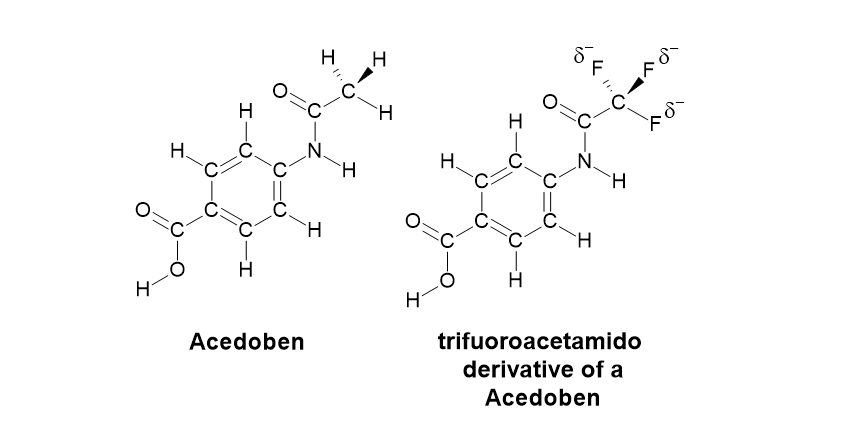
A Closer Look at Fluorine’s Impact on Acedoben’s Properties
Dr. Thomas Shell and Joshua Boldon found that adding fluorine atoms to acedoben made it far more fat-soluble, which could help it cross biological barriers, while its acidity barely changed.


Envision a future where medication not only battles diseases but does so more effectively and with fewer doses. This isn’t a scenario from the distant future; it’s a potential reality brought closer by improving how drugs interact with our bodies. A recent study investigates the subtle art of altering drug molecules, focusing on a drug component known as acedoben, used in the antiviral medication inosine pranobex. By adding fluorine atoms into the molecular structure of acedoben, researchers have unveiled significant changes in its characteristics, potentially revolutionizing its effectiveness and how quickly our bodies can utilize it.
Recent research by Dr. Thomas Shell and Joshua Boldon from the Department of Chemistry and Physics at Lincoln Memorial University explores the profound effects of fluorine substitution on the characteristics of the drug compound acedoben, a key ingredient in the antiviral drug inosine pranobex. Their findings, published in Results in Chemistry, highlight the significant enhancements in how the body can absorb acedoben’s trifluoroacetamido derivative, offering promising implications for drug design and efficacy.
Acedoben plays a crucial role in the formulation of inosine pranobex, used to combat various viral infections. The introduction of fluorine transforms acedoben into a new derivative, 3F-AcPABA, which shows distinct advantages over the original molecule in terms of how the body can process and utilize the drug.
Their research shows that 3F-AcPABA is over seven times more capable of merging with fats than AcPABA. This increased capability suggests that 3F-AcPABA could more efficiently transit biological barriers, particularly at the acidic levels typical of the stomach, where drug absorption into the bloodstream begins. This characteristic is crucial as it potentially increases the drug’s availability in the body, meaning that more of the drug can circulate and have an active effect.
Moreover, the study examines how the electron-withdrawing effect of the fluorine atoms impacts the electronic distribution within the molecule, influencing various properties including acidity and the nature of the carbonyl bond. Interestingly, despite these chemical modifications, the acidity levels of the carboxylic acid groups in AcPABA and 3F-AcPABA remained nearly unchanged, highlighting the subtlety of the structural changes involved.
Dr. Shell provided insights into the broader implications of their findings. “Our results demonstrate that even minor chemical modifications can substantially alter the physical properties of a molecule in ways that enhance its therapeutic potential. This can lead to more effective drugs with improved ability to passively cross biological barriers,” he explained.
The implications of this research extend beyond acedoben. For example, Dr. Thomas Shell and Joshua Boldon recently reported on the physicochemical properties of the trifluoroacetamido derivative of acetaminophen. Dr. Shell is currently exploring the effects of fluorine substitution on the physicochemical properties of other small molecule drugs. The current research contributes to a growing body of knowledge that supports the strategic use of fluorine in drug design, helping to optimize drug properties for better clinical outcomes. This study is a cornerstone for future research aimed at harnessing the full potential of fluorine in pharmaceutical development.
About the researcher

Thomas Shell
Thomas Shell was born and grew up in central Pennsylvania. He earned B.S. degrees in chemistry and biology from the University of Richmond, where he performed undergraduate research on the synthesis of pyrroles using vinylogous iminium salts with Stuart Clough and John Gupton.… As a graduate student at Emory University with Debra Mohler, he synthesized and studied light-responsive organometallic complexes that cleave DNA. He was a visiting assistant professor at Franklin and Marshall College before becoming an assistant professor at West Virginia State University where he studied the microwave-assisted organic synthesis of succinimides and maleimides. He was a postdoctoral associate with David Lawrence at the University of North Carolina and a research assistant professor at the UNC Eshelman School of Pharmacy, where he studied cobalamins as light-responsive compounds for the manipulation of biological systems. He discovered that hydroxocobalamin catalytically generates hydroxyl radicals with ultraviolet light illumination in the presence of oxygen. In addition, he discovered that alkylcobalamins are made responsive to infrared light wavelengths by conjugation with an appropriate fluorophore. This discovery is important for the development of molecules that are responsive to light wavelengths within the optical window of tissue, wavelengths that penetrate tissue most deeply. Molecules that respond to light wavelengths within the optical window of tissue are critical for using photoresponsive molecules for targeted treatment of disease. As an assistant professor at Saint Anselm College and as an assistant professor at Norwich University, he studied the ability of alkylcobalamins to cleave DNA and release cancer drugs in response to visible light and X-ray exposure. At Lincoln Memorial University he continues to synthesize alkylcobalamin-cancer drug conjugates and he investigates the physiochemical properties of fluorinated derivatives of drugs, which generally have improved lipophilicity relative to the parent molecule. He is an associate professor of chemistry at Lincoln Memorial University.
Journal reference
Joshua A. Boldon, Thomas A. Shell, “Physicochemical properties of acedoben and its trifluoroacetamido derivative,” Results in Chemistry, 2023. DOI: https://doi.org/10.1016/j.rechem.2023.101075
Joshua A. Boldon, Thomas A. Shell, “Physicochemical properties and cytochromes P-450 kinetics of a trifluoroacetamido derivative of acetaminophen,” Results in Chemistry, 2023. DOI: https://doi.org/10.1016/j.rechem.2023.101129