Charging Ahead: Breakthrough Sodium Battery Technology Ushers in New Era of Safety and Efficiency
Dr. Sayan Das's team made a non-flammable quasi-solid electrolyte from coated nonwoven mask fabric that let a sodium metal battery keep nearly all its capacity over long cycling.


A breakthrough in the development of sodium metal batteries has been achieved by a team of researchers led by Dr. Sayan Das with Professor Venimadhav Adyam from the Cryogenic Engineering Centre at IIT Kharagpur, India and his colleagues Professor Vilas Pol from Purdue University, IN, USA. Their innovative work, published in the peer-reviewed journal Energy Advances, presents a new quasi-solid-state electrolyte that promises significant advancements in battery safety and performance.
Traditional lithium-ion batteries (LIBs) have dominated the market for decades due to their high energy density and reliable performance. However, the limited supply and price fluctuations of lithium have driven the search for alternative solutions. Sodium-ion batteries (SIBs) have emerged as a promising candidate, utilizing the abundant and cost-effective sodium resources available globally. Despite this potential, SIBs have faced challenges related to safety and stability, particularly due to the flammable nature of conventional liquid electrolytes.
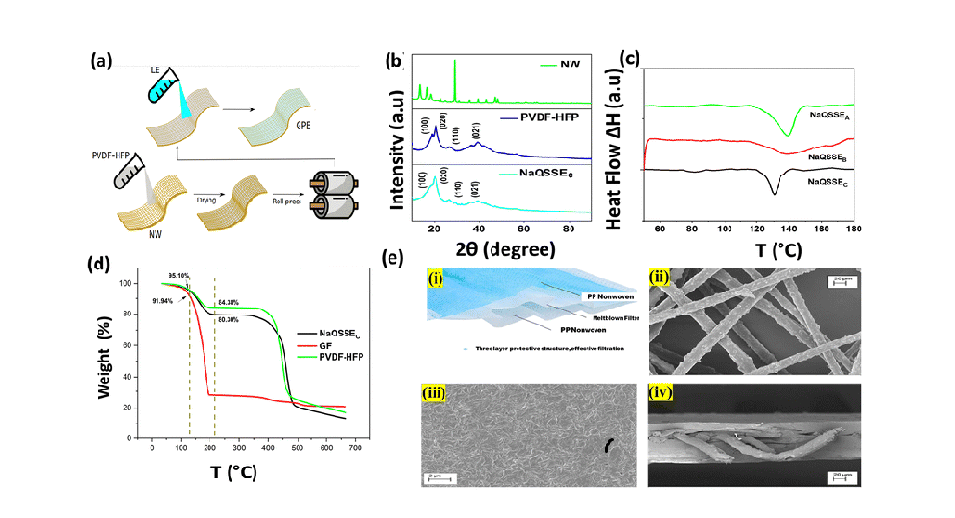
The team from IIT Kharagpur and Purdue University has addressed these issues by developing an inexpensive approach on tailored nonwoven-supported quasi-solid-state electrolyte (QSSE). This new electrolyte, based on poly(vinylidene fluoride-co-hexafluoropropylene) (PVDF-HFP), offers a non-flammable, flexible, and ultra-stable solution for sodium metal batteries. “Our cost-effective approach uses a cheap textile (nonwoven mask) coated with PVDF-HFP and soaked in an optimized sodium-based liquid electrolyte to make it non-flammable and practically applicable for sodium battery applications,” said Dr. Das.
The QSSE demonstrated remarkable properties, including enhanced room temperature conductivity and a significant sodium ion transfer number. When tested in a sodium metal cell with a Na3V2(PO4)3 (NVP) cathode, the QSSE-based battery delivered excellent discharge capacity at a high rate and exhibited exceptional capacity retention of nearly 99% after 2500th cycles. This indicates a negligible loss of capacity over long-term cycling, a critical factor for practical energy storage applications.
One of the most significant advantages of this new electrolyte is its enhanced safety profile. Unlike conventional liquid electrolytes, which can be highly flammable and pose serious risks of fire and explosion, the QSSE developed by the team is intrinsically non-flammable. This property was confirmed through an open flame test that showed the QSSE did not ignite, making it a much safer option for large-scale energy storage systems.
The researchers also highlighted the scalability of their approach. “Our simple, scalable, and cost-effective approach to developing QSSE is shown schematically, and the detailed procedure is described in the supplementary information,” said Dr. Adyam. This scalability is crucial for the widespread adoption and commercialization of sodium metal batteries, as it ensures that the production process can be easily implemented on a large scale.
The successful development and testing of this new electrolyte mark a significant step forward in the quest for safer and more efficient energy storage solutions. The research team is optimistic about the future applications of their work, noting that their findings could pave the way for the development of next-generation sodium metal batteries that are not only safer but also more cost-effective and sustainable.
“Future work will focus on further optimizing the electrolyte composition and exploring its applicability in other battery configurations,” said Dr. Pol. “Our goal is to develop a range of high-performance, safe, and affordable energy storage solutions that can meet the growing demands of the global energy market, sustainably.”
About the researchers

Dr. Sayan Das
Dr. Sayan Das is a postdoctoral researcher at Purdue University, IN specializing in energy storage technologies. With a Ph.D. in Science from Jadavpur University and an extensive background in lithium and sodium-ion batteries, Dr. Das excels in electrolytes formulation, materials characterization, and electrochemistry.… His work includes notable contributions to developing safer electrolytes for lithium batteries and quasi-solid-state sodium-ion systems. Currently, he leads and collaborates on projects aimed at advancing battery technologies for various applications. Dr. Das has published 19 peer-reviewed articles and has three issued patents.

Vilas G. Pol
Vilas G. Pol is a Professor of Chemical Engineering at Purdue University, IN, USA. He authored/co-authored >270 research publications (h index 58), an inventor on 20 issued US patents and 20+ applications. Purdue University honored him with Outstanding Engineering Teachers, Most Impactful Inventors, Seed for Success, Bravo, and Purdue Faculty Scholar awards.… He delivered hundreds of invited, keynote and plenary talks including ‘TEDx’. He is honored with 35+ prestigious awards from professional AIChE, ACS, MRS, ACerS, TMS and Carbon societies. He is a fellow of Royal Society of Chemistry, MASc (India) and IIAM (Sweden) as well as earned two Guinness World RecordsTM.

Venimadhav Adyam
Venimadhav Adyam is a distinguished professor at the Cryogenic Engineering Center, IIT Kharagpur. He received his Ph.D. in 2001 from the Indian Institute of Science, Bangalore, with a focus on the properties of perovskite-related oxide thin films.… His academic career is characterized by extensive international experience, having conducted research at Pennsylvania State University and Cambridge University. His research spans a variety of areas, including quantum materials, multiferroics, spintronics, and advanced battery technologies such as sodium-ion and thin film rechargeable batteries, and he has played a pivotal role in establishing advanced research facilities at IIT Kharagpur, enhancing its capabilities in magnetization measurement and nano-lithography. Venimadhav has received several prestigious awards and honors, including the MRSI Medal and the DST FastTrack Young Scientist Project. He is a member of PERM member of MRSI India, Magnetic society of india and Indian Cryogenic Ccouncil. His contributions to science are substantial, including a sponsored research projects, publications in peer-reviewed journals, and book chapters.
Journal reference
Sayan Das, Vilas G. Pol, and Venimadhav Adyama. “Tailored nonwoven supported non-flammable quasi-solid electrolyte enables an ultra-stable sodium metal battery.” Energy Advances, 2024. DOI: https://doi.org/10.1039/D3YA00435J