Efficient Synthesis of Marinoquinoline A Unveiled by Researchers
Dr. Bhaven Patel's team developed a safer way to make mono- and bis-methylated pyrroloquinoxalines from a shared precursor, and used it to synthesise the natural product marinoquinoline A.


A groundbreaking method for creating novel mono- and bis-methylated pyrroloquinoxaline derivatives has been developed by a team of researchers from the School of Human Sciences at London Metropolitan University. The team, led by Dr. Bhaven Patel, also includes Margarita Damai, Dr. Norman Guzzardi, Dr. Viliyana Lewis, Dr. Zenobia Rao, and Dr. Daniel Sykes. Their innovative approach uses a shared precursor and has been successfully applied in the total synthesis of marinoquinoline A. The research findings were published in the peer-reviewed journal RSC Advances.
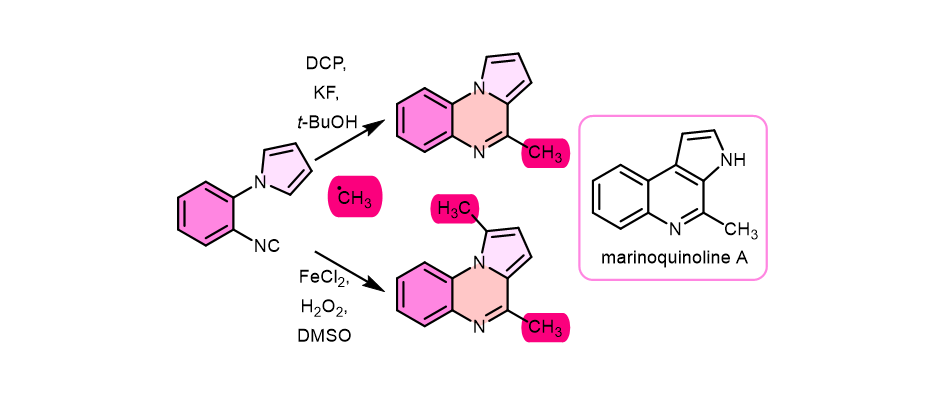
Nitrogen-containing heterocycles are crucial in natural products and medicinal chemistry, offering significant biological activity. Traditionally, the synthesis of pyrroloquinoxalines has faced challenges due to toxic and dangerous methods. The new strategy described by Dr. Patel and his team involves adding unstable methyl radicals to aryl isocyanides under specific reaction conditions, yielding both mono- and bis-methylated derivatives. “This novel approach not only simplifies the synthetic process but also enhances the safety and efficiency of producing these biologically active compounds,” explained Dr. Patel.
The researchers focused on optimizing the conditions for selective methylation. They discovered that using dicumyl peroxide (DCP) as a source of methyl radicals provided the highest yield for mono-methylated products. However, when Fenton reaction conditions were applied, bis-methylated pyrroloquinoxalines were predominantly formed. This selective control over the methylation process is a significant advancement in the field.
Key to this research is the successful application of the methodology in the total synthesis of marinoquinoline A, a natural product known for its acetylcholinesterase inhibition properties. “Our method enabled us to efficiently synthesize marinoquinoline A in just five steps from commercially available starting materials,” noted Dr. Patel. This achievement highlights the practical utility of their approach in producing complex natural products.
The team’s findings demonstrate the potential for these novel derivatives in medicinal chemistry, given their various biological activities, including anticancer, antimalarial, and antiproliferative effects. “The magic-methyl effect, where the addition of methyl groups can significantly increase a drug’s binding affinity and potency, underscores the importance of our work,” said Dr. Patel.
In their study, Dr. Patel and colleagues detailed the synthesis process, starting with the preparation of the cyclisation precursor. They employed various methods to generate methyl radicals, ultimately finding that DCP provided the best results. The team also explored the electronic effects of different cyclisation precursors, achieving successful cyclisation for most isocyanides, except for electron-rich variants.
This research not only advances the synthesis of pyrroloquinoxaline derivatives but also opens new avenues for developing nitrogen-based heterocycles with significant pharmaceutical applications. “Our approach offers a versatile and efficient pathway to synthesize biologically active compounds, paving the way for future discoveries in drug development,” emphasized Dr. Patel.
Margarita Damai’s contribution to this research resulted in RSC Advances Outstanding Student Paper Award of 2023 for the Organic Chemistry category from 700 nominations.
About the researchers

Bhaven Patel
Bhaven Patel is Reader in Organic Chemistry at London Metropolitan University. He achieved his MSci in Chemistry from King’s College London and his PhD in Organic Chemistry from the University of Birmingham. He then gained a prestigious EPSRC PhD Plus Fellowship working at the University of Birmingham and Queensland University of Technology.… He has also worked as a postdoctoral fellow at the University of Nottingham and UCL School of Pharmacy. He currently co-chairs the Applied Chemistry and Pharmaceutical Technology research theme and is a Fellow of the Royal Society of Chemistry. His current scientific interests incorporate reaction discovery, the development of innovative synthetic methods including in the application of natural product synthesis and bioactive molecules. His expertise also extends to medicinal chemistry and the application of 3D printing in science. Recently, his research has concentrated on the development of new chemosensors.

Daniel Sykes
Daniel Sykes gained an MChem (Hons) with year in industry from the University of Manchester. He remained in Manchester to study for a PhD under the supervision of Professor Stephen Faulkner.… Following postdoctoral work at the University of Manchester, the University of Oxford and the University of Sheffield he relocated to London Metropolitan University and is now the Head of Chemical and Pharmaceutical Sciences. He is a Fellow of the Royal Society of Chemistry and his research work has been cited over 1000 times. His research interests include photophysical measurements of metal complexes, particularly iridium and f-block metals, with a focus on energy transfer processes between them. This work has recently expanded to cell imaging and the use of complexes as emissive probes for diagnostic applications.

Margarita Damai
Margarita Damai is a second-year student at London Metropolitan University pursuing a BSc Biomedical Sciences degree. Her research work primarily revolves around synthesising complex molecular structures and their applications in medicinal chemistry. She is an active individual and has participated in several research conferences to represent her work.… Apart from research, Margarita is heavily involved in democracy, particularly within the LondonMet Students Union, where she served one year as a sabbatical officer.
Journal reference
Margarita Damai, Norman Guzzardi, Viliyana Lewis, Zenobia X. Rao, Daniel Sykes, and Bhaven Patel. “Crafting mono- and novel bis-methylated pyrroloquinoxaline derivatives from a shared precursor and its application in the total synthesis of marinoquinoline A.” RSC Advances (2023). DOI: https://doi.org/10.1039/d3ra05952a