Scientists Pioneer Fusion Method for Spinal Cord Injury Repair
Dr. Xiaoping Ren's team reviews spinal cord fusion, in which severed spinal cord ends are rejoined with polyethylene glycol and electrical stimulation, and its promising results in animal studies.


Spinal cord injury (SCI) is a debilitating condition resulting from traumatic events such as accidents, falls, and sports injuries. SCI often leads to severe complications including paralysis, loss of sensory functions, and autonomic dysfunctions such as incontinence. Despite advancements in medical science, effective treatments for SCI remain limited due to the complex nature of spinal cord repair. However, recent research highlights a promising technique known as “Spinal Cord Fusion” (SCF), which could revolutionize SCI treatment and offer new hope for individuals suffering from this condition.
Researchers from Guangxi University of Chinese Medicine, including Dr. Xiaoping Ren, the lead researcher, along with Tingting Shen, Weihua Zhang, and Xiaogang Wang have been pioneering this innovative approach. Their work, published in the journal Heliyon, details the potential of SCF in restoring neural function post-SCI. “Spinal cord fusion offers a novel method for reconstructing damaged spinal cords by fusing severed axonal ends, which could significantly enhance the recovery process,” said Dr. Ren.
The SCF technique involves the precise removal of the damaged spinal cord segment followed by the application of a fusogenic agent, primarily polyethylene glycol (PEG), to fuse the severed ends. This method aims to restore both neural and electrical continuity across the injury site. Post-surgery, electrical stimulation is employed to promote axonal regeneration, further facilitating the recovery of motor and sensory functions.
In various animal studies, SCF has shown remarkable results. For instance, in experiments conducted on rodents, dogs, and non-human primates, animals demonstrated significant recovery of motor functions post-SCF. In one study, rats regained the ability to stand and walk within weeks of surgery, and dogs achieved about 90% recovery of sensorimotor functions within three weeks. These promising outcomes underscore the potential of SCF to restore function after severe SCI.
Dr. Ren explained, “Our research has demonstrated that PEG-mediated axonal fusion, combined with electrical stimulation, can effectively promote neural regeneration and functional recovery. This represents a significant advancement in SCI therapy, offering a new pathway for treating paraplegia and other SCI-induced disabilities.”
The SCF technique also addresses the key challenge of bridging the neural gap caused by SCI. By utilizing fusogens like PEG, SCF helps stabilize and fuse axonal membranes at the injury site. This not only aids in the restoration of electrical conductivity but also supports the growth and regeneration of axons across the damaged area. The success of SCF in animal models suggests its potential applicability in human clinical trials, providing a new avenue for SCI treatment.
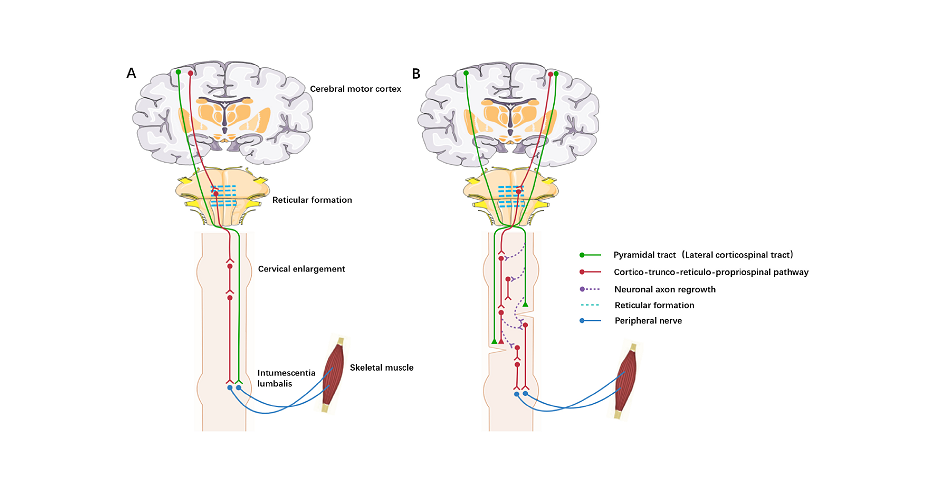
In addition to the technical aspects of SCF, the researchers have highlighted the crucial role of propriospinal neurons in functional recovery. These neurons, which form part of the cortico-trunco-reticulo-propriospinal pathway (CTRPS), are capable of extending their axons across the injury site, establishing new neural circuits that facilitate motor and sensory functions. This intrinsic neural network within the spinal cord is pivotal for the spontaneous recovery observed in some SCI cases.
The researchers emphasize that while SCF has shown great promise, further studies and clinical trials are necessary to optimize the technique and validate its efficacy in humans. The integration of advanced bioengineering technologies and multidisciplinary approaches will be essential in refining SCF and ensuring its success as a viable treatment for SCI.
In summary, Dr. Ren and colleagues’ study show that the SCF technique represents a significant breakthrough in the field of spinal cord injury repair. By leveraging the regenerative potential of fusogens like PEG and the plasticity of propriospinal neurons, SCF offers a promising new strategy for restoring function and improving the quality of life for individuals affected by SCI. As research progresses, this innovative approach could pave the way for more effective and comprehensive SCI treatments in the future.
About the researcher

Dr. Xiaoping Ren
Dr. Xiaoping Ren received his M.D in Harbin Medical University in 1984. He performed his Clinical and Research Hand Fellowship training in University of Louisville in Kentucky. During the period, Dr. Ren created a feasibility large animal CTA model for limb transplantation to allow modulation of the immune reaction and to investigate immunosuppressant.… The Nation’s First Hand Transplantation in US was successfully conducted as a direct result of the preclinical swine composite tissue allotransplantation model (CTA). Ren's team has applied small animals, large animals, non-human primates, and corpses in the laboratory to find solutions to the scientific and technological challenges behind allogeneic head and body reconstruction surgery. These research findings and designs have established this cutting-edge and emerging field of basic research in medicine. On this basis, he has been focusing on researching spinal cord fusion surgery. Among them, how to solve the problem of nerve regeneration and functional recovery after spinal cord disconnection is the most challenging, and it is also a world-class problem in the treatment of traumatic paraplegia in the field of orthopedics and neurosurgery today! The team's application of spinal cord fusion agent (PEG Cocktails) for a new treatment strategy for functional recovery after spinal cord injuries. In most recently, with the deepening of research, their team has found a new breakthrough, the first vascularized allogenic spinal cord transplantation in dog model to better solve the functional recovery of the spinal cord after being severed in the world; At the same time, a new theory of functional recovery and regeneration after spinal cord injury was proposed, which is the neurophysiological basis of spinal cord fusion. His team is currently committed to achieving the first clinical trail of this research achievement, further improving and optimizing clinical spinal cord fusion surgery in terms of technology, equipment, and application.
Journal reference
Shen, T., Zhang, W., Wang, X., & Ren, X. (2024). Application of “Spinal cord fusion” in spinal cord injury repair and its neurological mechanism. Heliyon, 10, e29422. DOI: https://doi.org/10.1016/j.heliyon.2024.e29422