Non-Invasive Method of Harnessing Muscle’s Secretions for Combating Cancer
Professor Alfredo Franco-Obregón's team found that brief magnetic pulses prompt muscle cells to release secretions that curb breast cancer cell growth and invasion, an effect that depends on the protein HTRA1.


The potential for muscles to combat cancer has taken a significant leap forward with the discovery of a new method that uses low amplitude and low frequency pulsing magnetic fields (PEMFs) to safely stimulate muscle cells. This novel approach aims to harness the natural secretions of muscle cells, which have been found to contain powerful anticancer properties. By leveraging these secretions, researchers hope to develop a non-invasive strategy to reduce cancer cell growth and invasiveness, particularly in breast cancer.
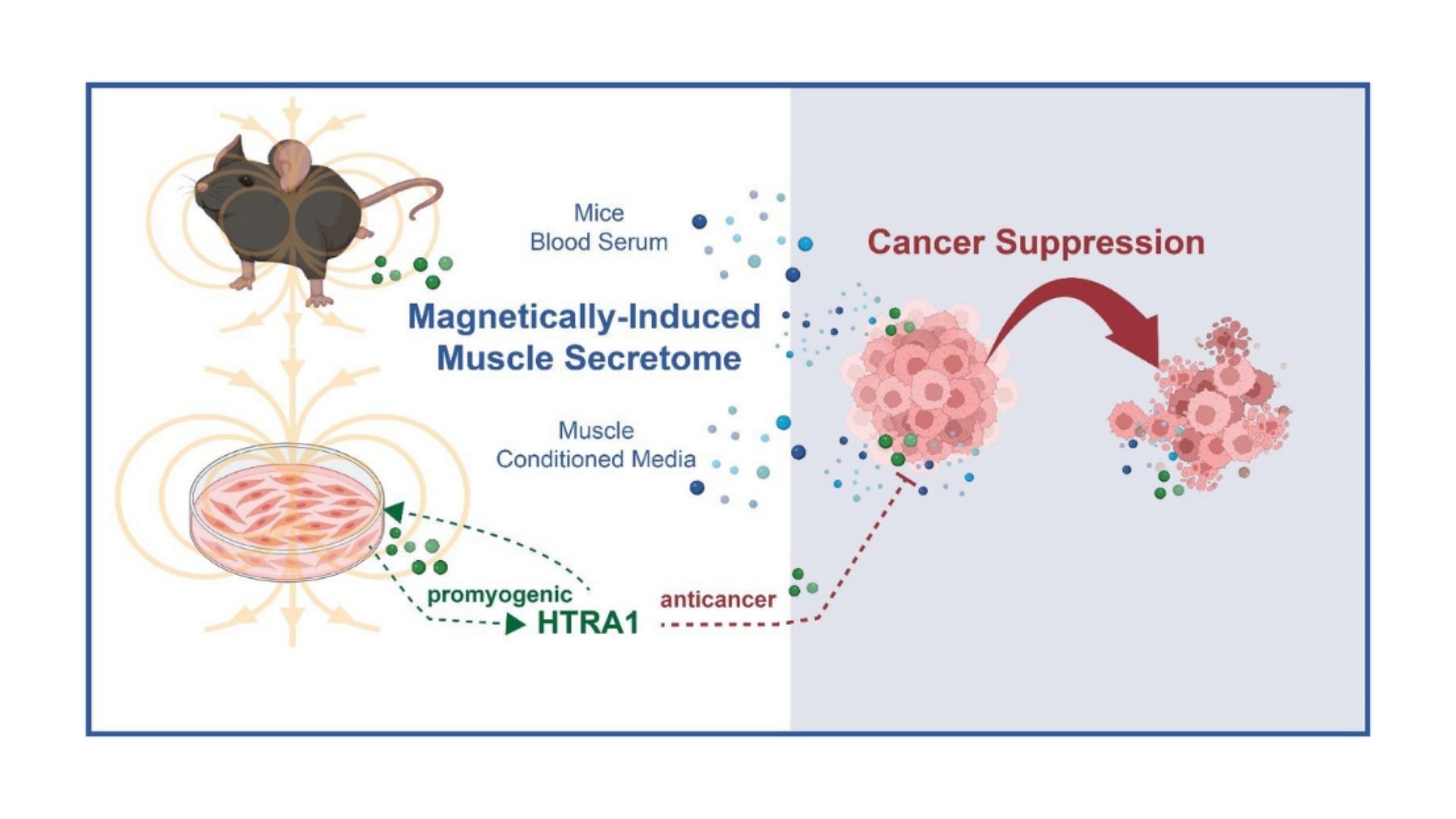
This groundbreaking research, led by Professor Alfredo Franco-Obregón and Dr. Yee Kit Tai from the National University of Singapore was published in the open access journal Cells. The research team demonstrated that a single 10 minute exposure to low energy PEMFs could induce muscle cells to release a secretome with potent anticancer properties. The study further highlights the critical role of High-Temperature Requirement A1 (HTRA1), a protein that was shown to be necessary and sufficient for the observed anticancer effects. “The secretome’s ability to suppress tumor growth and vascularity was markedly enhanced by the magnetic stimulation of the muscle cells donating the secretome,” noted Professor Franco-Obregón.
In the experiments, conditioned media from the PEMF-exposed muscle cells reduced the proliferation and invasion of several breast cancer cell lines, including the MCF-7 and more malignant MDA-MB-231 human breast cancer cell lines. When administered to breast cancer microtumors implanted onto the chorioallantoic membrane of chicken eggs, the PEMF-conditioned media significantly decreased the size of the microtumors as well as reduced the formation of new blood vessels that would otherwise support the growth of the tumours. Dr. Tai explained, “Our results indicate that the secretome produced by magnetically stimulated muscle cells can effectively target and diminish cancer cell growth and spread.”
A striking aspect of this study is the adaptability and increased potency of the secretome following repeated PEMF exposure. By preconditioning muscle cells in tissue culture with PEMF-generated pCM, the researchers were able to stimulate the production of muscle cells’ anticancer secretome response both in vitro and in vivo. “This preconditioning paradigm showcases a novel in vitro methodology to recreate the manner in which exercise adapts skeletal muscles to constitutively produce anticancer factors, but now, in isolated cultured muscle cells for the clean purification of generated anti-cancer factors for therapeutic exploitation. Furthermore, when our magnetic therapeutic platform is employed in the context of a person with cancer it may amplify the body’s natural anticancer defenses, similarly to exercise, but without the need for strenuous exercise, which may not be feasible for many cancer patients,” Professor Franco-Obregón added.
The BICEPS laboratory research team also explored the underlying mechanisms responsible for the observed anticancer effects. They identified HTRA1 as a key player in mediating these effects, as its upregulation in the pCM was essential for reducing cancer cell viability. The study further demonstrated that recombinant HTRA1 could mimic the anticancer properties of the pCM, while the depletion of HTRA1 from the PEMF-conditioned media abolished these effects. “HTRA1’s role in this process is crucial and highlights its potential as a therapeutic target,” remarked Dr. Tai.
These provocative in vitro and ex vivo results were validated in mice that either had been exercised (twice weekly) or given magnetic stimulation (once per week for 10 minutes) for 8 weeks. Blood from either group of mice were shown to inhibit breast cancer cell growth and invasion as well as showed elevated levels of HTRA1 relative to control mice that had not been exercised nor given magnetic therapy.
The implications of this research are indeed profound, offering a promising non-invasive strategy for leveraging the muscle secretome for cancer therapy. The findings could pave the way for new clinical applications, particularly for patients unable to participate in regular physical exercise. Professor Franco-Obregón concluded, “Our study opens up new avenues for cancer treatment by safely releasing and utilizing the natural bioactive agents released by muscle cells, providing a novel approach to cancer prevention and management.”
About the researchers

Associate Professor Alfredo Franco-Obregón
Associate Professor Alfredo Franco-Obregón approaches tissue engineering and regeneration from a biophysical perspective, as an alternative to conventional pharmacological interventions. He is particularly interested in how electromagnetic and mechanical forces drive tissue regeneration.… Professor Alfredo Franco-Obregón heads the BICEPS Lab (BioIonic Currents Electromagnetic Pulsing Systems) under the combined auspices of the Department of Surgery and iHealthtech (Institute for Health Innovation & Technology) of the National University of Singapore (NUS) and is actively investigating how magnetic fields promote mitochondrial respiration and downstream developmental and survival adaptations via a process known as Magnetic Mitohormesis. His key areas of interest are skeletal muscle development, stem cell biology and cancer and is a thought leader and innovator in the application of electromagnetics and mechanical forces for tissue engineering and regenerative medicine, clinical applications concerning human health and longevity as well as sustainable food production. National University of Singapore Profile: https://discovery.nus.edu.sg/4445-alfredo-francoobregon/about

Dr. Tai Yee Kit
Dr. Tai Yee Kit earned his PhD from the National University of Singapore (NUS). In 2016 he joined the BICEPS Lab as lead scientist. In collaboration with a team of skilled scientists, Dr. Tai has been pivotal in the development and validation of cutting-edge magnetic devices engineered to activate skeletal muscle.… This groundbreaking research has demonstrated the mobilization of beneficial factors from muscles, significantly advancing our understanding of muscle physiology and therapy. Moreover, Dr. Tai’s work has unveiled the remarkable effectiveness of electromagnetic fields in stimulating a specific class of cation channels, and thus presenting a transformative opportunity to target cancer types marked by the overexpression of these magnetic field-sensitive channels. This discovery holds the potential to revolutionize cancer treatment, offering new avenues for targeted therapies. Dr. Tai’s contributions to electromagnetism, cancer, and regenerative medicine highlight his dedication to advancing medical innovation and commitment to improving patient care. National University of Singapore Profile: https://discovery.nus.edu.sg/9228-yee-kit-alex-tai/about Learn more about the BICEPS Lab (Biolonic Currents Electromagnetic Pulsing Systems) here: https://medicine.nus.edu.sg/biceps-lab/
Journal reference
Tai, Y.K., Iversen, J.N., Chan, K.K.W., Fong, C.H.H., Abdul Razar, R.B., Ramanan, S., Yap, L.Y.J., Yin, J.N., Toh, S.J., Wong, C.J.K., Koh PEA, Huang RYJ, Franco-Obregón A (2024). Secretome from Magnetically Stimulated Muscle Exhibits Anticancer Potency: Novel Preconditioning Methodology Highlighting HTRA1 Action. Cells, 13, 460. DOI: https://doi.org/10.3390/cells13050460
Wong CJK, Tai YK, Jasmine Lye Yee Yap, Fong CHH, Loo LSW, Kukumberg M, Fröhlich J, Zhang S, Jing Ze Li, Wang JW, Rufaihah AJ, Franco-Obregón A (2022). Brief exposure to directionally-specific pulsed electromagnetic fields stimulates extracellular vesicle release and is antagonized by streptomycin: a potential regenerative medicine and food industry paradigm. Biomaterials, 287, 121658.DOI: https://doi.org/10.1016/j.biomaterials.2022.121658