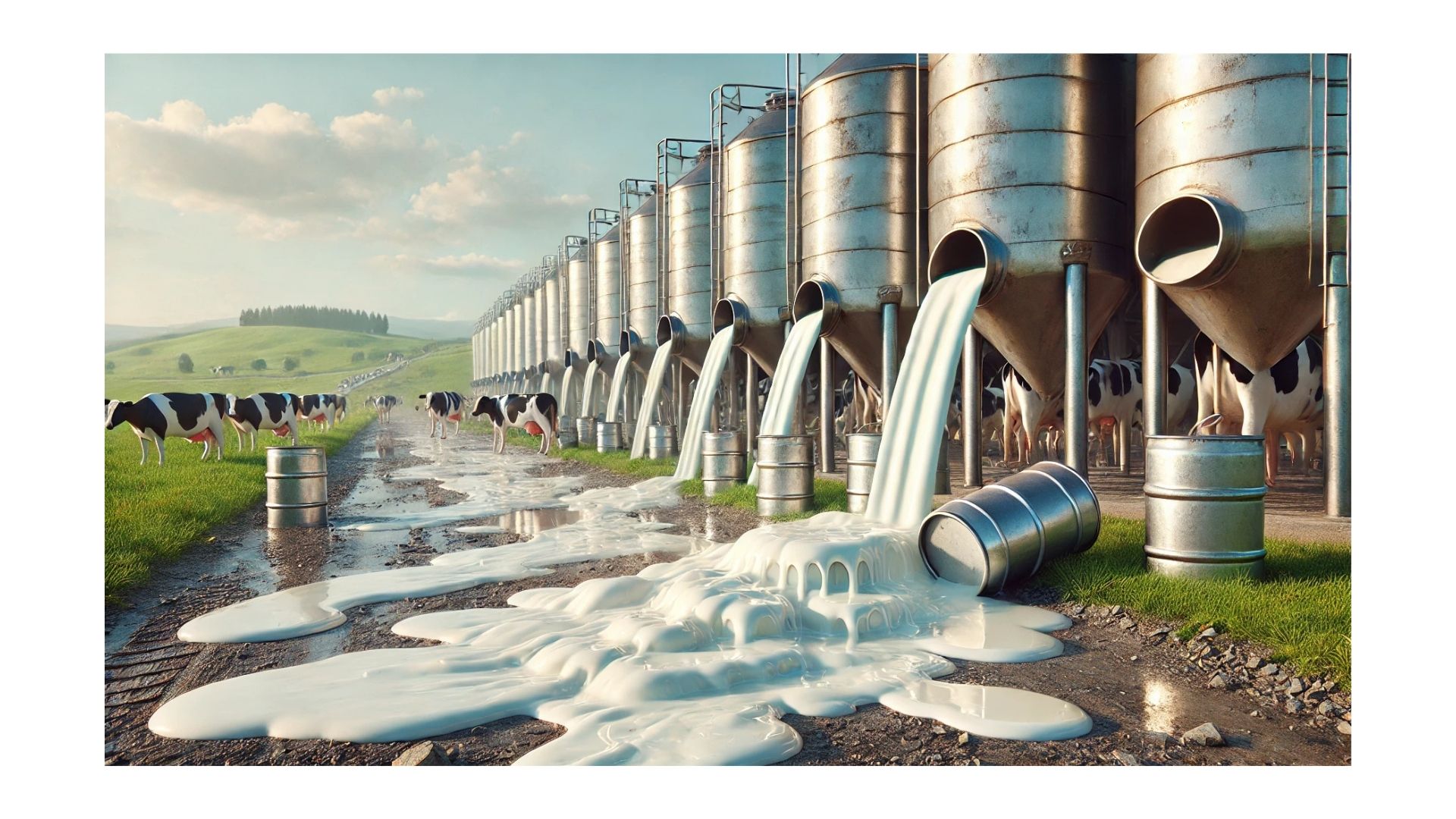
Millions of Gallons of Milk Wasted Due to Canada’s Dairy Rules
Dr. Thomas Elliot's team estimates that Canada's dairy quota system has led to vast amounts of milk being discarded over the past decade, with large economic, environmental and nutritional costs.


A staggering amount of milk has been wasted on Canadian dairy farms since 2012, according to a new study led by Dr. Thomas Elliot from Aalborg University, Denmark, in collaboration with Dr. Benjamin Goldstein from the University of Michigan and Dr. Sylvain Charlebois from Dalhousie University, Canada. Published in Ecological Economics, the study highlights a pressing issue in Canada’s dairy production system, which regulates milk production and sales. This waste, driven by overproduction, results in significant environmental and economic costs along with lost nutritional opportunities.
Canada’s dairy production system was designed to balance supply and demand, but as Dr. Elliot explains, “The current system incentivizes farmers to overproduce milk, leading to enormous amounts being discarded when supply exceeds demand.” Over the last decade, the discarded milk represents billions of dollars in economic losses, and its environmental impact includes the release of greenhouse gases equivalent to the emissions from hundreds of thousands of vehicles. The amount of milk wasted could have provided the annual dairy needs of millions of Canadians.
The research used a method called material flow analysis to estimate the wasted milk, using publicly available data from Statistics Canada. It revealed that while dairy farms produced vast amounts of milk between 2012 and 2021, only a portion of that was sold, leaving a significant share unaccounted for and presumed wasted. The lost milk not only represents an economic loss but also an environmental burden, as the study quantifies its greenhouse gas emissions and the land and water required to produce it.
The research team proposes several solutions to reduce milk wastage. One key suggestion is to reform the system by reducing incentives for farmers to overproduce. “Updating the quota system to better reflect actual consumption needs, particularly as plant-based alternatives grow in popularity, could help reduce overproduction and waste,” says Dr. Elliot. The study also advocates for increased transparency, urging the Canadian Dairy Commission to monitor and report discarded milk volumes as a step toward greater accountability.
This large-scale milk wastage is not just an isolated issue in Canada. Other countries with significant dairy production, including the United States and New Zealand, also struggle with surplus milk. However, Canada’s production system, with its strict quotas, results in a higher wastage rate compared to other nations. In the U.S., where milk dumping is also a problem, discard rates are typically lower, thanks to more flexible market-driven approaches.
The researchers argue that while Canada’s current system stabilizes prices and supports farmers, its structure leads to inefficiencies. Eliminating the system altogether could have unintended consequences, such as driving farmers to produce even more milk to stay profitable, further exacerbating waste. Thus, reforming the system to penalize overproduction more heavily and encourage sustainable dairy farming practices is a more viable path forward.
In conclusion, the study calls for urgent reforms in Canada’s dairy sector to address the environmental, economic, and nutritional impacts of milk waste. “We need to align dairy production with sustainability goals, reduce overproduction, and shift towards more efficient and transparent practices,” Dr. Elliot emphasizes. The findings raise important questions about how Canada and other dairy-producing nations can strike a balance between supporting farmers and reducing food waste.
About the researchers

Thomas Elliot
Thomas Elliot is a leading researcher in the fields of sustainability and resource management, currently affiliated with Aalborg University in Denmark and the École de technologie supérieure in Canada. With a strong academic background in environmental economics and urban planning, his work focuses on addressing inefficiencies in global food systems and sustainable development.… Elliot’s research often uses innovative material flow analysis to quantify environmental impacts, especially in the agricultural and dairy sectors. His recent work sheds light on the significant environmental and economic consequences of food waste, particularly in the Canadian dairy industry. Passionate about policy reform, he aims to provide data-driven solutions that promote transparency and sustainability in resource management.

Benjamin Goldstein
Benjamin Goldstein is an environmental scientist at the University of Michigan's School for Environment and Sustainability and McGill University's Faculty of Agricultural and Environmental Sciences in Canada. His research explores the intersection of agriculture, food systems, and environmental sustainability.… Goldstein specializes in life cycle assessments and material flow analysis, helping to quantify the environmental footprints of food production. His work has garnered attention for its focus on reducing agricultural waste and mitigating climate impacts in the dairy sector. Goldstein is particularly interested in how sustainable practices can be integrated into large-scale food production systems to reduce waste and emissions.

Sylvain Charlebois
Sylvain Charlebois is a renowned professor and researcher in food policy and agricultural economics, based at Dalhousie University, Canada. He is the Director of the Agri-Food Analytics Lab, where he leads numerous studies on food distribution, sustainability, and consumer behavior.… Charlebois is widely recognized for his expertise in food systems, contributing to public discourse on food security and waste reduction. His research often focuses on supply chain inefficiencies, particularly in Canada’s dairy industry, aiming to bridge the gap between food production and sustainable consumption. Charlebois is also a prominent media commentator, frequently discussing trends in food policy and innovation.
Journal reference
Elliot, T., Goldstein, B., & Charlebois, S. (2024). “Over 6 billion liters of Canadian milk wasted since 2012.” Ecological Economics, 227, 108413. DOI: https://doi.org/10.1016/j.ecolecon.2024.108413