Can Influenza Make COVID-19 Deadlier During Flu Season?
Professor Narasaraju Teluguakula and colleagues review evidence that influenza and SARS-CoV-2 together can amplify lung inflammation and worsen illness, although clinical findings remain mixed.


As the world continues to grapple with the aftermath of the COVID-19 pandemic, another potential health crisis looms on the horizon co-infection with influenza and SARS-CoV-2. While each virus on its own poses significant health risks, their interaction within the human respiratory system may lead to exacerbated disease outcomes, raising concerns about how these pathogens affect each other when they co-exist. Recent research by Professor Narasaraju Teluguakula and colleagues explores this interplay in their study and published in the journal Viruses in 2024.
The study draws attention to an alarming phenomenon: when these two viruses infect the lungs simultaneously, it can result in more severe respiratory illness. Professor Teluguakula, along with co-researchers from institutions including the University of Tennessee, the Adichunchanagiri University, India, and the National University of Singapore, discuss the risks posed by co-infection and how it affects the survival and replication of both viruses. As Professor Teluguakula notes, “Influenza co-infection has been associated with increased morbidity and mortality in patients with COVID-19, suggesting a synergistic effect that exacerbates lung disease and worsens clinical outcomes.” Their article highlights the pressing need for understanding the dynamics between these two viral pathogens during the flu season.
Both influenza and SARS-CoV-2 viruses share several key characteristics—they are single-stranded RNA viruses that infect the human respiratory tract and have overlapping transmission methods. However, their interaction within the lung environment remains complex. Clinical data from co-infection cases are inconclusive, with some patients showing increased severity of symptoms while others experience milder or unchanged outcomes. What is clear, however, is that the two viruses can amplify the immune system’s inflammatory responses, leading to increased lung damage and even organ failure.
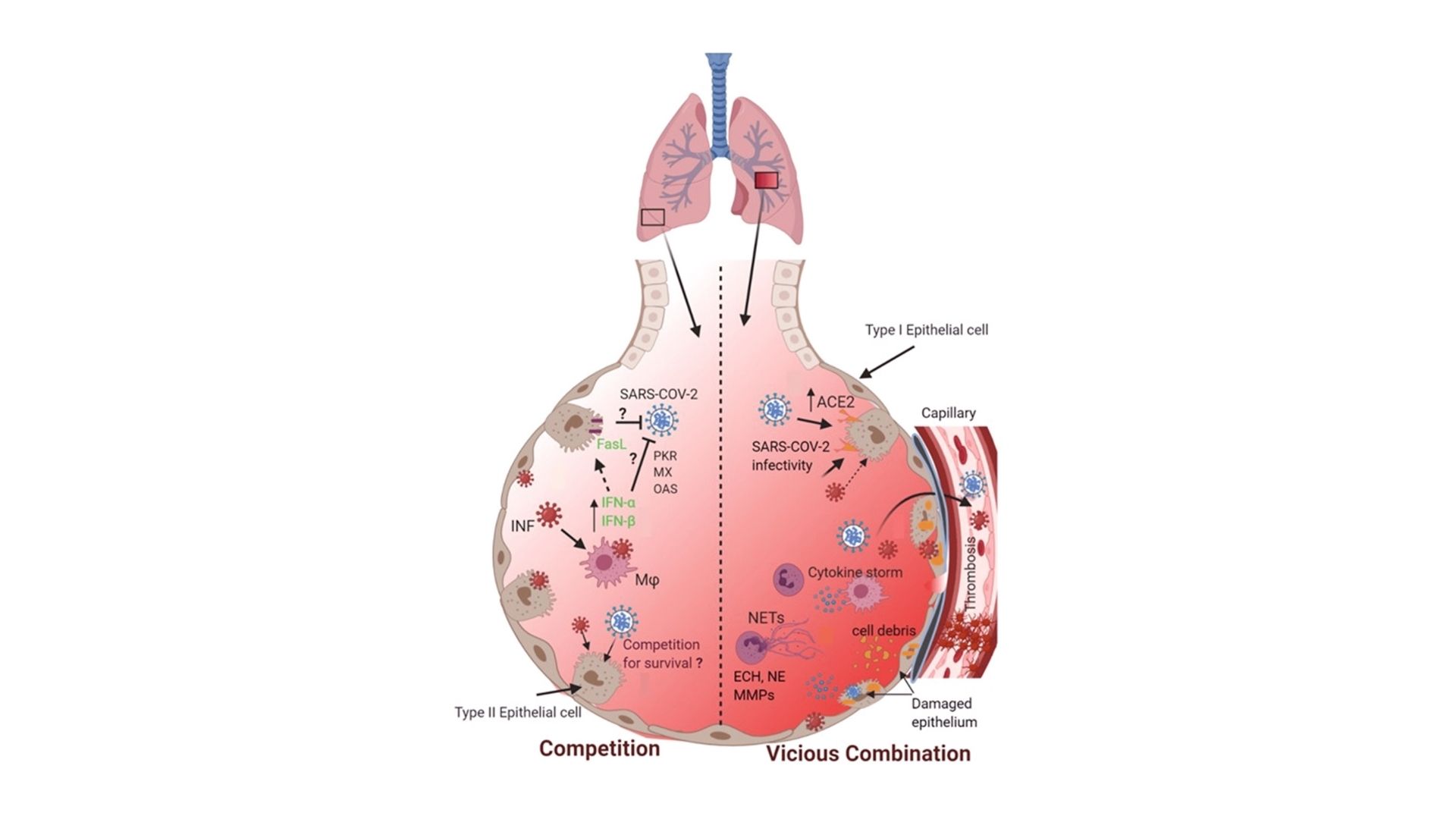
One critical finding is that influenza infection can alter the behavior of SARS-CoV-2 in the lungs. In laboratory experiments, influenza was found to outcompete SARS-CoV-2 by replicating more rapidly in lung cells. This competitive suppression could reduce the viral load of SARS-CoV-2, potentially offering some protection against severe COVID-19. However, this is not always the case in clinical scenarios, as influenza can also upregulate receptors like ACE2, which are critical for SARS-CoV-2 entry into cells, thus facilitating the virus’s spread.
Interestingly, Professor Teluguakula and his team highlighted that co-infection might sometimes create a lethal synergy between the viruses. For example, co-infected animals in their studies showed heightened inflammation, prolonged pneumonia, and worsened lung pathology compared to animals infected with just one virus. This phenomenon appears to be driven by a combination of both viruses’ ability to trigger an exaggerated immune response, often resulting in acute respiratory distress syndrome (ARDS), a life-threatening condition. “The co-existence of both pathogens in the lungs may lead to an overwhelming inflammatory response that damages the alveolar structure, exacerbating the pathophysiological consequences,” says Professor Teluguakula.
This dual viral threat has significant implications for public health, especially during the winter months when influenza typically surges. Data from the study suggest that patients, particularly the elderly and immunocompromised, are at heightened risk of severe outcomes if co-infected. The researchers also point to several case reports indicating that co-infection has contributed to higher ICU admissions, prolonged hospital stays, and increased mortality rates.
Vaccination emerges as a critical strategy in mitigating the risks posed by this dual threat. The study underscores the potential protective benefits of the influenza vaccine against severe COVID-19 outcomes. “Annual influenza vaccination can drastically reduce ICU admissions and may even offer some protection against SARS-CoV-2,” states Professor Teluguakula, referencing clinical studies that show a correlation between flu vaccination and better COVID-19 outcomes. These findings offer a glimmer of hope that widespread vaccination campaigns could help reduce the severity of co-infection cases, especially during flu season.
In conclusion, Professor Teluguakula and his co-researchers stress the need for more studies to better understand the complex interactions between these two viruses. With both influenza and SARS-CoV-2 expected to continue circulating in the global population, future research will need to explore new treatment strategies and improved diagnostic tools to manage co-infection cases. They emphasize that while co-infection can be deadly, it is also preventable through vigilant public health measures such as vaccination, early detection, and proper medical intervention. As we move into the future, understanding the interplay between these pathogens will be crucial in reducing the burden of respiratory diseases on global health systems.
About the researchers

Dr. Narasaraju Teluguakula
Dr. Narasaraju Teluguakula received his PhD in virology from the Department of Microbiology, Osmania University, Hyderabad, India in 2002. He joined the faculty of the Center for Veterinary Health Sciences and Oklahoma Center for Respiratory and Infectious Diseases (ORCID), a National Institute of Health (NIH)-funded Center at Oklahoma State University, Stillwater, Oklahoma, USA in 2010.… He is currently a Professor in Microbiology at Adichunchanagiri Institute of Medical Sciences and School of Natural Sciences, Adichunchanagiri University, Karnataka, India. He has been working on ‘respiratory and infectious diseases’ for more than 20 years. His lab mainly focused on understanding the lung pathophysiology in influenza and SARS-CoV-2 virus infections. His research identified several mechanisms for the role of neutrophils and their released neutrophil extracellular traps (NETs) in fatal influenza and SARS-CoV-2. He also served as a grant reviewer for the Department of Defense (DoD), USA, and The National Prok Board, USA. He has published over 50 peer-reviewed articles and editorial columns in high-impact medical and scientific journals.

Dr. Vincent TK Chow
Dr. Vincent TK Chow is a medical virologist and molecular biologist who graduated with MD, PhD, FRCPath, MBBS, and MSc qualifications. Currently, he serves as an Associate Professor of Microbiology and Principal Investigator of the Host and Pathogen Interactivity Laboratory at the Yong Loo Lin School of Medicine, National University of Singapore (NUS).… Dr Chow previously served as President of the Asia-Pacific Society for Medical Virology as well as Chair of the Virology Section of the International Society of Chemotherapy. He has received several awards and honors (including the Murex Virologist Award for Rapid Viral Diagnosis, the Special Commendation Award and Faculty Research Excellence Award from NUS, the Singapore Society of Pathology – Becton Dickinson Award, the Chan Yow Cheong Oration at the 6th Asia-Pacific Congress of Medical Virology). His research interests focus on the molecular genetics and infectomics of viruses/diseases such as influenza, enterovirus 71, dengue, SARS coronavirus, and human herpesvirus 6. He has published over 290 articles in peer-reviewed medical and scientific journals.

Dr. M.G. Shivaramu
Dr. M.G. Shivaramu, Principal of Adichunchanagiri Institute of Medical Sciences (AIMS) and Dean of Health Sciences (Medical) at Adichunchanagiri University, Karnataka, India, is a distinguished medical education and healthcare leader. He holds an MD in Forensic Medicine from Karnataka University, India.… He has been instrumental in various leadership roles in the institution’s academic, administrative, and financial management leading to recognition from national regulatory boards such as the National Accreditation Board for Hospitals & Healthcare Providers (NABH) and the National Accreditation Board for Testing and Calibration Laboratories (NABL). His leadership has driven the expansion of both undergraduate and postgraduate admissions, the establishment of a mentor-ward system, and the promotion of research culture among students and faculty. Dr. Shivaramu is a prominent researcher and educator, with a focus on forensic medicine and medical education technologies. He has been recognized for his efforts in improving the quality of education and research at AIMS, resulting in notable rankings and awards for the institution. Dr. Shivaramu continues to contribute to the field through his numerous publications and active participation in professional societies. He also serves on various councils and committees on public health at regional and national levels.
Journal reference
Teluguakula, N., Chow, V.T.K., Pandareesh, M.D., Dasegowda, V., Kurrapotula, V., Gopegowda, S.M., Radic, M. “SARS-CoV-2 and Influenza Co-Infection: Fair Competition or Sinister Combination?” Viruses, 2024, 16, 793. DOI: https://doi.org/10.3390/v16050793