Cost-effective Technique Brings HIV Treatment Within Everyone’s Reach
Dr. Limei Jin's team developed a short, scalable route from a cheap commodity chemical to a key building block of the HIV drug lenacapavir, avoiding column purification and hydrogen fluoride.


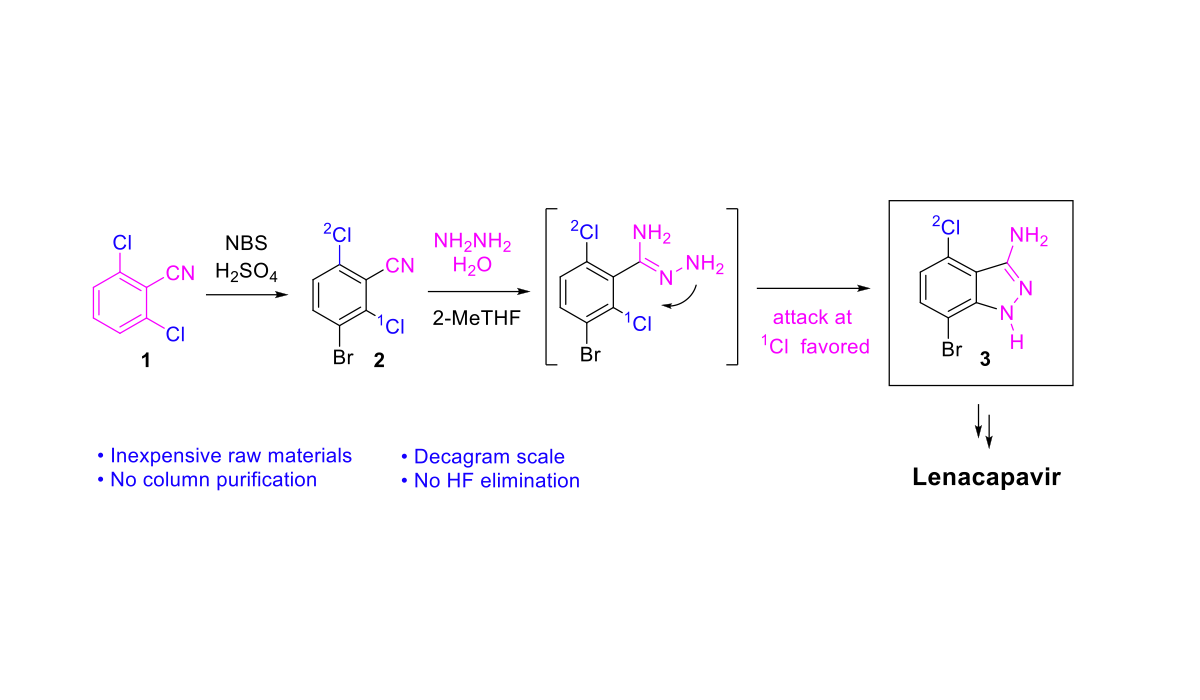
The effort to find more affordable and scalable ways to make medicines has taken a big step forward with a new method for producing 7-bromo-4-chloro-1H-indazol-3-amine (3). This substance is an essential material needed to synthesize Lenacapavir, a powerful new treatment for the human immunodeficiency virus (HIV). In research led by Dr. Limei Jin, the team at the Medicines for All Institute, Virginia Commonwealth University, developed this innovative synthetic route. Their work was shared in the journal Molecules.
The new process focuses on reducing costs and making production easier to scale up. It uses a starting material called 2,6-dichlorobenzonitrile (1), which is an inexpensive commodity chemical. The method involves two main steps: selective bromination to provide intermediate 2 and then generating the critical 3-aminoindazole ring with hydrazine. The new process avoids the need for costly chemicals and complex purification steps like column chromatography. As such, the new synthetic method is more favorable for economical, large-scale production. “We wanted to simplify the production process and make it more accessible,” explained Dr. Jin.
As part of the work from the team at the Medicines for All Institute, it was shown that the chemistry could be accomplished on a large scale. The team demonstrated that the process could be used to produce sizable batches of the 7-bromo-4-chloro-1H-indazol-3-amine (3) with high purity. Previously, compound 3 could only be prepared from an expensive starting material using a process that released a hazardous by-product (hydrogen fluoride, HF). The new chemistry makes the manufacturing process safer and more reliable.
The importance of this improvement goes beyond cutting costs. Lenacapavir is highly effective at targeting HIV proteins, offering a new type of long-lasting treatment for the virus. Proteins are molecules that perform essential functions in cells, and in this case, the drug blocks the action of HIV capsid proteins to stop the virus from multiplying. “This work provides a sustainable way to produce one of the key intermediates of this life-saving medicine, potentially benefiting countless people worldwide,” said Dr. Jin.
The Medicines for All Institute synthesis also utilizes an environmentally friendly approach. The solvent used in the 3-aminoindazole ring formation is 2-methyltetrahydrofuran, which is considered a biorenewable solvent. Two chemical reaction steps are used in the process and they were both optimized to minimize environmental impact. This aligns with the growing demand for greener practices in drug manufacturing.
Looking ahead, this method has the potential to revolutionize how other drugs are made, especially those that require complex structures like those found in Lenacapavir. The Medicines for All Institute remains committed to developing cost-effective solutions to address global health needs. The synthesis of 7-bromo-4-chloro-1H-indazol-3-amine (3) is an example of this commitment to lower the cost of pharmaceutical synthesis.
About the researchers

Dr. Limei Jin
Dr. Limei Jin is a chemist in the field of organic chemistry, with a Ph.D. from the Shanghai Institute of Organic Chemistry, the Chinese Academy of Sciences.… With over 20 years of experience in both industry and academia, he has developed a profound expertise in organic synthesis, particularly in asymmetric catalysis, active pharmaceutical ingredient (API) synthesis, process development, and scale-up in both research and development (R&D) and Good Manufacturing Practice (GMP) environments. Dr. Jin has published over 40 research articles in high-impact journals, including the Journal of the American Chemical Society (JACS) and Angewandte Chemie International Edition (ACIE), Organic Process Research & Development (OPRD), showcasing his contributions to the scientific community. At M4ALL, Dr. Jin serves as a team leader and project lead, managing various projects while fostering collaboration with funders, clients, and contract laboratories. As a Senior Synthetic Scientist and supervisor, he is dedicated to training team members and ensuring their professional growth. Dr. Jin's extensive background in medicinal chemistry and process development, along with his strong adherence to Good Documentation Practices (GDP) and Standard Operating Procedures (SOPs), positions him as a highly motivated and knowledgeable leader in the field.

Dr. Naeem Asad
Dr. Naeem Asad obtained his Ph.D from the University of Kansas under the guidance of Professor Paul R. Hanson. While there, he developed methods towards the synthesis of different heterocycles, specifically cyclic sulfonamides. He also performed diversity-oriented synthesis and constructed libraries of different heterocycles.… During his postdoc, he developed methodologies towards the synthesis of different photocleavable protecting groups (PPGs) and also developed different biological probes. He carried out photochemistry experiments on the protected probes synthesized by him. The biological probes were sent to different biological collaborators. At Medicines for All, he is involved in different projects entailing organic synthesis, process chemistry as well as method development. He is involved in developing cost-effective approaches towards high profile drug molecules for the treatment of human diseases. He is also involved in the development of processes for the scaling-up of these high-profile molecules. He has 16 years of experience in organic synthesis and 20 publications in high impact factor journals like JACS, Org. Lett., JOC, Chem. Comm., Cell reports etc.

Dr. G. Michael Laidlaw
Dr. G. Michael Laidlaw is the founder and sole owner of Pinnachem LLC, a Virginia-based company specializing in safety, compliance (FDA, DEA, EMEA, Kosher), technology transfers, market research, and employee development in the pharmaceutical and fine chemicals sectors. With over 50 years of experience, Pinnachem serves clients in the U.S., Mexico, China, and India. Dr.… Laidlaw’s extensive career includes key executive roles at Boehringer Ingelheim Chemicals (2006–2010), where he served as GVP of Manufacturing and Engineering and later as President and COO. Under his leadership, the company expanded its capacity by 50% through a $150 million capital project, successfully passed audits from the FDA, DEA, and international agencies, and established a global safety culture. Previously, at BASF North America (1984–2006), Dr. Laidlaw held various roles, including Works Manager, Technology Transfer Coordinator to Mexico, and Site Manager for a surfactant plant. He led technology transfers and capacity improvements, ensuring compliance with Kosher Orthodox Union standards. Earlier in his career, Dr. Laidlaw worked at Rutgers Nease Chemical Company, focusing on environmental compliance and the cleanup of a Superfund site. He also began his career in medicinal chemistry at Sterling Drug (now part of Sanofi), where he developed a total synthesis of Hycanthone and worked under the direction of Dr. Sydney Archer, a renowned medicinal chemist, on the synthesis of this drug to fight tropical worm disease. Dr. Laidlaw holds a BS in Chemistry from Siena College and a PhD in Organic Chemistry from Rensselaer Polytechnic Institute. His leadership, technical expertise, and experience in manufacturing, compliance, and environmental management have made him a recognized figure in the chemical and pharmaceutical industries.

Dr. Frank Gupton
Dr. Frank Gupton is the founder of Medicines for All Institute (M4ALL). He is also a distinguished professor at Virginia Commonwealth University, holding joint appointments in the Departments of Chemistry and Chemical and Life Science Engineering. As the Floyd D.… Gottwald Chair of Pharmaceutical Engineering and Chair of the Chemical and Life Science Engineering Department, Dr. Gupton brings over thirty years of industrial experience in developing and commercializing chemical processes for pharmaceutical applications. His current research focuses on continuous processing technologies that enhance the discovery, development, and commercialization of drug products. Before joining VCU, Dr. Gupton was the Executive Director of North American Process Development at Boehringer Ingelheim Pharmaceuticals, where he played a pivotal role in the commercialization of the widely prescribed HIV drug nevirapine. He earned his Bachelor of Science in Chemistry from the University of Richmond and his graduate degrees in Organic Chemistry from Georgia Tech and VCU. Dr. Gupton's research emphasizes streamlining pharmaceutical processes through principles of process intensification, including innovative chemistry, novel continuous manufacturing platforms, and efficient catalysts. He has received numerous accolades, including the 2018 American Chemical Society Award for Affordable Green Chemistry and the Presidential Award for Green Chemistry. His work has significantly impacted the development of efficient processes for producing essential medications. In 2018, Dr. Gupton secured funding from the National Science Foundation to establish a Center for Rational Catalyst Synthesis, a collaborative research center involving multiple institutions. His recent initiatives focus on on-shoring manufacturing in response to the COVID-19 pandemic, ensuring access to essential medicines in the U.S.

Douglas Klumpp
Douglas Klumpp obtained a B.S. degree in chemistry from the University of Oklahoma. He then earned his Ph.D. degree from Iowa State University under the supervision of Professor Walter S. Trahanovsky. This was followed by postdoctoral work in the laboratory of Professor George A. Olah at the University of Southern California.… His independent career has involved academic appointments at California State Polytechnic University, Pomona, and Northern Illinois University. More recently, he joined the scientific staff at the Medicines for All Research Institutes at Virginia Commonwealth University. To date, he has published over 100 original research articles, seven book chapters, and the monograph, “Superelectrophiles and Their Chemistry” coauthored with George A. Olah (Wiley, 2008). His interests include synthetic methodology development and target-oriented organic synthesis.
Journal reference
Asad, N., Lyons, M., Muniz Machado Rodrigues, S., et al. “Practical Synthesis of 7-Bromo-4-chloro-1H-indazol-3-amine: An Important Intermediate to Lenacapavir.” Molecules, 2024. DOI: https://doi.org/10.3390/molecules29122705