Pollutants in Our Water May Now Be Easier to Remove
Professor Shlomo Nir and colleagues modelled how filters combining adsorption with bacterial or enzyme breakdown remove pollutants such as medicine residues from water, with experiments supporting the model.


Understanding how to remove harmful pollutants from water is a critical challenge in environmental science. A recent review by Professor Shlomo Nir, Mr. José Manuel Jiménez-Barrera, and Dr. Tomás Undabeytia explores a new way to purify water more effectively. The research, published in the journal Water, highlights how certain bacteria, and enzymes, specialized proteins that help speed up natural chemical reactions, can help break down contaminants while water passes through filtration systems, which are designed to remove impurities as water flows through different materials.
Professor Nir from The Hebrew University of Jerusalem, along with his colleagues from the Instituto de Recursos Naturales y Agrobiologia, developed a model to simulate and predict how well this process works. “By combining natural breakdown processes with filtration and modeling, we can create a system that continuously removes pollutants, making water purification much more efficient, and amenable to planning,” explained Professor Nir. Their approach offers an improvement over existing methods.
The study focused on removing various pollutants commonly found in water, such as chemicals from medicines, beauty products, and industrial waste. One key example involved a filter including activated carbon, a porous material that traps pollutants and provides a surface for bacteria to grow denoted a biofilm, which supports bacteria capable of breaking down toxic compounds. These toxins, dangerous even in tiny amounts, were successfully removed over a long period. The researchers also showed that their method could handle even higher levels of pollution without losing effectiveness.
Another major benefit of this research is its potential use in wastewater treatment plants, facilities that treat used water before it is delivered to the environment. If treatment facilities adopt this filtration method, they could significantly improve their ability to purify water before releasing it into the environment. “This approach not only makes drinking water safer but also helps reduce the impact of wastewater on natural ecosystems,” noted Professor Nir.
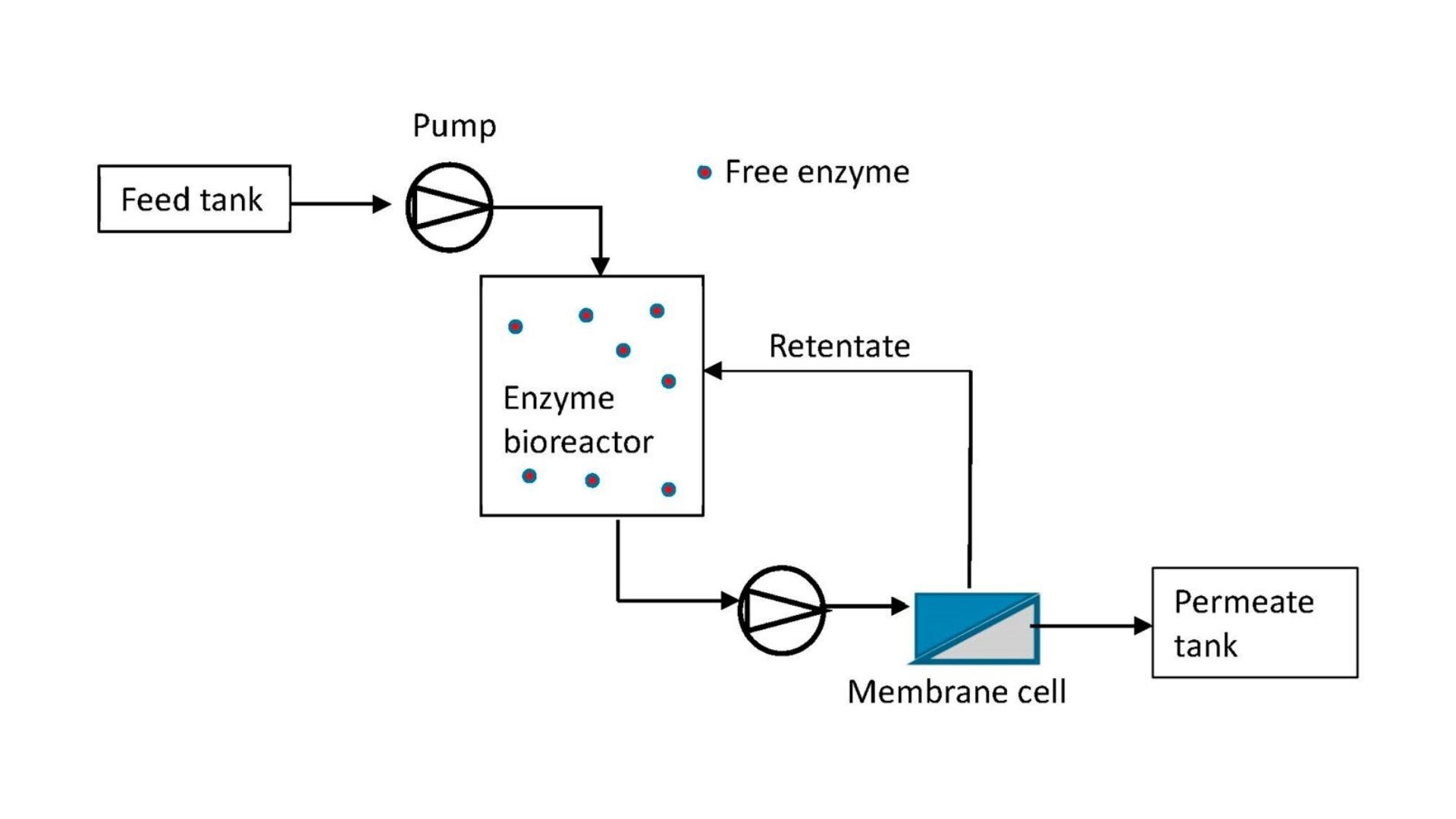
In addition to using bacteria, the study also explored filtration systems that rely on enzymes—proteins that speed up chemical reactions. These enzymes are kept active within special filters, allowing them to break down pollutants in a controlled and efficient way. This method could be especially useful for removing contaminants that are difficult to eliminate with conventional treatments. Modeling of the filtration, experimentally corroborated, indicates that the removal of pollutants in enzyme filtration systems is initially driven mostly by adsorption, with minimal degradation. The concentration of the emerging pollutant increases over time until a steady state is reached, at which point removal occurs solely through degradation.
The figure above shows a schematic diagram of some of the reported processes, which includes an enzymatic system for the removal of contaminants in the form of tangential filtration and another one in the form of fixed bed filtration using different types of filters (biofilm formation followed by another filter for the removal of contaminants, metabolites and bacteria released from the biofilm). The lower part represents a suggestion to add to the GAC filter in series a micelle-clay filter which is powerful in removing from water bacteria and other microorganisms, as a remedy against occasional escape of pollutants from the GAC filter.
This research highlights the need to combine biological and chemical techniques to improve water purification. As water safety regulations become stricter, advanced filtration methods like this could play a key role in ensuring access to clean and sustainable water supplies.
New Results
S. Nir extended the program for degradation during filtration to any number of pollutants. It yielded simulations and predictions for removal of dissolved organic matter (DOM) from Lake Kinneret water in a full year pilot. Filtration by a GAC filter exhibited a steady state during months 5-12, and a large removal capacity of 129 m3/kg GAC.
About the researchers

Shlomo Nir
Shlomo Nir is Professor Emeritus at The Hebrew University of Jerusalem (HUJI). 1969 Ph.D-Theoretical Physics. Thesis: Atomic Spectroscopy; calculations of energy levels. 1970 Fellow, Inst. Life Sciences, HUJI. 1970-1980. RPMI, Buffalo NY. Cancer Research Scientist I-IV, and Assoc. Prof. Biophysics; University of NY, Buffalo. 1980 Assoc. Prof. HUJI; Dept Soil and water Sciences.1985 Professor.… 2003 Professor Emeritus. Recent research mainly on Water Purification. Developed models for: 1. Simultaneous adsorption of several cations (including organic cations) to surfaces, electrostatic equations and specific binding in a closed system: applied to biological membranes and clays, and extended to organic cations. 2. Particle aggregation, extent and kinetics. 3. Membrane fusion and endocytosis 4. Pore formation by peptides. 5. Kinetics of filtration for a solution with several pollutants. The model has yielded simulations and predictions for removal of chemicals and bacteria for laboratory and pilot scales. 6. Degradation during filtration. The model, which predicts steady state phenomena was applied in (i) removal from fish ponds of off flavor compounds (ii)Very efficient purification of lake drinking water. Recently the program was extended to deal with several pollutants in solution and yielded simulation and prediction for low-cost DOM removal from lake water on a pilot scale. Designed organo-clay complexes, which remove from water efficiently chemicals and microorganisms. Published 265 articles in Journals and books, 4 books, 6 patents.

Tomás Undabeytia
Tomás Undabeytia: Institute of Natural Resources and Agrobiology-Spanish Research Council (IRNAS-CSIC). Permanent research scientist position.… Research fields focusing on the dynamics of contaminants in the soil-water system, by addressing the following topics: (i) the influence of trace metals on the adsorption and mobility of organic contaminants in soils and vice versa; (ii) the influence of organic amendments on the mobility of agrochemicals; (iii) the development of recovery methodologies for soils contaminated with pesticides and other organic and inorganic chemicals; (iv) the development of controlled release formulations of pesticides (CRFs); and (v) development and study of water purification systems for persistent organic compounds and pathogenic micro-organisms. Indicators: h-index, 31; 72 publications; 4 patents.
Journal reference
Undabeytia T, Jiménez-Barrera JM, Nir S. “Removal of Emerging Contaminants by Degradation during Filtration: A Review of Experimental Procedures and Modeling.” Water. 2024; 16(1):110. DOI: https://doi.org/10.3390/w16010110
Undabeytia T., Jiménez-Barrera J.M., Nir S. “Removal of Emerging Contaminants by Degradation during Filtration: A Review of Experimental Procedures and Modeling.” Water, 2024; 16(1): 110. DOI: https://doi.org/10.3390/w16010110