Misshapen Cells Could Be Quietly Shutting Down Important Genes
Dr. Jason Buenrostro's team developed a way to sequence DNA inside intact nuclei and found that misshapen nuclei in progeria cells carry scattered patches of wrongly silenced active DNA.


The structure of a cell’s nucleus has long served as a visible clue to whether a cell is healthy or affected by disease. While scientists have made major progress in understanding genes and their functions, it’s been much harder to directly link what we see under the microscope with what’s happening inside our DNA. Now, a new method helps bring these two worlds together.
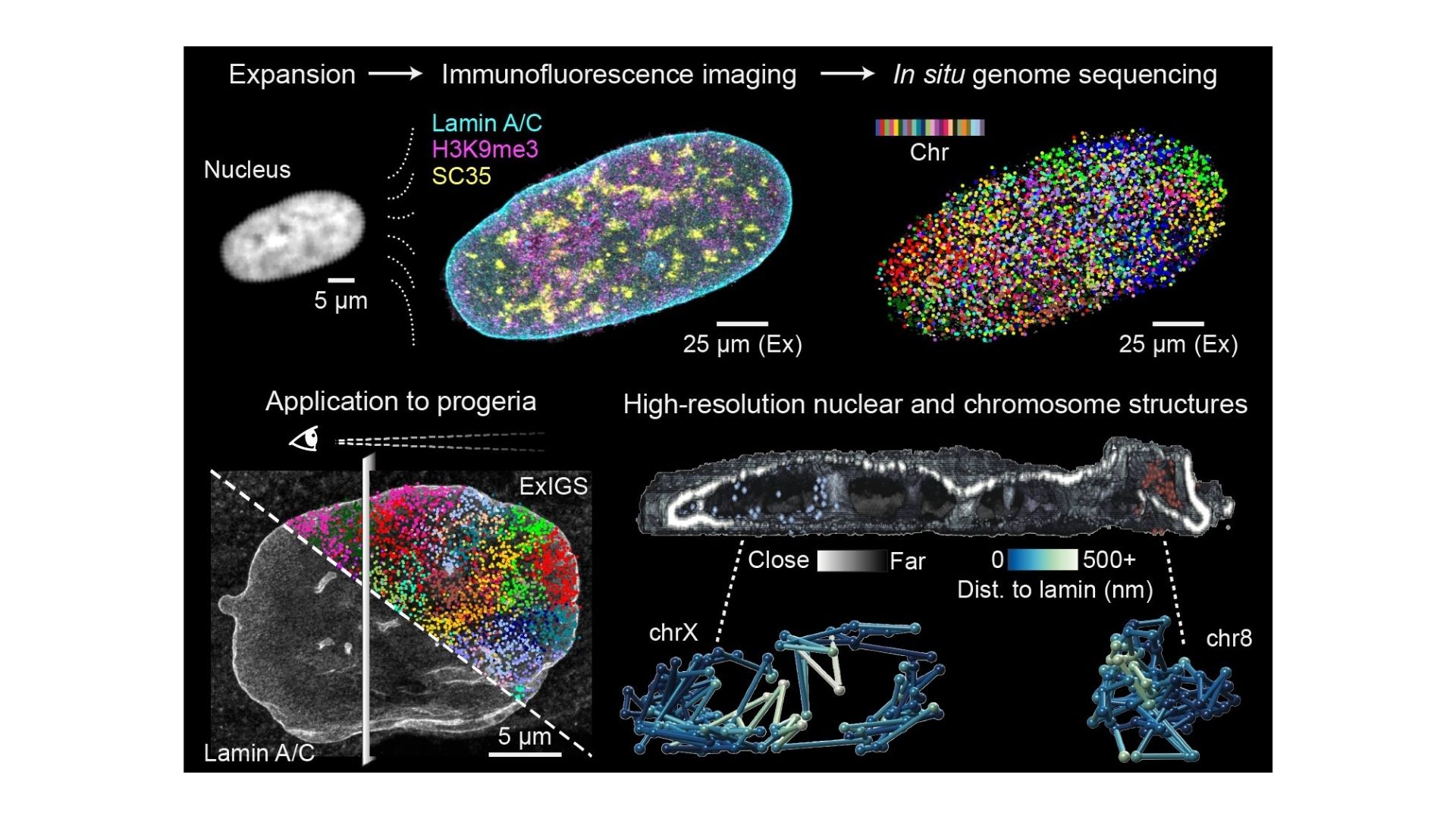
Dr. Ajay Labade, Dr. Zachary Chiang, Caroline Comenho and researchers led by Dr. Jason Buenrostro from Harvard University have created a new technique called Expansion in situ Genome Sequencing (ExIGS), which involves sequencing DNA directly inside cells while preserving their natural structure. The study was published in the journal Science.
ExIGS gives researchers the ability to look at both DNA and important proteins inside the nucleus—the control center of a cell—in extremely fine detail. Unlike earlier techniques, this one allows scientists to actually see how these molecules are arranged in space and how they interact. The team used this method to study cells from a person with Hutchinson-Gilford progeria syndrome (HGPS), a rare disease that causes children to age rapidly.
They found an unexpected connection between the abnormal shapes of these cell nuclei and the silencing of certain genes. In healthy cells, euchromatin, a loosely packed and active form of DNA where genes are turned on, keeps the cell functioning normally. But in the progeria cells, this typically active DNA was found to be shut down in certain areas. This suggests that changes in the shape of the nucleus may be enough to turn off important genes.
“Lamin abnormalities are linked to hotspots of aberrant euchromatin repression that may erode cell identity,” said Dr. Buenrostro. Lamin proteins form part of the supportive shell of the nucleus. This means that when this supportive structure breaks down, it may silence genes that give cells their unique roles.
To confirm the reliability of their method, the researchers showed that ExIGS keeps the natural structure of the nucleus intact while providing much sharper detail—about ten times more than earlier sequencing methods. They combined this with fluorescent tagging, a way of making specific molecules glow so they can be tracked, to see how chromosomes—the structures that hold DNA—move and how these changes are connected to gene activity.
“The presence of lamin abnormalities is associated with increased frequency of disrupted neighborhoods,” said Dr. Labade. He noted that while these abnormalities are clearly linked to changes in gene activity, they do not directly drag euchromatin toward them. Instead, the effect is more patchy and local, rather than affecting the whole nucleus evenly.
Their observations revealed that even within a single cell, the areas affected by these structural changes were not predictable. These problem spots were spread out and tended to affect regions of the genome—the full set of genetic material—involved in communication between cells. That randomness could make the effects harder to fix.
Dr. Chiang looked back on the years of effort it took to reach this point: “This project started as nothing more than a crazy idea: that we could directly sequence genomes inside the nucleus. It would never fly anywhere but academia, where we spent 7 painstaking years making it a reality.” He also reflected on the importance of continued funding for this kind of high-risk, high-reward science. Although the project received top marks in a national research funding competition, that support was suddenly pulled due to wider political issues affecting science budgets.
The significance of this new tool reaches far beyond one disease. ExIGS opens the door to exploring how changes in the shape and structure of the nucleus might play a role in aging, cancer, and many other conditions. It provides a way to finally connect what we see under the microscope with how our genes behave.
About the researchers

Dr. Jason Buenrostro
Dr. Jason Buenrostro is a leading researcher in the field of gene regulation and single-cell genomics. Based at Harvard University and the Broad Institute, he has pioneered several techniques that reveal how cells organize and regulate their DNA, including the widely adopted ATAC-seq method.… His work focuses on developing technologies that connect the spatial arrangement of the genome to its functional state, with the aim of understanding how these processes go wrong in diseases like cancer and aging. Dr. Buenrostro is deeply committed to training the next generation of scientists and promoting open, innovative research environments. His interdisciplinary approach bridges molecular biology, bioengineering, and computational science.

Dr. Zack Chiang
Dr. Zack Chiang is a genomics researcher known for his contributions to spatial genome analysis and high-resolution DNA mapping in individual cells.… As a scientist at Harvard University and the Broad Institute, he played a key role in the development of Expansion in situ Genome Sequencing (ExIGS), a method that visualizes DNA and nuclear proteins at nanoscale precision. His research interests lie at the intersection of technology development and biological discovery, particularly in how physical changes in the cell can influence gene activity. Dr. Chiang is also an advocate for robust academic funding and transparent research practices. He recently announced his departure from academia, reflecting on the challenges of sustaining ambitious, long-term projects in a shifting scientific landscape.

Dr. Ajay Labade
Dr. Ajay Labade is a molecular biologist and technology innovator specializing in genomic sequencing and spatial cell analysis. At Harvard University and the Broad Institute, he co-developed ExIGS, a novel method that allows scientists to study the physical and functional organization of the genome within intact cells.… With a strong focus on basic science and experimental rigor, Dr. Labade has spent years refining tools that connect microscopic cellular structures to large-scale genetic patterns. His approach integrates wet-lab experimentation with advanced imaging and computational modeling. A firm believer in the power of curiosity-driven science, Dr. Labade has emphasized the importance of academic freedom and long-term investment in high-risk, high-reward research.
Journal reference
Labade A.S., Chiang Z.D., Comenho C., Reginato P.L., Payne A.C., Earl A.S., Shrestha R., Duarte F.M., Habibi E., Zhang R., Church G.M., Boyden E.S., Chen F., Buenrostro J.D. “Expansion in situ genome sequencing links nuclear abnormalities to aberrant chromatin regulation.” Science, 2025; 389(6758): eadt2781. DOI: https://doi.org/10.1126/science.adt2781