Your Immune System Learns and Remembers in Ways That Echo the Brain
Professor Volker Schirrmacher's review compares how the brain and the immune system find their way, learn and remember, and presents them as partners that evolved side by side.


Every animal that moves through the world needs to know where it is, learn from experience and remember what it has learned. Through evolution, the vertebrate brain grew larger and more complex to meet these demands. In parallel, a second system with strikingly similar needs appeared: the adaptive immune system, the branch of the body’s defenses that recognizes specific invaders and remembers them. Its cells must also find their way, learn to recognize threats and remember them.
Professor Volker Schirrmacher from the Immune-Oncological Center Cologne has brought these two worlds together in a review that compares how the brain and the immune system handle spatial orientation, learning and memory. The work is published in the International Journal of Molecular Sciences, a peer-reviewed journal.
It is the second part of a two-part series on brain and immune system, drawing on decades of research, much of it recent. Intercellular communication is the focus of the first part. Interestingly, there exist special neuroimmune interfaces, e.g. skull bone marrow, a brain lymphatic-like membrane, and choroid plexus.
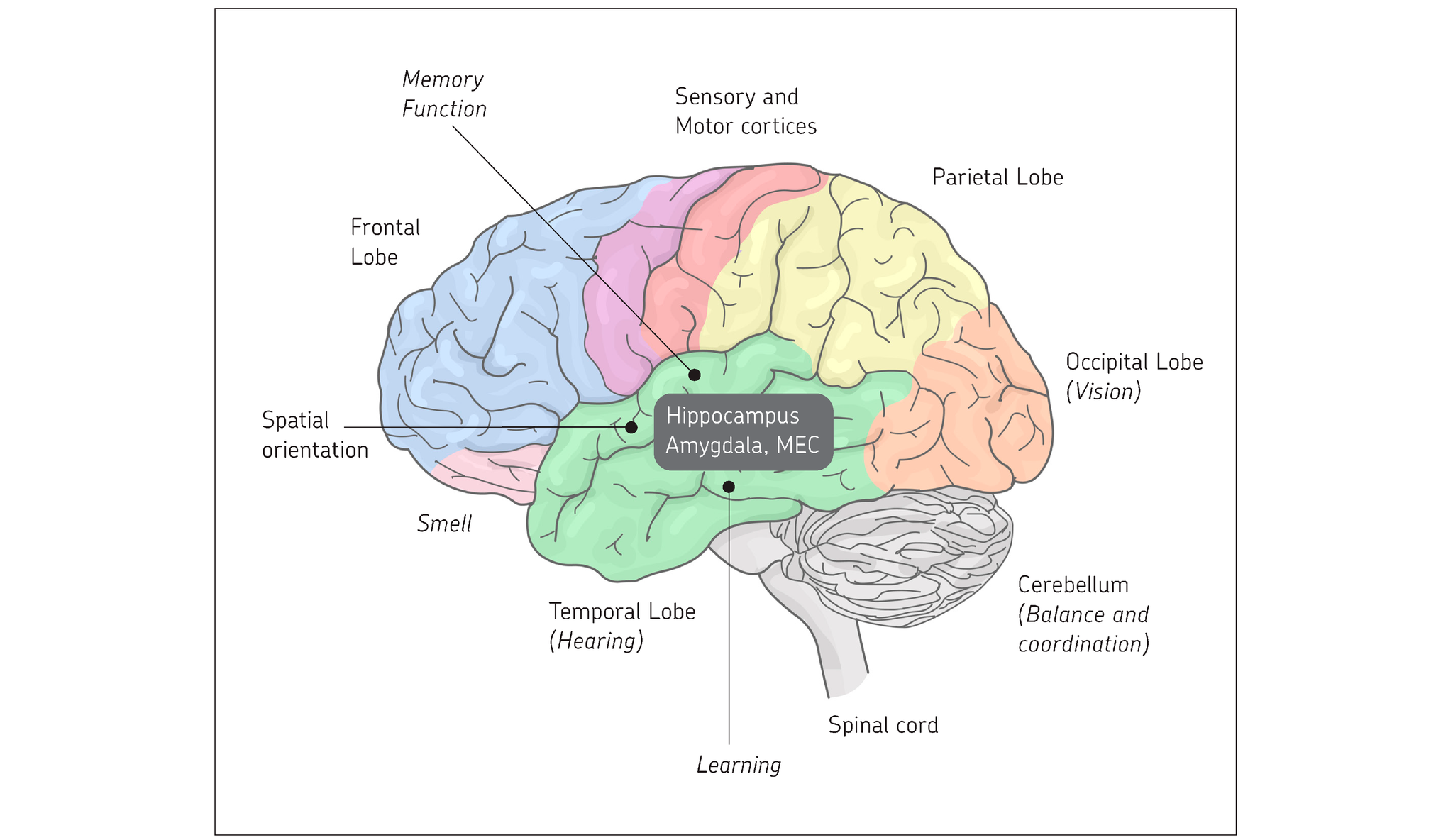
On the brain side, Schirrmacher’s review places the hippocampus, a curved structure deep inside each temporal lobe, at the center of spatial orientation, learning and memory. In and around it sit specialized navigation neurons, such as place cells that fire at particular locations and grid cells that lay a coordinate map over the surroundings, letting animals build mental maps. Learning and memory rely on engram neurons, nerve cells thought to hold the physical trace of an experience, and on information passing between the hippocampus and the brain’s outer layers.
The immune system faces a different challenge. Unlike the brain’s largely fixed network of neurons, it relies on cells that travel through blood, lymph and tissues. For a T cell, a type of white blood cell, finding the one cell that displays its matching target is like finding a needle in a haystack. Chemical messengers called chemokines help by forming trails that cells with the right receptors follow. “Spatial orientation in the immune system functions similar to a postal code,” explained Schirrmacher. T cells return to the place where they once met their target.
Each new T or B cell during development reshuffles pieces of its genes to build a unique receptor, a molecular sensor, and is screened so that it does not attack the body’s own tissues. Recognition happens at the immunological synapse, a close contact where two cells (T cells and dendritic cells) exchange signals. Brain’s neurons can make up to ten thousand synapses with other neurons. The intercellular communication capacity of the immune system rests on an impressive number (more than ten quadrillion) and diversity of synapses. This is also the case for the brain. While brain’s activity is based on electrical signals, the immune system’s activity is based on communication via chemical signals.
People learn languages and music. “In a similar way, the immune system can become educated deliberately, for instance by vaccination,” Schirrmacher argued. Like repetition at school, repeated vaccinations can strengthen long-term immune memory.
Memory is where the parallels become most striking. After an immune response, only a small share of the cells involved survive as long-lived memory cells, many resting in niches in the bone marrow. When recalled, they go through a massive burst of multiplication, something nerve cells do not do. Otherwise the systems share key features: priming of immune cells mirrors the formation of a memory trace in neurons. Both strengthen memories through networks of connections, and both stay open to threats never met before. Schirrmacher also highlights bone marrow memory T cells as a promising source for cancer immunotherapy, based on his team’s earlier work in animals and an early clinical trial in advanced breast cancer.
Turning to evolution, Schirrmacher discusses suggestions that rare changes in a few genes may have helped the neocortex, the brain’s outer layer and seat of higher thinking, grow larger in humans, though real evidence is still lacking. He also proposes that jumping genes, stretches of genetic material that can move within the genome, may have contributed.
Taken together, Professor Schirrmacher’s review presents the brain and the immune system as partners that evolved side by side the last 500 million years to communicate, orient, learn and remember, each in its own way. “Without mutual interactions, protection and controlling between these two systems, survival would not have been possible,” he concluded.
About the researcher

Prof. Volker Schirrmacher
Prof. Volker Schirrmacher is Scientific Director at the Immune-Oncological Center Cologne (IOZK) in Germany, where he took up the position of Scientific Director of Tumor Immunology in 2009.… He studied biochemistry at the Universities of Hamburg, Berlin and Tübingen and earned his PhD in immunology at the Institute of Genetics of the University of Cologne, supervised by Professor K. Rajewsky. After postdoctoral research at the Karolinska Institute in Stockholm, Sweden, with Professor H. Wigzell, he worked as a Senior Research Fellow at the Transplantation Immunology Unit of The London Hospital Medical College. From 1976 to 2008 he headed the Division of Cellular Immunology at the German Cancer Research Center (DKFZ) in Heidelberg. He completed his habilitation in immunology at the University of Heidelberg in 1979 and in 1986 was appointed full professor and Chair of Immunology at Heidelberg University. He was elected President of the Section of Experimental Cancer Research of the German Cancer Society and of the international Metastasis Research Society, served as Germany's representative on the Council of the European Association for Cancer Research, and was President of the European Association of Applied Immunology and Editor-in-Chief of The Open Cancer Immunology Journal. His awards include the Aronson Prize, the Meyenburg Prize and the German Cancer Prize.
Journal reference
Schirrmacher, V. “Brain and Immune System: Intercellular Communication During Homeostasis and Neuroimmunomodulation upon Dysfunction.” International Journal of Molecular Sciences, 2025; 26(14): 6552. DOI: https://doi.org/10.3390/ijms26146552 Schirrmacher, V. “Brain and Immune System Part II—An Integrative View upon Spatial Orientation, Learning, and Memory Function.” International Journal of Molecular Sciences, 2025; 26(23): 11567. DOI: https://doi.org/10.3390/ijms262311567