Overactive brain signals disrupt light sensitivity in autism-related disorder
Dr. Justyna Zmorzynska's team found that an overactive growth pathway in zebrafish modelling tuberous sclerosis disrupts light-processing neurons and light preference, which the drug rapamycin restored.
Read the original paper
Researchers at the International Institute of Molecular Mechanisms and Machines (IMol), Polish Academy of Sciences have uncovered a key mechanism behind sensory issues often linked to autism. Led by Dr. Justyna Zmorzynska, the team studied how overactivity in a cell pathway that helps control growth and brain signals affects the brain’s ability to process light. Using zebrafish, a common research model, they examined a condition called Tuberous Sclerosis Complex (TSC), a genetic disorder that often leads to autism-like symptoms. The results, published in iScience, offer new insights into how brain signaling disruptions can lead to unusual responses to sensory experiences, like sensitivity to light, which is common in people with autism.
Tuberous Sclerosis Complex is a genetic condition that impacts thousands of people around the world. It occurs when certain genes that help regulate cell growth stop working properly. This causes a specific cell pathway, called the mechanistic target of rapamycin complex 1 (mTORC1), to become overactive. This overactivity can lead to various issues, including seizures, learning difficulties, and autism-like behavior. “We know that when mTORC1 is too active, it disrupts how the brain develops and can result in autism-like behaviors,” Dr. Zmorzynska explained, “but we wanted to understand how it affects sensory processing, specifically sensitivity to light.”
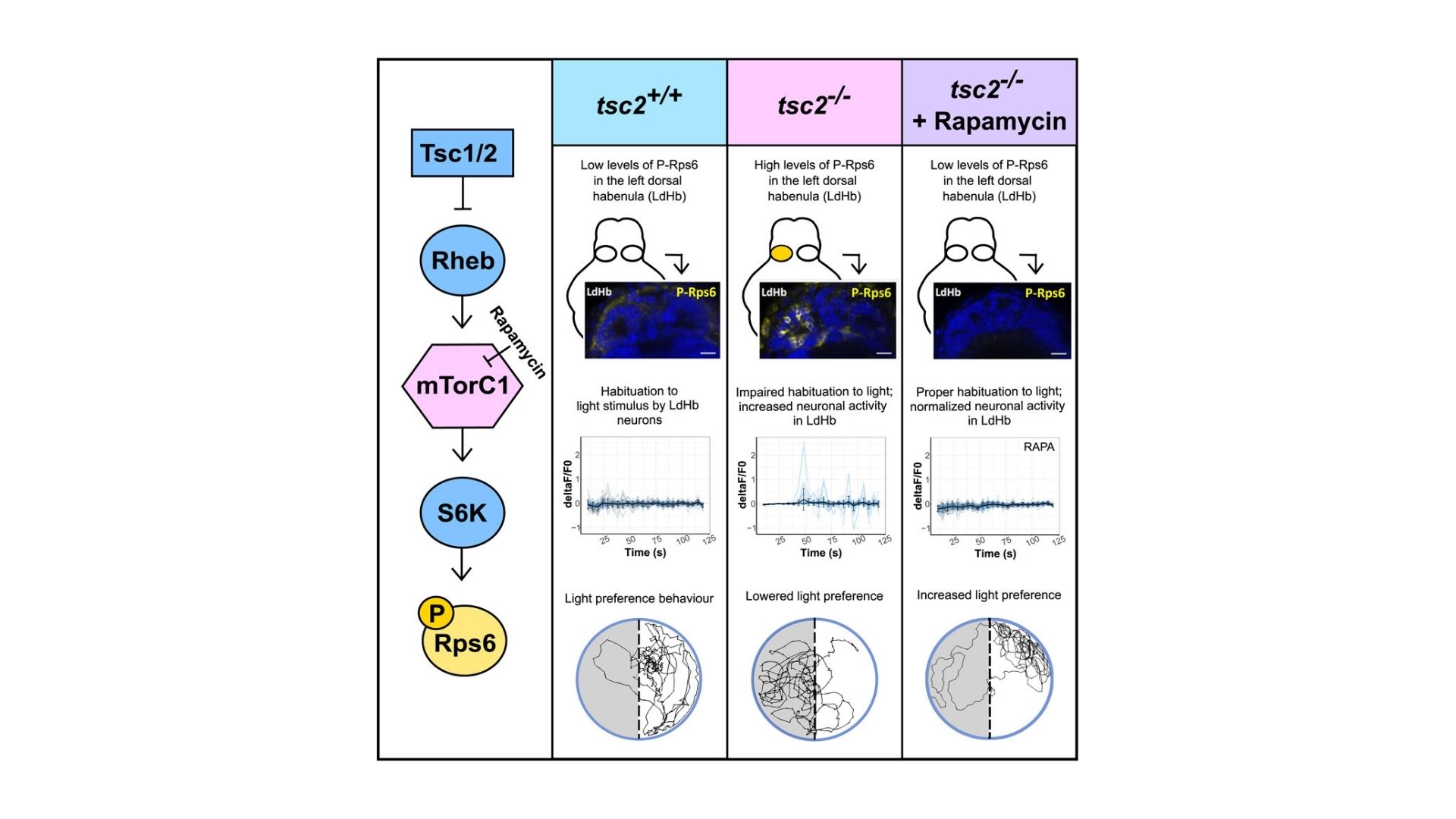
The researchers used zebrafish with faulty versions of the genes linked to Tuberous Sclerosis Complex to explore how this overactive pathway might interfere with brain function. They found that the zebrafish responded abnormally to light. Normally, zebrafish prefer well-lit areas, but these TSC zebrafish did not show a preference, spending equal time in both light and dark environments. The researchers determined that this unusual behavior wasn’t due to problems with the fish’s development or eyesight. Instead, the issue was in a part of the brain called the left dorsal habenula, which plays a key role in processing sensory information like light.
To dig deeper, the team studied the brain activity of zebrafish with Tuberous Sclerosis Complex. They found that neurons in the left dorsal habenula were unusually active and didn’t calm down in response to repeated exposure to light, as they normally would. Dr. Zmorzynska elaborated, “The overactivity in this part of the brain, caused by the hyperactive mTORC1 pathway, likely explains the sensory processing issues we observed in the fish.”
An important discovery from the study is that a drug called rapamycin, which blocks the mTORC1 pathway, restored normal light preference in the TSC zebrafish. After treatment, the zebrafish’s brain activity in the left dorsal habenula returned to normal levels, and they once again showed a preference for light. This suggests that overactivity in this pathway directly leads to sensory processing problems in individuals with Tuberous Sclerosis Complex, and potentially in people with autism.
These findings could have wider implications beyond just Tuberous Sclerosis Complex, as overactivity in the mTORC1 pathway is also linked to other developmental disorders. “Our study offers hope for new treatments,” Dr. Zmorzynska pointed out. “By targeting this specific pathway in the brain, we may be able to help people who struggle with sensory issues, which are often seen in autism.”
However, the researchers also warned against the widespread use of drugs like rapamycin in people with autism unless they have confirmed overactivity in this pathway. “While rapamycin worked well in our zebrafish model, it also caused unwanted side effects in animals without mTORC1 overactivity,” Dr. Zmorzynska cautioned. “It’s important to ensure that treatments are carefully targeted and only used in patients who truly need them.”
The study emphasizes the need for further research into how this brain pathway impacts sensory issues in autism. Future work will aim to explore how mTORC1 affects other sensory processing functions and whether these findings can be applied to human clinical trials. Ultimately, this research provides a clearer understanding of how brain signaling problems contribute to the sensory difficulties many individuals with autism face, offering new possibilities for treatment.
About the researcher

Justyna Zmorzyńska
Justyna Zmorzyńska is a developmental neurobiologist and a head of The Laboratory of Developmental Neurobiology at the International Institute of Molecular Mechanisms and Machines (IMol) in Warsaw, Poland. She leads a group that focuses on neuropsychiatric disorders, particularly autism spectrum disorders and intellectual disabilities.… Her research explores how early environmental factors, such as maternal infections during pregnancy, affect brain development and connectivity.A key aspect of her work involves investigating the role of the mTORC1 pathway in brain development and its connection to neuropsychiatric disorders. She uses zebrafish models in her research to study these developmental processes, which allows for insights into how disruptions in brain connectivity.She graduated from University of Warsaw with an MSc degree in Molecular Biology performing her Master project in the Department of Medical Genetics at the Institute of Mother and Child (Warsaw, PL). She did her PhD projects in the Department of Genetics, University Medical Center Groningen in Netherlands. She was awarded the Jan Kornelius de Cock stichting, grants for PhD students, three years in a row (2011-2013). She was a post-doctoral fellow and then senior researcher in the Laboratory of Molecular and Cellular Neurobiology, International Institute of Molecular and Cell Biology in Warsaw (PL). She did internships in in prof. Didier Stainier lab (Max Planck Institute for Heart and Lung Research, Bad Nauheim, Germany) and in Prof. William Harris lab (Department of Physiology, Development and Neuroscience, Cambridge, UK). She is also a recipient of prestigious grants, including the NCN SONATA BIS grant, which supports her research into the effects of maternal infection on brain development.
Journal reference
Doszyn, O., Kedra, M., & Zmorzynska, J. “Hyperactive mechanistic target of rapamycin complex 1 disrupts habenula function and light preference in zebrafish model of Tuberous sclerosis complex.” iScience, 2024. DOI: https://doi.org/10.1016/j.isci.2024.110149