Researchers find a surprising way bacteria fight and regulate genes
Professor Patrick Pausch's team mapped the structures of type IV-A CRISPR systems, showing how they lock onto DNA and recruit a helicase to block gene activity without cutting.


Scientists have made a major step in understanding how CRISPR systems work, particularly those known as Type IV-A systems, which act differently from most others. These systems use unique ways to manage genetic material without cutting it. A team of researchers led by Professor Patrick Pausch, Dr. Lina Malinauskaite, Dr. Rafael Pinilla-Redondo, and Professor Lennart Randau including those from Vilnius University, Philipps-Universität Marburg, and the University of Copenhagen, used advanced imaging methods to reveal new details about these systems. Their findings were published in the journal Nature Communications.
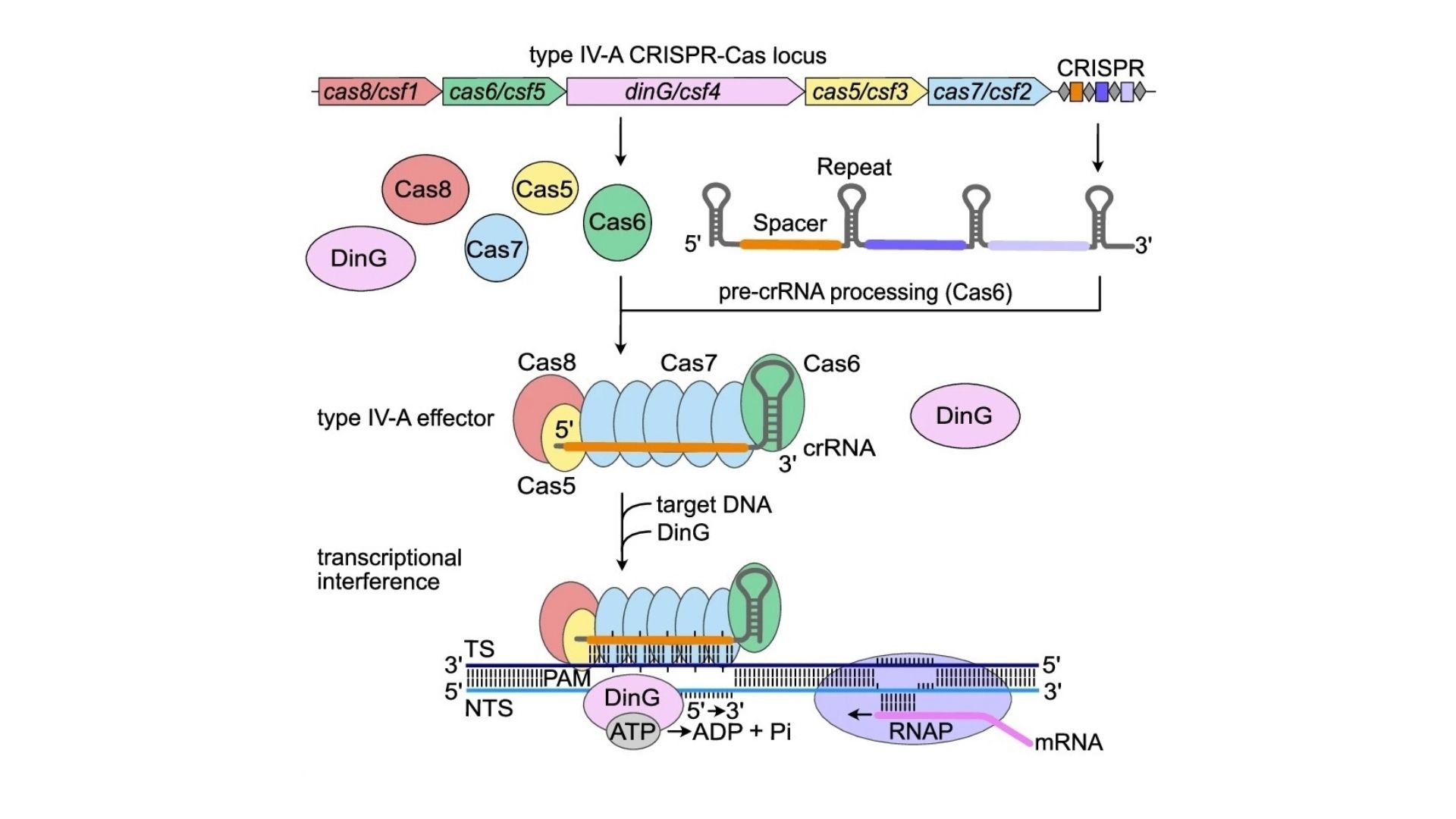
Unlike other CRISPR systems that cut DNA to disable it, Type IV-A systems work by stopping the process that converts genetic material into RNA molecules, a step required for protein creation in cells. This type of interference is especially useful in controlling genetic competition and regulating genes. Scientists focused on learning how these systems identify DNA targets and bring in a specialized protein called DinG helicase, which unwinds DNA strands to make them accessible for further processes, to carry out their tasks.
Speaking about the work, Dr. Malinauskaitė said, “Our findings reveal the detailed processes behind type IV-A CRISPR mechanisms and show how they function in unique ways. This understanding can help us develop tools to edit genetic material and regulate genes in new ways.”
Researchers used cryogenic electron microscopy, a method that freezes samples to ultra-low temperatures to capture their structures at high resolution, to map the structures of two different versions of Type IV-A systems. One version came from a bacterium called Pseudomonas oleovorans, while the other came from Klebsiella pneumoniae. The systems were found to have a shrimp-like shape, with protein components forming a backbone that holds the guiding RNA, which directs the system to specific DNA targets, and binds to the target DNA. Specific proteins called Cas8 and Cas5 play a key role in ensuring the system locks onto the correct DNA sequence. Differences in these proteins suggest each version works slightly differently, allowing them to adapt to various needs.
Another key finding was how the systems recruit DinG helicase, the protein that helps them interfere with genetic processes. One system uses a narrow interaction zone, a small area where proteins connect, to attach this protein, while the other has a broader connection involving multiple proteins. These differences suggest the systems have evolved to meet different challenges in managing DNA.
Researchers also highlighted similarities and differences between these systems and others that combine RNA and DNA. While some processes look familiar, the way these systems use DinG helicase sets them apart. This variation reflects the flexibility and adaptability of CRISPR systems over time, showcasing their evolutionary success in handling genetic material.
Experts believe this research has practical applications beyond understanding genetics. Professor Pausch noted, “The compact design of Type IV-A systems makes them ideal for creating new tools to edit genomes, especially in situations where there is limited space, such as in virus-based delivery systems.”
By the end of the study, scientists provided a clearer picture of how these systems operate, offering potential for future applications. The unique designs and mechanisms of Type IV-A systems could be used to develop advanced tools for medical and agricultural purposes. These findings are expected to shape the future of genome editing technologies and provide a new direction for researchers working in genetic engineering.
About the researchers

Professor Patrick Pausch
Professor Patrick Pausch is a prominent researcher in genome editing technologies, leading groundbreaking studies on CRISPR systems. Based at Vilnius University, his expertise lies in decoding molecular mechanisms of genetic regulation, aiming to develop advanced tools for genetic engineering.

Dr. Lina Malinauskaite
Dr. Lina Malinauskaite is a molecular biologist whose work focuses on understanding DNA-protein interactions. Her research has contributed significantly to CRISPR system innovations, with an emphasis on structural biology to unlock their potential in medical and agricultural applications.

Dr. Rafael Pinilla-Redondo
Dr. Rafael Pinilla-Redondo is a distinguished microbiologist specializing in bacterial immune systems and their applications in biotechnology. Affiliated with the University of Copenhagen, he explores the diversity and evolution of CRISPR systems to address pressing scientific challenges.

Professor Lennart Randau
Professor Lennart Randau is a molecular scientist known for his work in RNA biology and microbial defense systems. He is based at Philipps-Universität Marburg and has significantly advanced our understanding of CRISPR’s adaptive mechanisms in microorganisms, with implications for future biotechnological innovations.
Journal reference
Čepaitė R., Klein N., Mikšys A., et al. “Structural variation of types IV-A1- and IV-A3-mediated CRISPR interference.” Nature Communications (2024). DOI: https://doi.org/10.1038/s41467-024-53778-1