Struggling After COVID Heart Symptoms Fixed with Simple Targeted Therapy
Professor Mariann Gyöngyösi's team found that patients with long COVID heart problems improved in symptoms and heart scans after guideline-based anti-inflammatory and heart failure treatment, though the study had no comparison group.


Long COVID affecting the heart, officially referred to as Post-Acute Sequelae of SARS-CoV-2 Cardiovascular Syndrome, has left many struggling with lingering heart-related symptoms, including chest pain and irregular heartbeats. Researchers from the Medical University of Vienna, led by Professor Mariann Gyöngyösi, have made significant progress in addressing this issue. Their study, published in the journal Biomedicines, highlights how specific treatments guided by medical recommendations can improve both symptoms and heart abnormalities in affected patients.
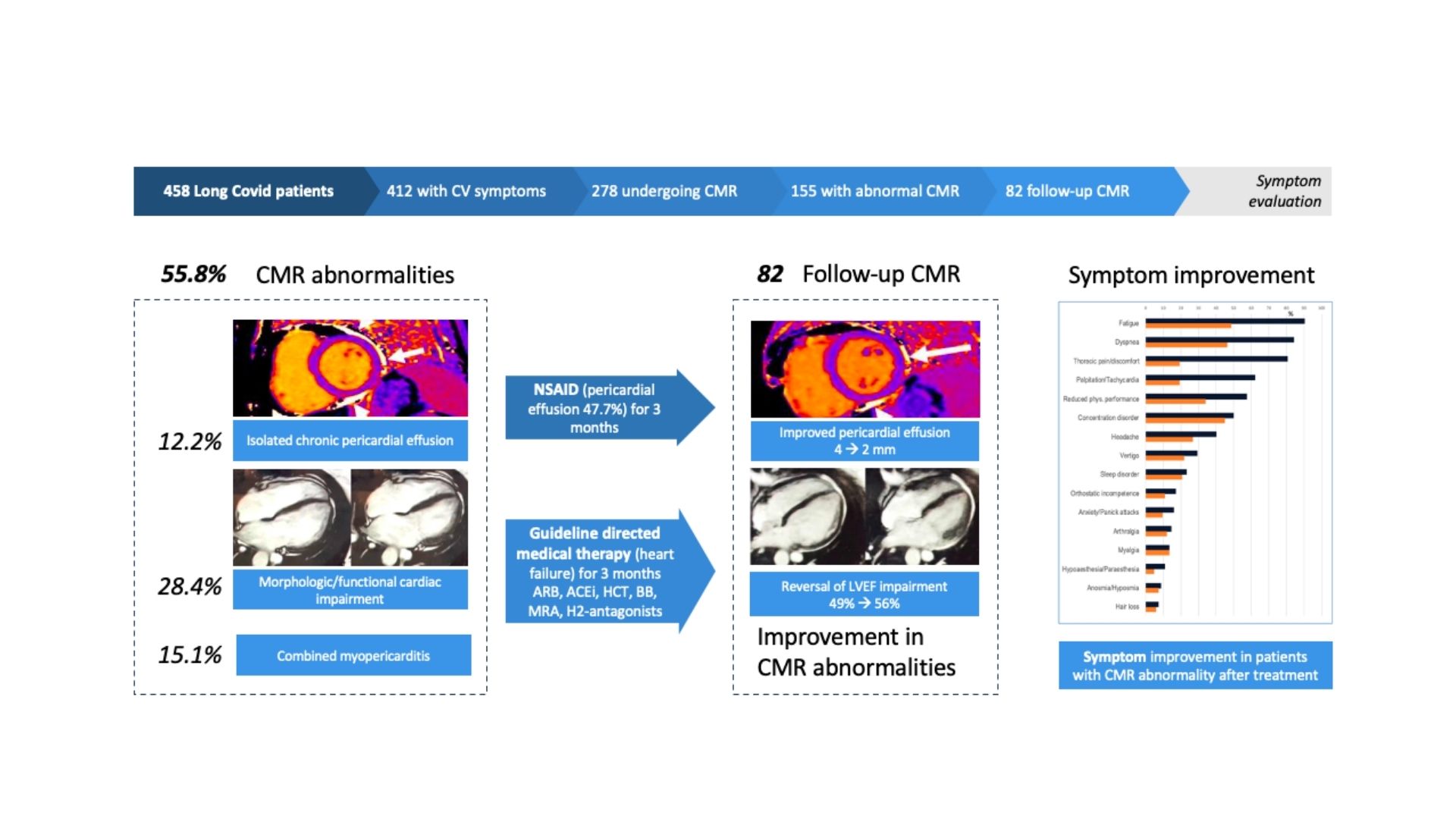
Professor Gyöngyösi’s team studied hundreds of patients who were part of the Vienna POSTCOV study between 2021 and 2023. Most patients were women in their middle years who continued to experience heart-related issues long after recovering from mild to moderate COVID-19 infections. This detailed research involved collecting medical data, performing blood tests, and using advanced heart imaging techniques called cardiac magnetic resonance imaging. This is a special type of scan that provides detailed pictures of the heart, helping doctors understand its structure and function. “We aimed to see how targeted therapy could reduce symptoms and address heart abnormalities detected in these scans,” shared Professor Gyöngyösi.
More than half of the patients showed signs of heart-related issues in these scans. These included fluid buildup around the heart, known as pericardial effusion, which is an accumulation of fluid in the sac surrounding the heart that can affect its function. There was also reduced heart function, and a condition called myopericarditis, which involves inflammation of both the heart muscle and its surrounding membrane. Many patients also reported ongoing chest discomfort and struggled with everyday physical activities.
The results of the study were encouraging. After three months of carefully planned treatments, patients showed significant improvement in both their symptoms and heart scan results. Anti-inflammatory medications, which reduce swelling and irritation, helped reduce fluid around the heart, while treatments typically used for heart failure helped restore the heart’s pumping ability to healthier levels. For instance, patients whose heart’s pumping function was initially reduced saw it return to what would be considered normal and healthy. “These findings demonstrate how consistent treatment can lead to measurable recovery,” Professor Gyöngyösi explained.
The study highlights that addressing long-term heart effects of COVID-19 requires ongoing and focused care. Importantly, the research supports earlier findings that suggest starting anti-inflammatory treatments and heart-related medications early can prevent more serious problems later. As Professor Gyöngyösi noted, “The role of well-planned treatment strategies is crucial in improving outcomes for patients with long COVID-related heart problems.”
While the findings are promising, the researchers emphasize the need for additional studies to confirm their results and refine the treatments further. They suggest that future research, including larger studies comparing treatment groups, is essential. However, the improvements in patients’ daily lives and the reductions in heart-related problems highlight the importance of targeted therapy in managing long COVID symptoms.
About the researcher

Mariann Pavone-Gyöngyösi
Mariann Pavone-Gyöngyösi completed her medical studies, PhD and successful education in internal medicine and cardiology at the Albert Szent-Györgyi Medical University, Szeged, Hungary, followed by habilitation at the Medical University of Vienna (Cardiology) in 2002. Her present position is professor at the Dept.… Cardiology, Medical University of Vienna, Austria, leader of the cardiologic Long-COVID Outpatient care, and leader of the Translational Experimental Cardiology Group. She is the founder of the PhD Course of the Medical University of Vienna “Cardiovascular Tissue Regeneration and Repair”. Since 2021, she is Honoris Doctor Causa of the Semmelweis Medical University of Budapest, Hungary. Her most important awards are Pfeiffer-Competition Austria, 1. Prize, Austrian Society of Cardiology 1. Prize, Billroth Preis of the Österreichisches Ärztekammer, Werner-Klein Translational Research Prize of the Austrian Society of Cardiology, Best Manuscript Award of the journal Circulation Research and Paul Dudley Award of the American Heart Association. Most important grants are LifeValve, Fibro-targets, Science, ReGenHeart, CresPace EU projects, numerous unrestricted research grants and contracts for experimental invasive cardiology projects. Her research and clinical interests involve ischemic heart disease, interventional cardiology, cell- and gene-based therapy, heart failure, cardiotoxicity. She has developed several experimental models, such as “In vitro bioluminescence imaging. Gyöngyösi et al. JACC: Cardiovasc Imaging 2010”, “Porcine model of progressive cardiac hypertrophy and fibrosis with secondary postcapillary pulmonary hypertension. Gyöngyösi et al. J Transl Med. 2017, “3D display of the gene expression profile and sequential activation of different pathway networks in ischemia-affected and non-affected myocardium, inducing intrinsic remote conditioning. Pavo et al. Sci Rep 2017 (corresponding author)”, “NOGA-Guided Analysis Of Regional Myocardial Perfusion Abnormalities with custom-made software. Gyöngyösi et al. Circulation 2005”.
Journal reference
Gyöngyösi M., Hasimbegovic E., Han E., Zlabinger K., Spannbauer A., Riesenhuber M., et al. “Improvement of Symptoms and Cardiac Magnetic Resonance Abnormalities in Patients with Post-Acute Sequelae of SARS-CoV-2 Cardiovascular Syndrome (PASC-CVS) after Guideline-Oriented Therapy.” Biomedicines. 2023;11(12):3312. DOI: https://doi.org/10.3390/biomedicines11123312