This natural frog remedy may revolutionize skin protection from radiation
Professor Shuyu Zhang's team found that a peptide from dark-spotted frog skin protected skin cells and mice from radiation injury by damping an inflammation pathway, speeding wound healing.


Something remarkable in radioprotective treatments comes from an unlikely source—frog skin. Researchers led by Professor Shuyu Zhang from Sichuan University, Professor Jie Zhang from Fourth Military Medical University, Professor Jianping Cao from Soochow University and colleagues have identified a substance derived from the skin of frogs that offers substantial protection against radiation-induced skin injuries. This innovative work, published in Advanced Science, highlights the potential of nature-inspired solutions in addressing critical medical challenges.
Exposure to radiation poses an ongoing threat in both medical treatments, such as cancer radiotherapy, and environmental disasters. The skin, being the body’s largest organ and the first line of defense, often takes the most damage from radiation. However, effective treatments to manage such injuries remain limited. “The need for new and effective treatments for radiation-induced skin injury is critical,” said lead researcher Professor Shuyu Zhang.
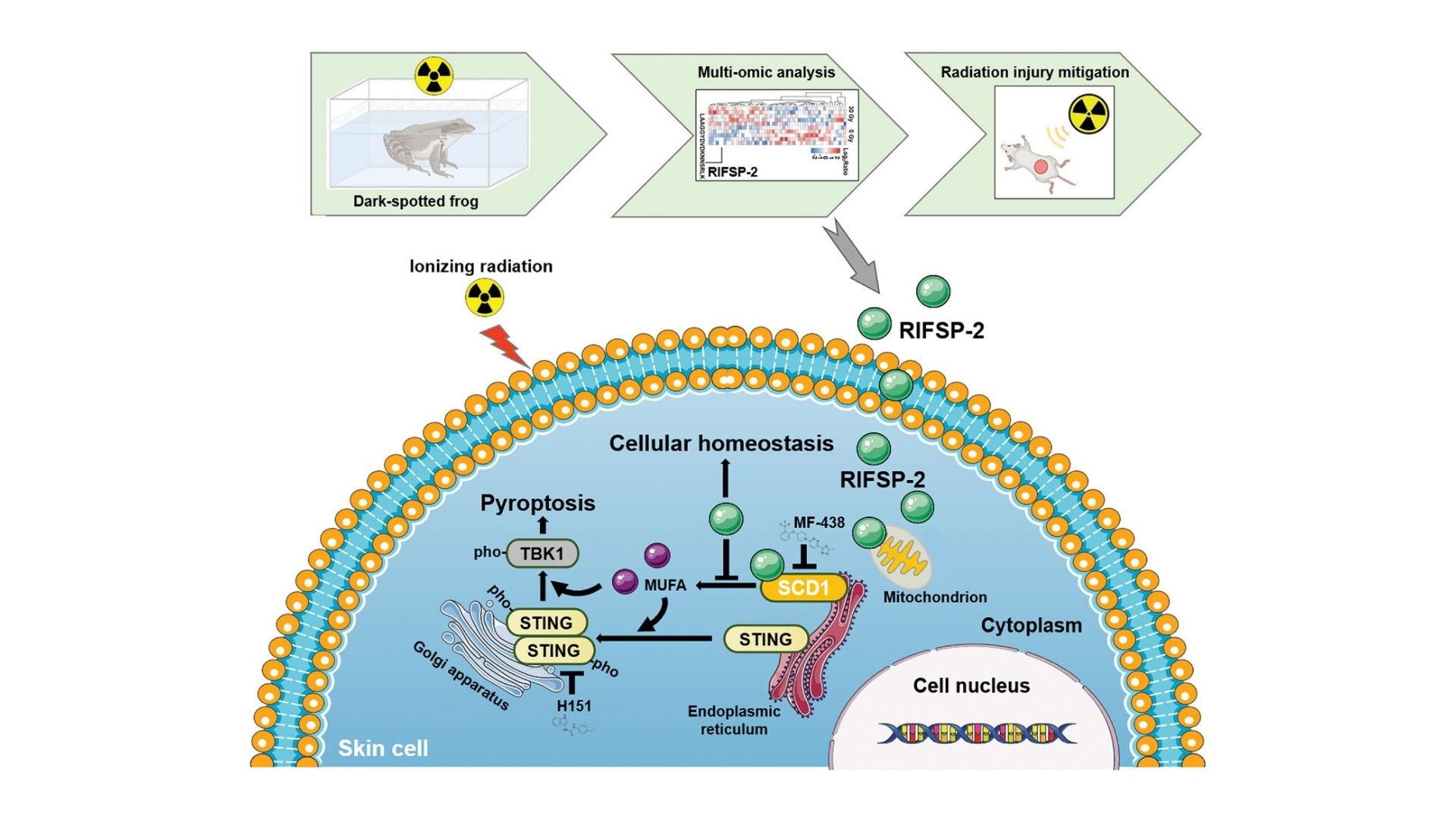
Scientists made this notable discovery by studying the skin of the dark-spotted frog (Pelophylax nigromaculatus), which has shown a natural resistance to radiation. Through advanced scientific methods, they identified several small protein fragments, also called peptides, that were significantly altered by radiation. Among these, one fragment, named Radiation-Induced Frog Skin Peptide-2, demonstrated exceptional protective qualities. This substance helps maintain the balance within cells and reduces a specific type of cell death caused by inflammation, which often worsens after radiation exposure.
Further testing revealed how Radiation-Induced Frog Skin Peptide-2 works. It targets an enzyme called stearyl-coenzyme A desaturase 1, which plays a key role in producing fatty acids, the building blocks for cell membranes and energy storage. By interfering with this enzyme, the peptide reduced the production of certain fatty acids. This, in turn, prevented the activation of a pathway responsible for triggering inflammation after radiation. “This pathway, known as the stimulator of interferon genes pathway, is critical in how cells respond to stress caused by radiation,” explained Professor Zhang. “By influencing this process, the peptide helps protect the skin from further damage.”
Studies on skin cells and animal models showed that the peptide speeds up wound healing while preserving the energy centers of cells, called mitochondria, and their structural support. Mice treated with the peptide recovered faster from radiation-induced skin ulcers compared to those that did not receive the treatment. Importantly, the peptide was also shown to be safe, making it a promising candidate for future medical use.
Stress-induced peptides like this one highlight the broader potential of substances produced by amphibians. “Living organisms have developed unique ways to survive harsh conditions. These peptides represent a valuable source of new medical treatments,” emphasized Professor Zhang.
Research is ongoing to improve how the peptide can be delivered and to study its long-term effects, but this discovery marks an important step in protecting skin from radiation damage. The scientists see applications for this treatment not only in medical procedures but also in emergency scenarios involving nuclear exposure. As researchers continue to explore nature’s resilience, this frog-derived peptide offers exciting possibilities for creating therapies that protect and heal.
About the researchers

Shuyu Zhang
Shuyu Zhang, Professor, Chief Scientist of Key Laboratory of Medical Translation of Nuclear Technology, National Health Commission. He has long been engaged in research on tumor radiosensitivity mechanisms and nuclear radiation damage prevention and treatment strategies. He has published more than 150 papers, with more than 80 papers as first author or corresponding author.… He has published (co-)corresponding author papers in Cell Mol Immunol, Adv Sci (cover story), Exp Mol Med, Int J Radiat Oncol Biol Phys (Red J), J Eur Acad Dermatol Venereol, J Invest Dermatol, J Exp Clin Cancer Res, Cancer Commu (cover story), Environment Int, Free Radical Biol & Med and Radiat Res, among others. He has edited 3 monographs; led the formulation of 1 group standard; obtained 26 Chinese invention patents and 3 U.S. invention patents, and some of the patent achievements have been transformed. He has revealed novel mechanisms of radiation damage such as tetrahydrobiopterin metabolism, zinc homeostasis and adipocyte-mediated radioprotection. Some of his achievements have been clinically translated.

Fenghao Geng
Fenghao Geng: A young scientist studying the mechanism of radiation induced skin injury (RISI) and the prevention strategies at the Department of Radiation Medicine, Sichuan University.… Once, being an attending physician in radiation oncology, he was shocked by the suffering of patients in the course of radiotherapy, which fuelled his interest in further research in mitigating the side effects. The urgent need for developing effective medical treatment led to his current project focusing on investigation of the mastermind in RISI. He is moving to clinical practice where he will continue the in-depth basic research and potent clinical transformation research of radiation prevention.
Journal reference
Fenghao Geng, Li Zhong, Tingyi Yang, Jianhui Chen, Ping Yang, et al. “A Frog Skin‐Derived Peptide Targeting Stearyl-Coenzyme A Desaturase 1 Exerts Radioprotective Effects Against Skin Injury by Inhibiting Stimulator of Interferon Genes‐Mediated Inflammation.” Advanced Science, 2024. DOI: https://doi.org/10.1002/advs.202306253