Gene expression in brain cells studied with high resolution
Dr. Xiaokuang Ma and colleagues describe a protocol for preparing fixed frozen mouse brain sections for Xenium spatial transcriptomics, mapping gene activity in individual cells with less tissue damage.


Understanding how genes are activated or suppressed in different cells under physiological or pathological conditions of the brain is essential for studying brain disorders and how the brain functions. A team of researchers led by Dr. Xiaokuang Ma, Dr. Zhiyu Dai, and Dr. Shenfeng Qiu from the University of Arizona College of Medicine-Phoenix and Washington University School of Medicine has developed a new method to improve the way scientists study gene activity in the brain through high resolution mapping of gene expression in specific cell types. Their work, published in STAR Protocols, presents a refined approach in fixed frozen mouse brain samples that enhances the accuracy and efficiency of spatial transcriptomics—mapping where and how genes are expressed within the brain at the cellular level.
Dr. Ma, Dr. Dai and Professor Qiu developed a step-by-step method for preparing and mounting fixed frozen brain tissue onto Xenium slides, a specialized tool for studying gene activity in precise locations. The process includes preserving the brain in a typical way most neuroscientists use for immunofluorescence, cryosectioning it into thin slices (10 μm thickness), and carefully placing them on the slides for imaging, which means capturing high-resolution pictures of the tissue to analyze gene abundance. According to Dr. Ma, “Fixed frozen sections with floating mounting allow for better sample preparation and usage of the imaging area,” meaning that their approach preserves mRNA integrity while making the best use of the available imaging space. Unlike conventional methods that use either fresh frozen or formalin-fixed paraffin-embedded (FFPE) tissues, this new technique helps maintain the integrity of mRNA, which carries instructions for the body’s functions, while improving the quality of imaging.
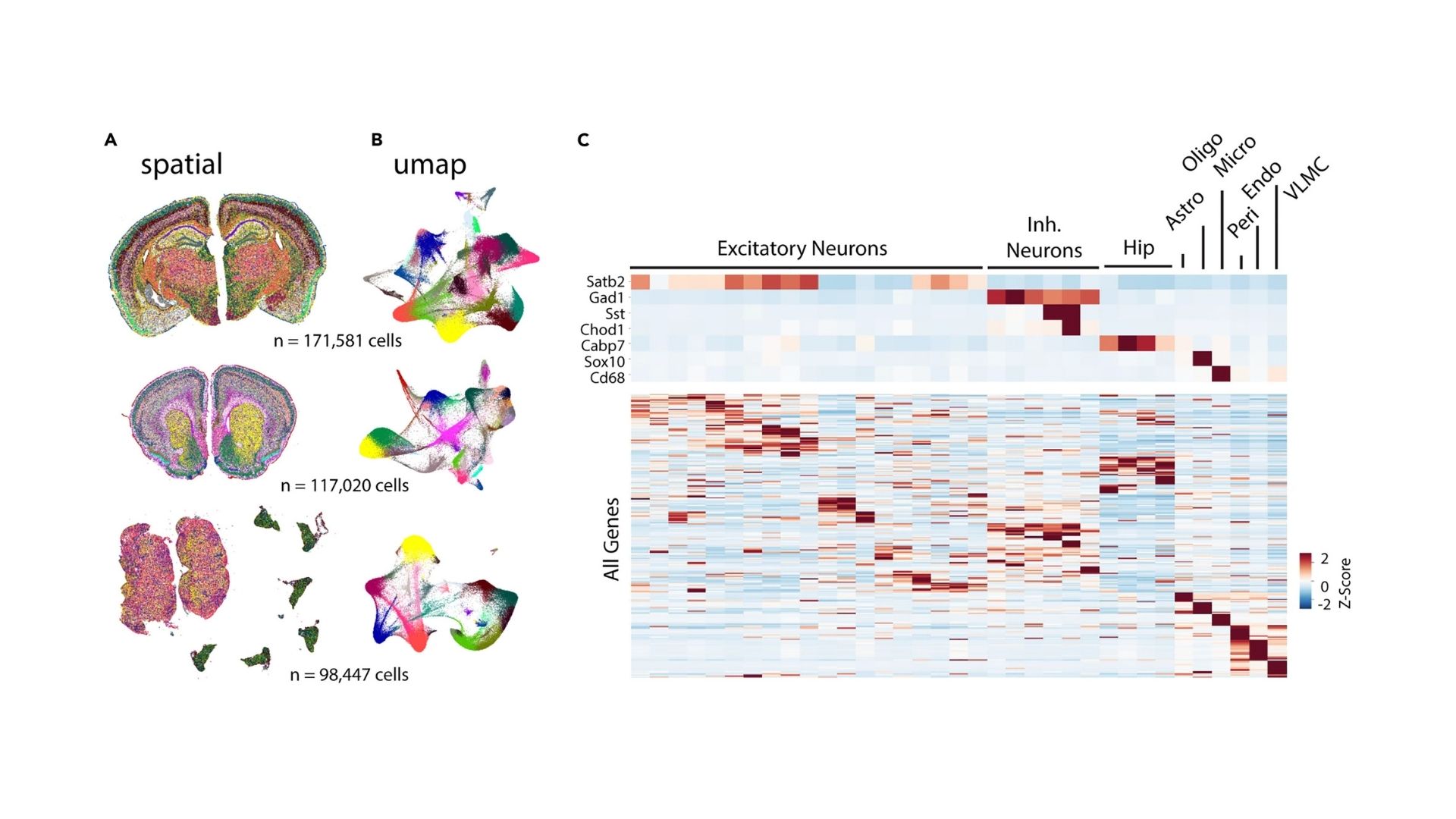
Using this optimized method, the researchers achieved highly detailed images that accurately display gene expression in the different brain regions. By employing precise slicing and free-floating mounting techniques, the team achieved clear and reliable images of gene activity at the level of individual cells, the basic building blocks of the body. This improvement is especially useful for brain research, as understanding where genes are active can help scientists study brain diseases and how the brain develops. The ability to analyze gene activity in specific brain regions can provide critical insights into neurodevelopmental disorders, neurodegenerative diseases, and brain injury mechanisms.
Dr. Ma, Dr. Dai and Professor Qiu also pointed out several advantages of their technique compared to older methods. Their approach reduces issues like tissue folding, which can distort images, prevents damage to genetic material, and makes imaging more efficient. “This method ensures optimal data collection while reducing costs and improving reproducibility,” Professor Qiu explained. Reproducibility means that the results can be consistently repeated by other researchers, making the findings more reliable. By enhancing spatial transcriptomics, their work could lead to more reliable research on gene activity in different areas of the brain, helping scientists make new discoveries about neurological conditions, which are disorders that affect the brain and nervous system.
This improved method is a significant step forward for researchers studying gene expression in the brain. Maintaining mRNA integrity and improving imaging makes it a valuable tool for neuroscience, the study of the nervous system, and other areas of biomedical research. As scientists continue to refine these techniques, methods like this will be essential for advancing our understanding of the brain’s intricate functions.
About the researchers

Dr. Xiaokuang Ma, Ph.D.
Dr. Xiaokuang Ma, Ph.D., is a Researcher/Scientist III at The University of Arizona College of Medicine-Phoenix. He obtained his Doctor of Medicine degree in Pharmacology from a joint PhD training program between Shantou University Medical College and The University of Arizona College of Medicine-Phoenix in 2020.… His research focuses on the role of microglia in the processes of developmental cortical synapse pruning, maturation, functional connectivity, and critical period plasticity. He aims to understand how MET signaling influences the development of synaptic connectivity and plasticity, which are essential functions of forebrain circuits with implications for autism-related brain pathophysiology. His future research involves how the brain developmental and brain circuits influence neurodevelopmental disorders and neuropsychiatric disorders, such as Autism Spectrum Disorders and Alzheimer’s Disease.

Dr. Zhiyu Dai, Ph.D.
Dr. Zhiyu Dai, Ph.D., is a Tenure Associate Professor of Medicine at Washington University School of Medicine in St Louis. He received his B.S. from Shandong University and Ph.D. in Biochemistry and Molecular Biology from Zhongshan School of Medicine, Sun Yat-sen University, China in 2013. Dr.… Dai completed his postdoctoral training in lung vascular biology at the University of Illinois at Chicago. Dr. Dai’s lab aims to understand lung vascular homeostasis and the pathogenesis of pulmonary diseases using novel animal models, integrated pharmacological approaches, genome editing and single-cell RNA-sequencing, and spatial transcriptomics. In addition, he investigates the delineation of the molecular and cellular mechanisms of right heart failure in patients with pulmonary arterial hypertension and identification of therapeutic targets for the treatment of pulmonary vascular disease patients.

Dr. Shenfeng Qiu, M.D. Ph.D.
Dr. Shenfeng Qiu, M.D. Ph.D., is a Tenure Professor at The University of Arizona College of Medicine-Phoenix. He earned his M.D. from Nanjing Medical University in 1994 and his Ph.D. in Environmental Toxicology and Neuroscience from the University of California in 2004. The overall interest of Dr.… Shenfeng Qiu's laboratory is to understand the developmental origin of neurodevelopmental and neuropsychiatric disorders, particularly autism spectrum disorders. One ongoing project focuses on the role of MET tyrosine kinase, identified as a major risk factor for ASD in human genetic studies. His lab aims to identify mechanisms by which MET signaling affects neuronal growth, maturation, and brain circuit function. His lab is also interested in the role of UBE3A protein in Angelman syndrome, and distinct brain circuit mechanisms mediating anxiety and depression.
Journal reference
Ma X., Chen P., Wei J., Zhang J., Chen C., Zhao H., Ferguson D., McGee A.W., Dai Z., Qiu S. “Protocol for Xenium spatial transcriptomics studies using fixed frozen mouse brain sections.” STAR Protocols, 2024. DOI: https://doi.org/10.1016/j.xpro.2024.103420