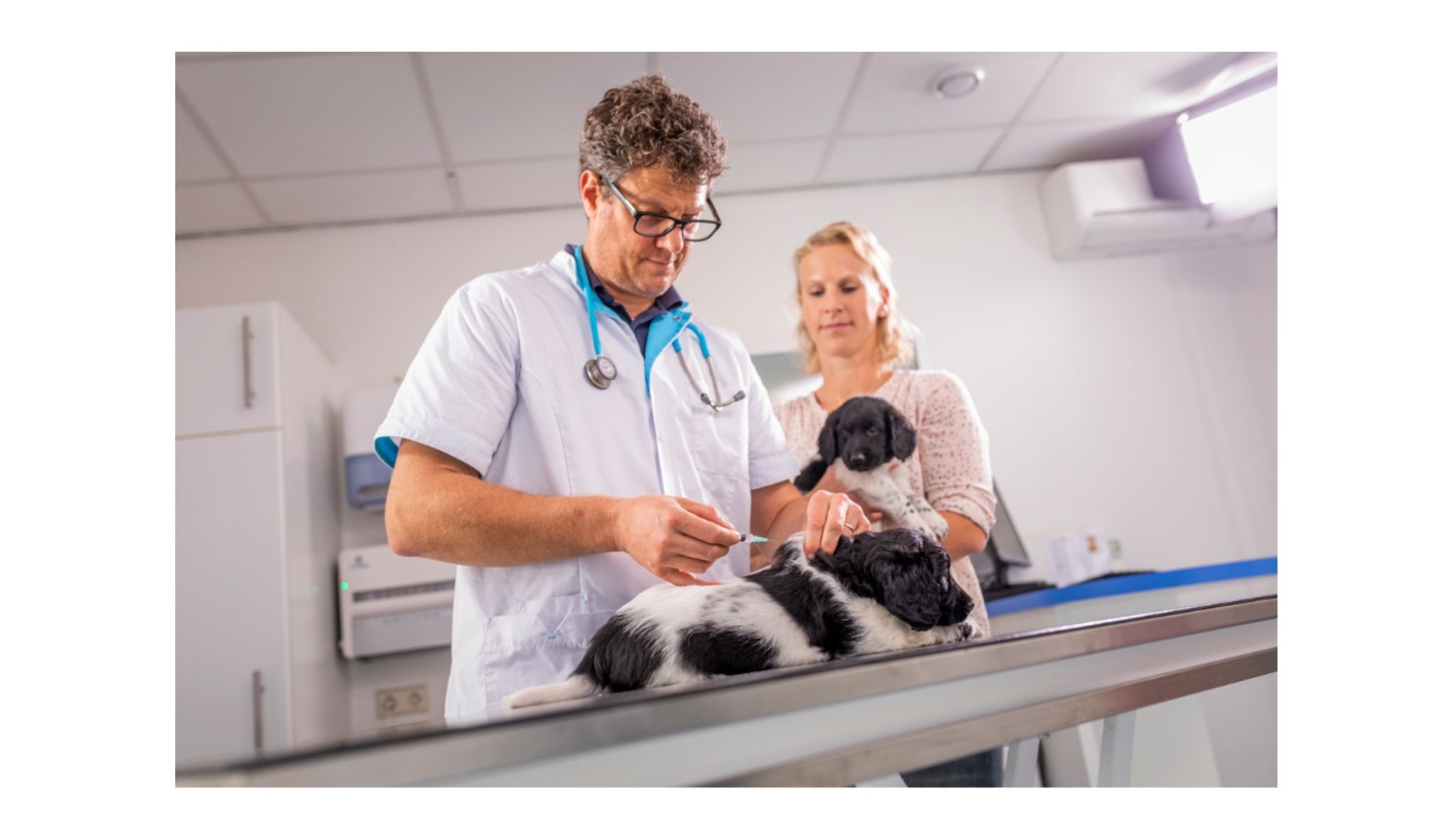
This Puppy Vaccine Succeeded When the Others Fell Short
Using a design that pairs each vaccinated puppy with an unvaccinated companion, Dr. Jacqueline Pearce's team found parvovirus vaccines differed in overcoming maternal antibody, with every Nobivac DP PLUS puppy responding.


Understanding how best to protect young dogs from canine parvovirus, a highly contagious virus that causes severe gastrointestinal illness and even death, remains a central focus in veterinary medicine. Early in life, puppies rely on maternally derived antibody, a temporary form of immunity passed from the mother that helps shield them until their own immune system matures but can prevent vaccines from working. This inherited protection is essential, yet it is difficult to know how long it will last. Different puppies (even from the same litter) can receive different amounts of maternal antibody from their mother, meaning that the duration of protection varies in different individuals. This makes it difficult to determine the ideal moment for vaccination to take effect. At the same time, environments where multiple puppies interact may contain released vaccine virus (live weakened virus that leaves the body after vaccination) that can be unknowingly taken up by another puppy. These overlapping factors — different levels of declining maternal immunity, varying timing of vulnerability, and exposure to released virus — shape how effectively young puppies begin building their own immune defences.
Until now, studies measuring the ability of vaccines to overcome maternal antibody ignored the possible effects of environmental vaccine virus which can exaggerate the true effectiveness of vaccination. To address this Dr. Jacqueline Pearce, Ellen Versmissen, Dr. David Sutton, Dr. Qi Cao and Dr. Ian Tarpey from MSD Animal Health investigated this issue by proposing and testing a refined design that pairs a vaccinated puppy with a non-vaccinated sentinel, a companion puppy used to detect virus transmission under strict biocontainment (a controlled environment preventing movement of infectious agents). Their research, published in the journal Vaccines, evaluates how four widely used canine parvovirus vaccines perform in the presence of maternal antibody. Dr. Pearce explained that grouping puppies into pairs in this way and keeping each pair separated from others avoids unintentional environmental transmission of vaccine virus to other vaccinated puppies that can blur the distinction between true vaccine response and later exposure. This mimics the home environment that a puppy being brought to the veterinary clinic for its first vaccinations would be living in. Using this new design they aimed to more accurately determine which vaccines could successfully replicate and stimulate immunity during this sensitive time.
The researchers found that for three of the vaccines, puppies with lower levels of maternal antibodies were able to form an immune response, but puppies with higher levels of maternal antibodies could not. This illustrates that the level of maternal antibodies and differences in the vaccines used play important roles in how puppies respond to vaccination. Those puppies with higher levels who did not mount an immune response to vaccination became vulnerable over time.
This distinction is central to understanding why some pups respond to vaccination and others do not.
A fourth vaccine stood out from the others. As Dr. Pearce noted: “All the pups vaccinated with Nobivac® DP PLUS seroconverted, with significantly higher antibody titres compared to the pups in other vaccine groups”. Seroconversion refers to the point when the immune system begins producing detectable antibodies, signalling a successful response and protection against disease. This observation highlights the extent to which vaccine strains vary in their ability to overcome maternal antibody. Furthermore, as Dr. Pearce emphasised, “Different canine parvovirus vaccines differ in their ability to replicate in and immunise puppies with maternally derived antibody, the levels of which may vary widely between individuals.” These statements underline the importance of selecting vaccines capable of performing consistently no matter what the immunological conditions.
The most notable findings show that group housing can unintentionally inflate perceived vaccine effectiveness. When live attenuated virus, a weakened form of the virus used for vaccination, from vaccinated puppies circulates in shared environments, non-responders may appear protected due to later oral exposure rather than vaccination itself. By eliminating this confounding factor, the researchers show more clearly which vaccines genuinely stimulate immunity in the face of maternally derived antibody. This more precise approach provides a better reflection of how a single puppy in a household setting will respond when brought in for routine early-life vaccination.
In conclusion, Dr. Pearce and her team emphasise that early-life immune protection is influenced both by the amount of maternal antibody and by each vaccine’s ability to replicate despite that interference. This improved study design, together with the clear differences observed among available vaccine options, offers valuable guidance for practitioners and developers working to optimise protection for young puppies. A more precise understanding of these dynamics helps practitioners to ensure that puppies receive the most effective early-life immunisation against canine parvovirus, one of the most persistent and widely distributed viral threats affecting young animals.
About the researchers

Dr. Jacqueline Pearce
Dr. Jacqueline Pearce is the director of the Companion Animal R&D team at MSD Animal Health in Europe. She holds a PhD in viral oncology from Imperial College London and a BSc/MSc in microbiology and virology from Warwick University.… She is a research leader with nearly 20 years experience in veterinary vaccine development across different species and indications, with a specialism in canine parvovirus. Throughout her career, Dr. Pearce has been driven by a commitment to advancing innovative, high-quality vaccines that protect the health and wellbeing of companion animals. She is particularly passionate about translating scientific insights into practical, effective solutions that prevent disease, reduce animal suffering, and support the bond between pets and their owners.

Ellen Versmissen
Ellen Versmissen is a Senior Scientist in the Companion Animals R&D team at MSD Animal Health in the Netherlands. She graduated cum laude as a Bachelor of Applied Science from Fontys University Eindhoven in 2013. During her studies, she conducted award‑winning research on Lyme disease in dogs and bacterial surface display.… She also gained additional experience in chemical analyses for veterinary pharmaceutical products and played a key role in studying immune responses in dogs treated with a second‑generation JAK1 inhibitor for atopic dermatitis. Currently, she contributes to the development and registration of novel and improved dog vaccines. Looking ahead, she is committed to advancing veterinary health through rigorous science and translational research. Her analytical mindset and fascination for biology continue to shape her work.

Dr. Qi Cao
Dr. Qi Cao is Associate Director in Biostatistics at MSD Animal Health since April 2019 with over 20 years of experience in applied statistics and biostatistics and 15 years in (human and veterinary) epidemiology and health economics.… Qi holds a BSc in Mathematical Statistics (Renmin University of China), an MSc in Applied Statistics (Dalarna University, Sweden), and a PhD in Epidemiology and Health Economics (University of Groningen, The Netherlands). Qi has published more than 25 articles in the above-mentioned fields and frequently serves as a scientific reviewer for leading journals in these fields. His work mainly focuses on support analyzing pre-clinical/clinical animal trial data targeting better animal health and support designing experiment for biological assay validation from statistical point-of-view.

David Sutton
David Sutton is a Veterinary Surgeon who studied and qualified from the Royal Veterinary College, University of London, UK. He initially worked in private practice but has latterly spent most of his time employed in various technical roles in the Veterinary Pharmaceutical Industry.… Most recently he was employed as the Global Technical Director responsible for small animal vaccines at MSD Animal Health. He has been involved in the development and launch of several unique vaccines such as the first combined myxomatosis and haemorrhagic disease vaccine for rabbits, the first European tetravalent canine leptospirosis vaccine, the first recombinant canine parvovirus vaccine capable of reliably immunising very young puppies with high maternal antibody.David is a recognised industry expert on small animal vaccines; he has lectured widely at an international level and has organised and chaired many highly successful symposia and round table meetings on various infectious disease and vaccination-related topics.David has recently retired from his role as Global Technical Director and now provides part-time consultancy services to MSD Animal Health in the field of small animal vaccines.
Journal reference
Pearce J., Versmissen E., Sutton D., Cao Q., Tarpey I. “Assessing Canine Parvovirus Vaccine Performance in Puppies with Maternally Derived Antibody: An Improved Study Design.” Vaccines, 2025. DOI: https://doi.org/10.3390/vaccines13080832