Exploring the Molecular Maze of TDP-43 in Neurodegenerative Conditions
Dr. Bing Yao's team found that chronic loss of TDP-43 disturbs the interplay between R-loops and 5hmC, unsettling gene activity and transposable elements in ways that may contribute to neurodegeneration.


Within the intricate journey to decode brain mysteries, TDP-43 emerges as a pivotal figure, navigating the cellular landscape’s inner workings. Known for its critical role in managing RNA messages within the cell and maintaining the stability of our genetic material, TDP-43’s failure is closely linked to the mysterious emergence of neurological conditions like ALS and dementia. When TDP-43 stumbles, it triggers a domino effect of malfunctions—from misguided stress responses in cells to energy-producing units in distress and errors in genetic messaging, setting the stage for the gradual loss of neuron function. The tale of TDP-43 is not merely one of decline but offers a glimpse into the fine equilibrium that upholds brain health. As scientists delve into this terrain, they uncover molecular markers—R-loops and 5hmC—that, when misdirected by the absence of TDP-43, shed light on potential paths to neurodegeneration, unveiling a complex network of interactions that maintain our cognitive vitality.
A team from Emory University, led by Dr. Bing Yao and including Dr. Yingzi Hou, Dr. Yangping Li, Dr. Jian-Feng Xiang, Kedamawit Tilahun, Dr. Jie Jiang, and Professor Victor Corces, has taken a significant step toward demystifying the complex nature of neurodegenerative diseases by revealing the critical role of TDP-43. This protein, which is involved in managing genetic information within the cell, has been previously associated with brain disorders such as Alzheimer’s disease and ALS.
TDP-43 plays a vital role in the cell, helping to manage and protect genetic information and participating in the process of converting genetic material into functional cell components. Its accumulation outside the nucleus of the cell has been implicated in several diseases of the brain, contributing to cell dysfunction and death.
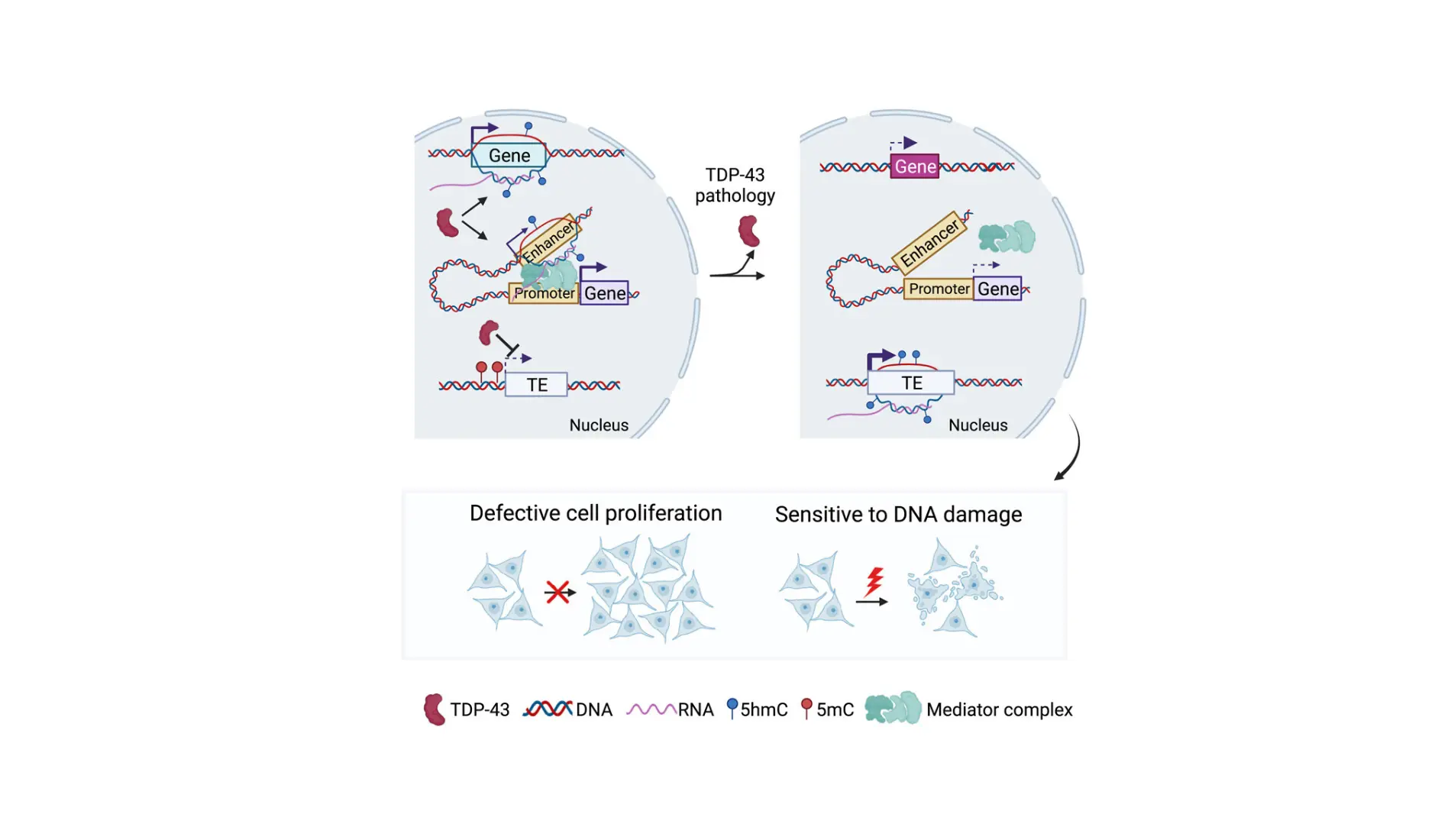
Dr. Bing Yao highlighted the significant impact of TDP-43 on cell health, noting, “TDP-43’s chronic deficiency influences gene behavior both nearby and at a distance by altering the interaction between R-loops and 5hmC in the genetic material and the communication between enhancers and promoters.” This intricate balance, when disturbed, leads to notable changes in cell behavior that could contribute to the development of brain diseases.
The team meticulously showed how the prolonged absence of TDP-43 leads to widespread disruptions across the cell’s genetic landscape. By influencing the balance between R-loops, structures formed during the reading of genetic information that can affect gene regulation, and 5hmC, a modification of the genetic code involved in activating gene expression, TDP-43 deficiency disrupts normal cell functions. This disturbance extends to enhancers, which are crucial for controlling the expression of genes over long distances, thereby affecting genes responsible for cell growth and the response to genetic damage.
A key discovery was the activation of transposable element (TE) families related to neurodegeneration due to the changed balance of R-loops and 5hmC at TE genomic loci. These elements, which constitute a significant part of the human genome, have the capacity to move within the genetic material, and their activation is a sign of genetic instability, often linked with disease states.
Dr. Yao further emphasized the wider implications of their findings, stating, “Our data offer a comprehensive view of the diverse roles of TDP-43 in maintaining the balance of R-loops and 5hmC to ensure accurate transcription and preserve important long-range genetic interactions.” This in-depth insight into the role of TDP-43 underscores its potential as a crucial factor in the onset of neurodegenerative diseases. The implications of this research are profound, providing a new perspective on the molecular origins of neurodegenerative disorders. By clarifying the role of TDP-43 in gene and TE regulation, this study lays the groundwork for future research into targeted treatment strategies that could lessen the impact of TDP-43 dysfunction, potentially offering hope to those affected by these challenging conditions.
About the researchers

Bing Yao Bing Yao, Ph.D.
Bing Yao Bing Yao, Ph.D. I am an Associate Professor of Human Genetics and my long-term research interests are to understand the pivotal roles of epigenetic regulation in mammalian neurodevelopment, as well as how dysregulation of these processes may contribute to neural pathology.… I have a broad background in genetics, epigenetics, cell biology, biochemistry, molecular biology, and bioinformatics using multiple model systems. Since opening my lab in the fall of 2017, I set up a multifaceted research program tackling fundamental questions at different layers of neuroepigenetics. The ongoing projects in my lab include i) canonical epigenetic mechanisms such as DNA modifications, ii) a novel DNA:RNA hybrid structure termed "R-loops," and iii) a unique class of regulatory RNAs with circularized structures termed circRNAs, which are considered as "epigenetic regulators" in a broad sense. We aim to elucidate their coordinative functions in neurodevelopment and how dysregulation of these processes may contribute to brain diseases such as Alzheimer's Disease (AD). Our work integrates multiple approaches, including genome-wide high-throughput epigenomic and transcriptomic analysis, CRISPR-Cas9 gene editing and engineering, and cellular and molecular biology. We are moving to include next-generation long-read sequencing, single-cell epigenomics and spatial transcriptomic techniques to enhance the resolution of our study. We already established various disease mouse models, obtained human postmortem brains, and developed human iPSC-derived 2D neurons and 3D mini-brain organoids to study these mechanisms in vitro and in vivo.

Yingzi Hou, Ph.D.
Yingzi Hou, Ph.D. I joined Dr. Bing Yao’s lab as a postdoc. I am excited to learn more about epigenetic mechanisms in brain development and brain disorders and I am working on the role of R-loops in the nervous system and associated diseases.

Yangping Li, Ph.D.
Yangping Li, Ph.D. I joined Dr. Bing Yao’s lab as a postdoctoral fellow. I’m very interested in using integrated computational analysis to better understand the epigenetics mechanisms that underlying mammalian brain development and neurodegenerative disorders.
Journal reference
Yingzi Hou, Yangping Li, Jian-Feng Xiang, Kedamawit Tilahun, Jie Jiang, Victor G. Corces, Bing Yao, “TDP-43 chronic deficiency leads to dysregulation of transposable elements and gene expression by affecting R-loop and 5hmC crosstalk.” Cell Reports, January 23, 2024. DOI: https://doi.org/10.1016/j.celrep.2023.113662