New RNA Tool Could Offer Opportunities on How We Tackle Deadly Illnesses
Dr. Gang Chen's team designed dual-affinity peptide nucleic acids that bind where paired and unpaired RNA regions meet, letting them block microRNA processing and boost ribosomal frameshifting.


Scientists led by Dr. Gang Chen from The Chinese University of Hong Kong, Shenzhen (CUHK-Shenzhen) have introduced a new approach to identify and interact with specific RNA structures. Their study, featured in Cell Reports Physical Science, explains how specially designed molecules called dual-affinity peptide nucleic acids can simultaneously attach to double-stranded RNA regions, which are sections of RNA where two strands are paired together, and single-stranded RNA regions, where the RNA remains unpaired, at their junctions.
RNA, an essential molecule in living organisms, helps carry out various functions, including regulating genes and producing proteins. Its complex folded shapes, known as secondary structures, make it difficult to target specific areas. Previous methods, such as synthetic molecules called antisense oligonucleotides, which bind to specific RNA sequences to block their function, and similar compounds, only worked on single-stranded or loosely paired double-stranded RNA regions, leaving many other important structures untouchable. Dual-affinity peptide nucleic acids overcome this limitation by combining two types of targeting mechanisms. One type is designed for flexible single-stranded RNA, while the other is built to attach to rigid double-stranded regions. Together, they can tightly bind to areas where these two regions meet, enabling a new way of studying and manipulating RNA.
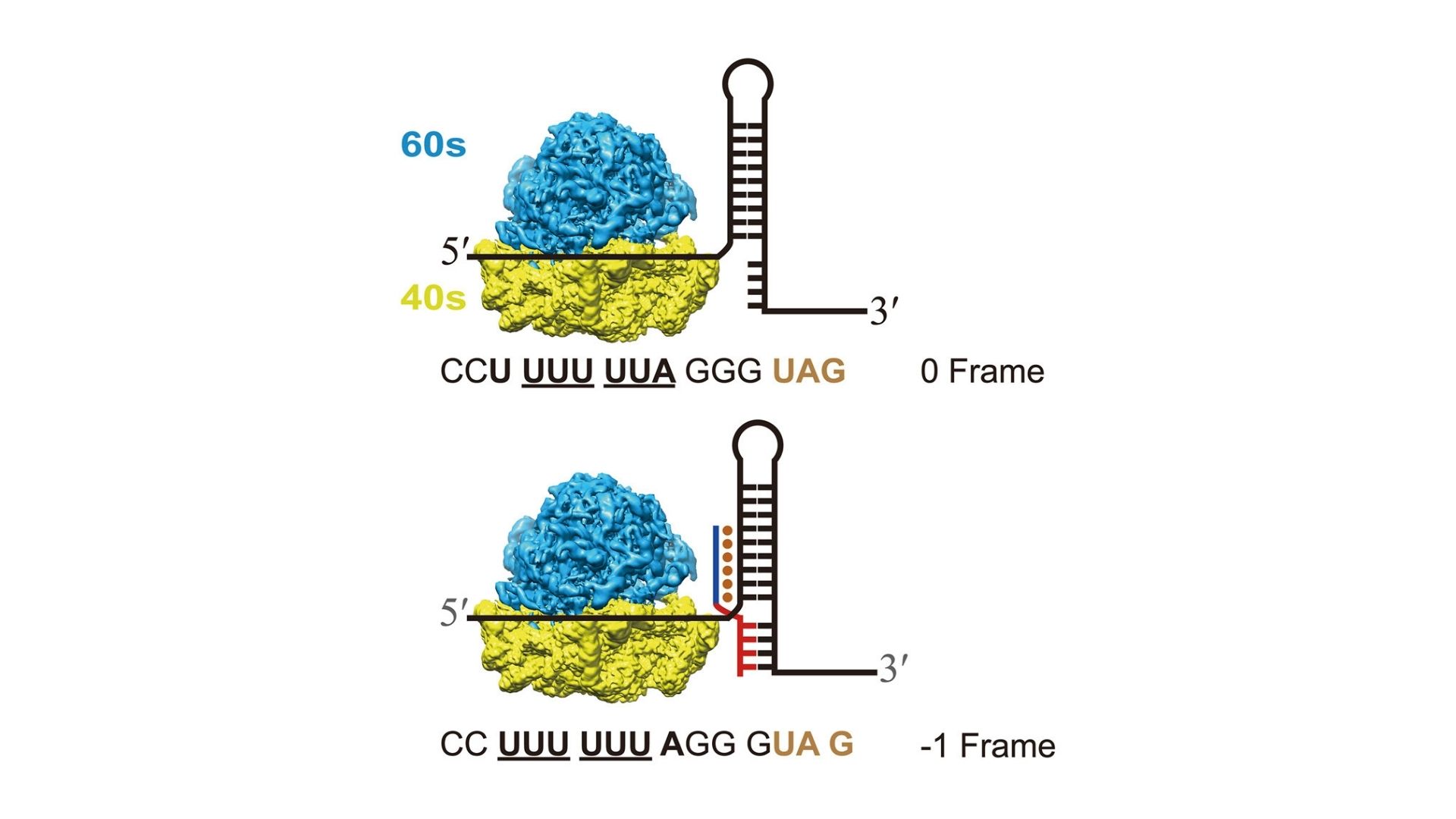
Experts tested these molecules on different types of RNA, such as hairpin-shaped RNA, which forms a loop-like structure, precursor microRNAs, the immature forms of microRNAs before they become active, and messenger RNA, a molecule that carries genetic instructions for making proteins. The experiments demonstrated their versatility. For instance, they showed that a specific dual-affinity peptide nucleic acid could block the activity of the Dicer enzyme, which cuts precursor microRNAs into their mature forms. This capability could open the door to regulating microRNA levels in cells. In another experiment, these molecules increased the efficiency of a process called ribosomal frameshifting, a mechanism some viruses, including SARS-CoV-2 and HIV-1, use to shift the genetic reading frame to produce essential proteins. By targeting structured regions in messenger RNA, the researchers highlighted the potential applications of this innovative technology.
Dr. Chen explained, “By combining two types of synthetic molecules, we have achieved a new level of precision and programmability in targeting RNA structures.” He emphasized how this platform could lead to new tools for treating diseases or investigating RNA in detail.
Remarkably, the study also explored how these molecules could target RNA structures linked to certain diseases. For example, neurodegenerative disorders often result from faulty RNA splicing, where pieces of RNA are incorrectly joined together. These dual-affinity peptide nucleic acids could potentially correct such errors by focusing on specific structural regions, acting like molecular tools that fix or probe important RNA conformations.
Advancements in RNA-targeted treatments and research have gained momentum in recent years. This study represents a significant step forward, offering more accurate and adaptable tools for working with RNA. These findings pave the way for applications in disease treatment and scientific exploration, with promising potential for the future.
About the researcher

Dr Gang CHEN
Dr Gang CHEN is an Associate Professor in the School of MEDICINE, The Chinese University of Hong Kong, Shenzhen (https://med.cuhk.edu.cn/en/teacher/164). He received his B.S. degree in Chemistry at the University of Science and Technology of China (USTC) in 2001. He did his Ph.D. studies with Prof.… Douglas TURNER in the Department of Chemistry at the University of Rochester. His Ph.D. work involved thermodynamic and NMR studies of RNA internal loops. A better understanding of the sequence dependence of thermodynamics for RNA structures will improve the accuracy of the RNA secondary structure prediction programs such as MFOLD and RNAstructure. He earned his Ph.D. in 2005. He was a postdoctoral fellow in Prof. Ignacio TINOCO’s lab in the Department of Chemistry at the University of California, Berkeley from January 2006 to June 2009. His research in TINOCO lab was on single-molecule mechanical unfolding and folding of RNA pseudoknots by laser optical tweezers, which provided new insights into ribosomal reading-frame regulation by cis-acting mRNA structures. He was a Research Associate in Prof. David MILLAR's lab in the Department of Molecular Biology at The Scripps Research Institute working on HIV-1 Rev-RRE assembly using single-molecule fluorescence techniques. In July 2010, he joined the faculty in the Division of Chemistry and Biological Chemistry at Nanyang Technological University in Singapore. He joined CUHK-Shenzhen in 2020.
Journal reference
Lu, R., Deng, L., Lian, Y., et al. “Recognition of RNA secondary structures with a programmable peptide nucleic acid-based platform.” Cell Reports Physical Science, 2024, 5, 102150. DOI: https://doi.org/10.1016/j.xcrp.2024.102150