Your Sleep Might Hold the Secret to Stopping Constant Ear Ringing
Dr. Linus Milinski and Dr. Victoria Bajo found that ferrets with noise-induced tinnitus slept worse, but tinnitus-linked brain hyperactivity was much weaker during sleep than during wakefulness.


Tinnitus, a condition in which individuals perceive a ringing or buzzing sound in the absence of an external source, affects a substantial portion of the global population. Many sufferers report disrupted sleep, but the precise link between tinnitus and sleep has remained elusive. A significant study led by Dr. Linus Milinski and Dr. Victoria M. Bajo from the University of Oxford sheds new light on this connection. Their work, published in the peer-reviewed journal PLOS ONE, presents important findings on how tinnitus-related brain activity, which refers to the electrical signals in the brain that control functions such as hearing and perception, is affected by sleep in an animal study using ferrets.
The researchers utilized a small group of adult ferrets exposed to mild noise trauma to induce tinnitus-like symptoms. They employed multiple behavioral tinnitus tests that assess the animals’ ability to detect silence, a lack of which is a strong indicator for tinnitus. The team obtained tinnitus indicators before and up to half a year after noise exposure. Additionally, recordings that check the health of the hearing pathway from the ear to the brain were conducted to examine the integrity of the auditory system. The results revealed lasting, frequency-specific deficits in auditory processing—which describe how the brain analyzes sound signals from the ears—as well as lasting signs of tinnitus, suggesting persistent hearing impairment and tinnitus.
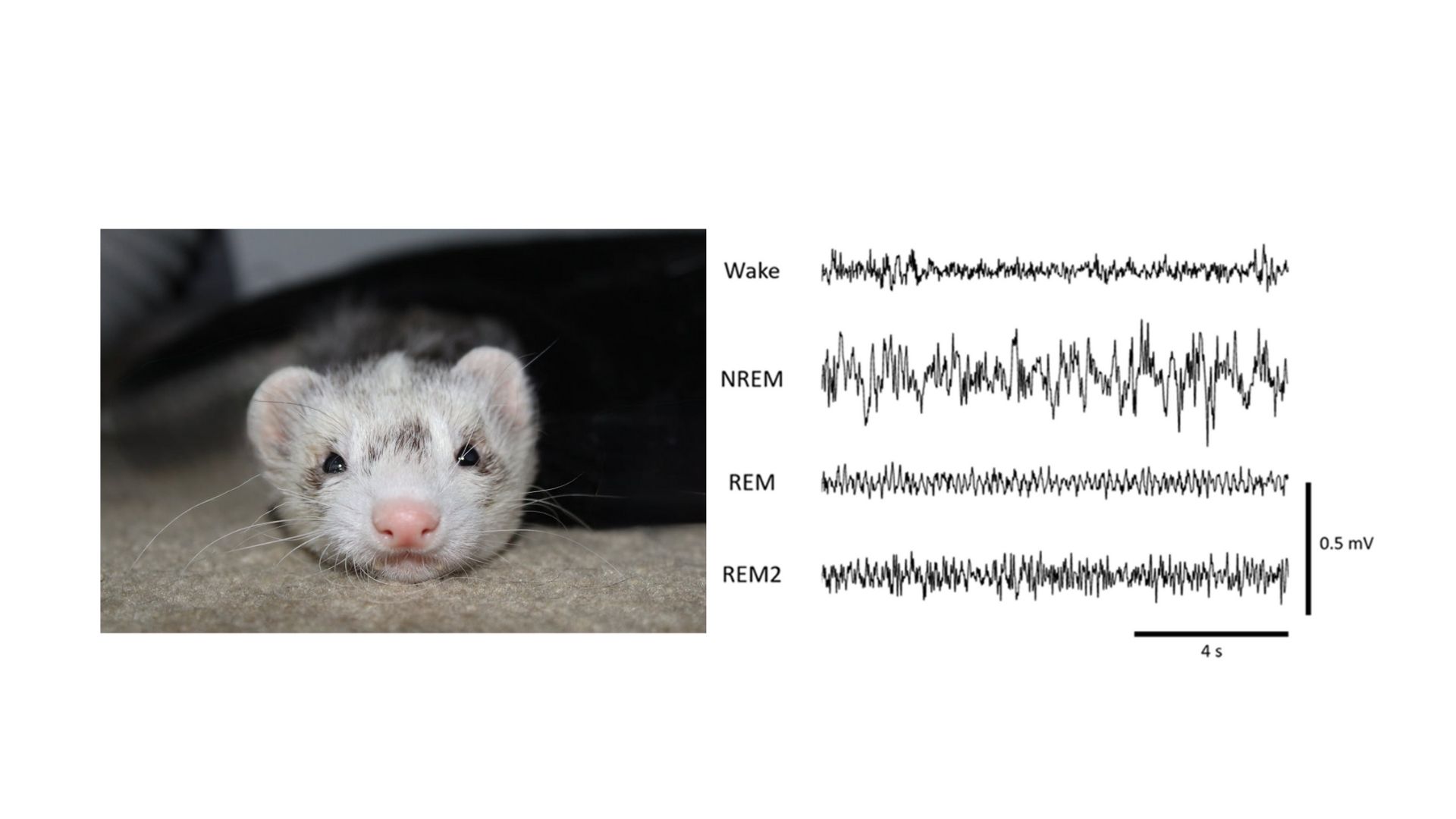
Crucially, the study explored both how sleep changed in animals when they developed tinnitus, and how tinnitus-related patterns of brain activity were modulated across sleep and wakefulness. Behavioral and brain activity data demonstrated that ferrets experiencing tinnitus also exhibited disrupted sleep patterns, with increased wake episodes and altered sleep patterns during deep sleep stages, supporting the possibility that tinnitus disrupts sleep. However, neural markers of tinnitus appeared to be significantly reduced during sleep, suggesting that sleep might temporarily suppress the phantom auditory perception. “Although tinnitus can disturb sleep, our findings indicate that sleep-state-dependent brain activity may also modulate tinnitus-related neural patterns, which could have implications for developing sleep-based interventions,” explained Dr. Milinski.
The study’s brainwave recordings, which track the brain’s electrical activity to assess sleep and wake states as well as brain responses to stimuli, highlighted that neural responses to sound varied across different stages of wakefulness and sleep. Auditory evoked potentials were most pronounced during wakefulness and rapid eye movement sleep, and reduced during non-rapid eye movement sleep. This raises the possibility that tinnitus-related neural hyperactivity, which drives responsiveness to stimuli, may not be uniform across all brain states and that sleep might offer a natural, albeit temporary, alleviation of symptoms. Indeed, once ferrets developed tinnitus, indicators for neural hyperactivity were extensive during wakefulness, but much less pronounced or even absent during sleep. “It is particularly intriguing that neural signatures of tinnitus appear less active during sleep, hinting at a possible gating mechanism, a process in the brain that controls which signals reach consciousness and which could play a role in mitigating the perception of phantom sounds,” noted Dr. Bajo.
The findings of Dr. Milinski, Dr. Bajo and colleagues open new avenues for potential treatments. If sleep reduces tinnitus-related brain activity, interventions aimed at enhancing sleep quality could be beneficial for individuals suffering from chronic tinnitus. Future research could explore pharmacological or behavioral strategies that leverage sleep’s natural modulation of tinnitus-related brain activity. The researchers emphasize that further studies are needed to determine whether similar mechanisms exist in humans and how they might be harnessed for therapeutic purposes.
However, by demonstrating a dynamic interaction between tinnitus and sleep states, this research already provides intriguing insights into the neurophysiological basis of tinnitus. As sleep appears to play a role in reducing the severity of tinnitus-related brain activity, these findings offer a promising direction for future research in auditory neuroscience.
About the researchers

Linus Milinski
Linus Milinski gained his BSc and MSc in Biology and Neuroscience from the Georg-August University in Göttingen, Germany, researching how sound is processed during sleep. He obtained his PhD at the University of Oxford, investigating how pathological and spontaneous brain activity, especially tinnitus, interacts with natural sleep processes and sleep regulation.… Now based at Oxford University’s Department of Physiology, Anatomy, and Genetics, the Sir Jules Thorn Sleep and Circadian Neuroscience Institute (SCNi) and the Kavli Institute for Nanoscience Discovery, his research focuses on how neural circuits in the cerebral cortex control sleep-related brain activity and the build-up of sleep pressure.

Victoria M. Bajo
Victoria M. Bajo is an Associate Professor of Neuroscience at the University of Oxford, studying neural circuits involved in auditory attention, sensory processing, and plasticity. Her research focus is in descending cortical pathways that shape auditory perception.… She has shown that removing specific corticofugal neurons disrupts pitch perception, while silencing cortical neurons impairs adaptation to auditory changes. She also investigates cross-modal interactions, revealing how whisker stimulation suppresses sound-evoked activity in the auditory cortex. Another major focus of her work is tinnitus, a phantom auditory perception affecting 1-3% of the population. Her team examines its impact on speech intelligibility and how sleep and tinnitus interact. Her work advances understanding of auditory plasticity, sensory processing, and potential treatments for tinnitus and hearing-related disorders.

Fernando R. Nodal
Fernando R. Nodal obtained his PhD in Neuroscience at the University of Salamanca, Spain, then, he moved to Oxford as an EU Marie Curie Fellow to work with Prof A J King on the development of spatial representations in the Superior Colliculus.… Since then he has been researching different aspects of auditory perception by combining behavioural, electrophysiological and anatomical techniques. One of his main interests is the experience-dependent neural plasticity. Sensory neural plasticity underpins our stable perception in ever-changing situations or after altered sensory inputs e.g. unilateral hearing loss, although maladaptive processes can result in phantom perceptions like tinnitus.

Matthew K.J. Emmerson
Matthew K.J. Emmerson was a medical student at the University of Oxford who had his research placement in the Auditory Laboratory at the Department of Physiology, Anatomy and Genetics, where his Final Honours Scheme Research Project working on tinnitus and sleep were conducted. He is now working as a doctor in the Royal Berkshire Hospital, Reading, UK.

Andrew King
Andrew King is a Wellcome Principal Research Fellow, Professor of Neurophysiology and Director of the Centre for Integrative Neuroscience in the Department of Physiology, Anatomy and Genetics at the University of Oxford. He studied physiology at King’s College London and obtained his PhD from the MRC National Institute for Medical Research.… Apart from a spell as a visiting scientist at the Eye Research Institute in Boston, he has worked at the University of Oxford since then, where his research has been supported by fellowships from the Science and Engineering Research Council, the Lister Institute of Preventive Medicine and the Wellcome Trust. Andrew’s research uses a combination of experimental and computational approaches to investigate how the auditory brain adapts to the rapidly changing statistics that characterize real-life soundscapes, integrates other sensory and motor-related signals, and learns to compensate for the altered inputs resulting from hearing impairments. He is a winner of the Wellcome Prize in Physiology, a Fellow of the Royal Society, the Academy of Medical Sciences and the Physiological Society, and is a Senior Editor at eLife.

Vladyslav Vyazovskiy
Vladyslav Vyazovskiy graduated from Kharkiv National University, Ukraine, in 1997, and in 2004 he received his PhD degree at the University of Zurich.… Following postdoctoral and lecturership positions at the University of Wisconsin-Madison and Surrey University, he joined the Department of Physiology, Anatomy and Genetics (DPAG) at the University of Oxford in 2013 as a Senior Research Fellow, before becoming Associate Professor of Neuroscience in 2015 and Professor of Sleep Physiology in 2021. Since 2020, he is a Tutorial Fellow in Medicine at Hertford College, and is a member of Sir Jules Thorn Sleep and Circadian Neuroscience Institute (SCNi) and Kavli Institute for Nanoscience Discovery. Vladyslav Vyazovskiy is a Vice-President of the European Sleep Research Society and a Director of Graduate Studies at DPAG. His research interests include neurobiology of sleep and torpor, ageing, behaviour, neuropharmacology and mechanisms of brain oscillations during waking and sleep.
Journal reference
Milinski L., Nodal F.R., Emmerson M.K.J., King A.J., Vyazovskiy V.V., Bajo V.M. “Cortical evoked activity is modulated by the sleep state in a ferret model of tinnitus. A cross-case study.” PLOS ONE, 2024; 19(12): e0304306. DOI: https://doi.org/10.1371/journal.pone.0304306