Daily Peanuts May Improve Insulin Response in Older Adults’ Memory Regions
In Dr. Peter Joris's Maastricht University trial, older adults who ate unsalted, skin-roasted peanuts every day for about four months showed a potentially beneficial change in how memory-related brain regions responded to insulin.
Read the original paper
Beyond controlling blood sugar, insulin also acts in the brain, where specific regions respond to it by adjusting nerve cell activity in circuits involved in memory, thinking and appetite. A weakened brain response to insulin is increasingly recognised as a key feature of diabetes and of age-related disorders of memory and thinking, including Alzheimer’s disease and other dementias. Nuts, including peanuts, are recommended as part of a healthy diet, but whether eating peanuts daily changes how the ageing brain responds to insulin has been unclear.
Lucia Kerkhof, Professor Ronald Mensink, Professor Jogchum Plat, Dr. Kevin Nijssen and Dr. Peter Joris from Maastricht University tested whether a daily portion of unsalted peanuts, roasted with their skins on, changes how the brains of older adults respond to insulin. The work is published in the peer-reviewed journal, Food & Function.
Dr. Joris’s team ran a randomised, controlled crossover trial with healthy older men and women, in which every volunteer went through two periods of about four months. In one, they ate a daily portion of peanuts with the skins kept on, as the skins are rich in plant compounds; in the other, they ate no nuts. A break separated the periods, the order was decided by chance, and the staff running the measurements and analyses did not know which period was which. At the end of each period, a brain scan measured blood flow before and half an hour after insulin was given as a nasal spray, a route that lets it reach the brain. The change in blood flow showed how strongly each region responded to insulin. Scans measured liver fat, and fasting blood tests tracked blood sugar, insulin, cholesterol, blood fats and inflammation.
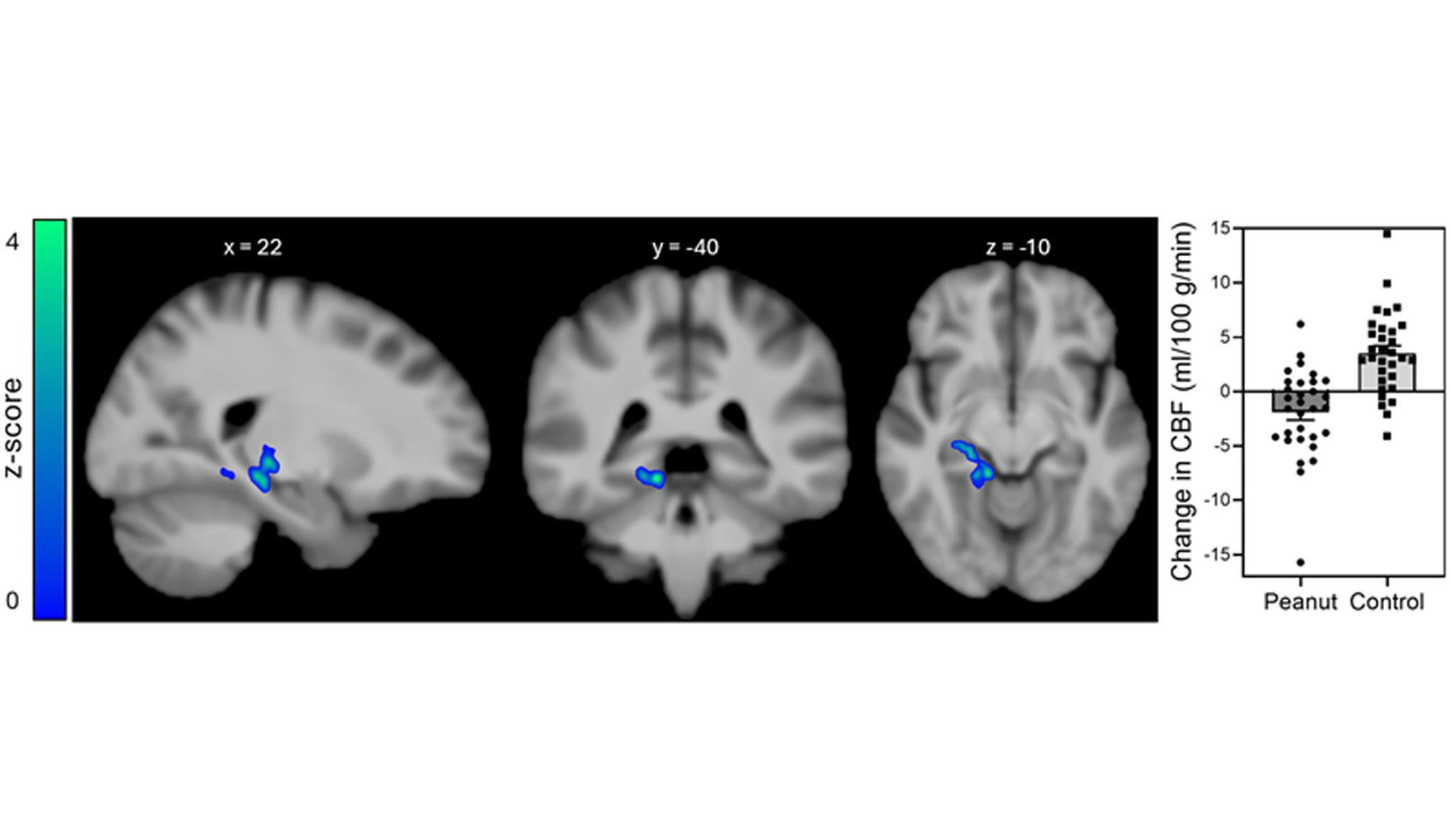
Dr. Joris’s findings point to one area on the right side of the brain where blood flow responded less strongly to insulin after the peanut period than after the period without peanuts. This area takes in parts of the hippocampus, central to memory and rich in insulin receptors, and neighbouring regions linked to memory. Averaged over the whole brain, the response to insulin did not change significantly.
Dr. Joris’s team describes this as a potentially beneficial effect: in the hippocampus, insulin tends to quieten nerve cells, and blood flow follows nerve activity. “Lower blood flow in the hippocampus may therefore reflect more efficient or better regulated nerve cell activity in response to insulin,” explained Dr. Joris. An earlier report from the same trial found that the daily peanuts improved memory. “This finding suggests that changes in brain insulin responsiveness may represent another mechanism through which longer-term peanut intake exerts beneficial effects on memory performance,” he said. Even so, no significant direct link appeared between each volunteer’s change in insulin response and their change in memory, which the trial was not designed to detect.
Peanuts did not change liver fat, fasting blood sugar, insulin, cholesterol or inflammation. Triglycerides, a type of blood fat, were lower halfway through the peanut period but back to starting levels by the end.
Dr. Joris’s study has limits. Volunteers partly added the peanuts on top of their usual diet, taking in more energy, and no comparison food was matched for calories and nutrients, so the effects may also reflect these wider diet changes. Blood flow is only an indirect measure of nerve cell activity. “Future research should examine the clinical relevance of changes in brain insulin responsiveness,” he noted. The research was funded by The Peanut Institute Foundation, which, according to the published study, took no part in its design, data collection, analysis, writing or publication decisions. The researchers declare no conflicts of interest.
Dr. Joris’s findings suggest that daily unsalted, skin-roasted peanuts may help memory-related brain regions in healthy older adults respond to insulin more favourably, offering one possible explanation for the memory benefits seen earlier in the same volunteers. Whether this matters for long-term brain health remains to be shown.
Journal reference
Kerkhof L., Mensink R.P., Plat J., Nijssen K.M.R., Joris P.J. Daily consumption of unsalted, skin-roasted peanuts beneficially affects regional brain insulin responsiveness in older adults: results of a longer-term randomized controlled trial. Food & Function. 2026; 17:9354. DOI: https://doi.org/10.1039/d6fo03208g
Funding: This research was funded through a grant from The Peanut Institute Foundation (TPIF). TPIF did not participate in the study design, data acquisition or analysis, decisions regarding publication, or the writing of the manuscript. The authors declare no conflicts of interest. Trial registration: ClinicalTrials.gov NCT05724654.