A New Meta-Model Shows When People Act Sustainably
A literature review by Dr. Barbara Meyer's team finds that self-interest widens the gap between people's green values and their actions, while concern for others and the planet narrows it.


The urgent need to tackle environmental issues requires more than just awareness; it requires people to take action. Yet, many individuals struggle to align their values with their everyday behaviors. This gap between what people believe and how they act, often referred to as the “inner–outer gap,” is a key challenge for those promoting sustainable lifestyles. A recent review by researchers Dr. Barbara Meyer, Dr. Elena Gaertner, and Christian Elting from Ludwig-Maximilians-University Munich and Otto-Friedrich-University of Bamberg, Germany suggests that the Tripartite Structure of Sustainability could be a valuable tool for educators to bridge this gap. Their study, published in the journal Sustainability, sheds light on the factors that influence sustainable behavior and how education can be used to encourage more environmentally friendly actions.
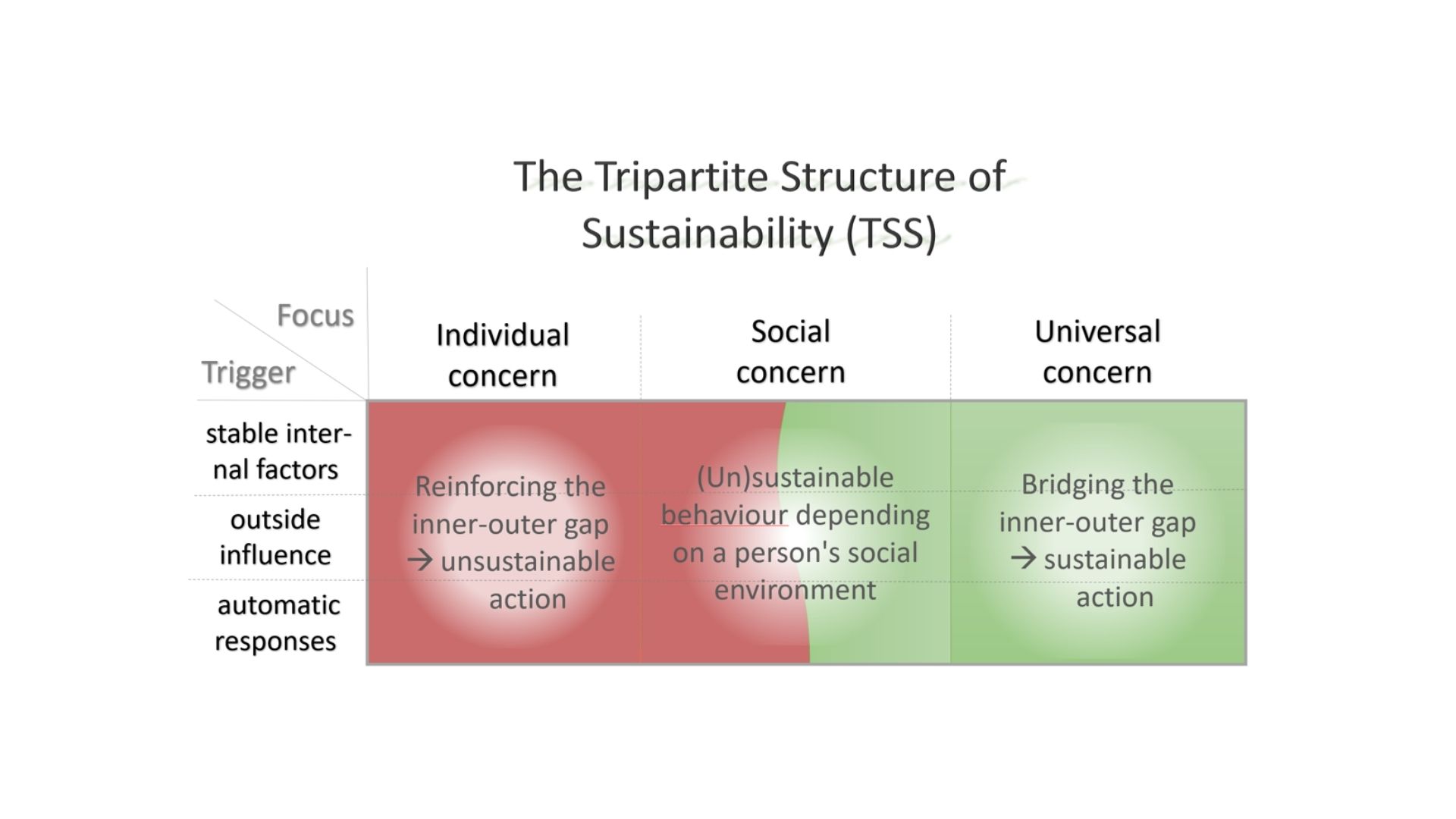
Researchers analyzed numerous studies spanning over a decade to better understand why people fail to turn their eco-friendly intentions into actions. The research was driven by the need to find effective ways to reduce this disconnect and help individuals make more sustainable choices. By using the Tripartite Structure of Sustainability model, the researchers divided the different motivations for actions into three categories: individual, social, and universal concerns. They also looked at how these motivations are triggered—whether by stable internal factors, outside influences, or automatic responses.
Dr. Meyer and her colleagues found that focusing on self-interest—such as personal goals and immediate rewards—tends to increase the gap between values and actions, making it harder for people to act sustainably. On the other hand, when people focus on the well-being of others or the environment, they are more likely to behave in ways that are better for the planet. Social influences, such as peer pressure or cultural norms, had mixed effects depending on whether the social environment was supportive of sustainable behavior. Dr. Meyer noted, “The gap between values and actions is shaped by many different factors, and by understanding them, we can create better educational systems that encourage people to act more sustainably.”
The Tripartite Structure of Sustainability framework breaks down human actions into three main categories: self-focused, socially influenced, and universally driven. Self-focused actions are motivated by personal gain, while socially influenced actions are shaped by what is seen as acceptable or desirable in a person’s community. Universally driven actions, on the other hand, are motivated by broader concerns, such as the welfare of future generations or the planet as a whole. For example, people who focus on universal concerns, driven by values like compassion and care for others, are more likely to make sustainable choices when given the right support. On the other hand, those driven by self-interest may only make green choices if there are strong rewards, like financial incentives or social approval, pushing them to do so. “But it seems that people usually have many different motives at hand and weigh them up internally – often without even realising it” explained Dr. Meyer.
The researchers examined how these motivations are activated, which can happen in various ways. Some motives are stable and internal, like long-term values or attitudes or the stage of ego-development that shape behavior over time. These might include personal beliefs about the environment or the influence of cultural norms. Other motives are influenced by external triggers, like rewards, punishments, or peer pressure, which can temporarily push people toward or away from sustainable behavior. In contrast, many decisions are shaped by automatic responses—unconscious habits or tendencies like reacting without thinking—that either support or hinder sustainability efforts.These automatic responses, such as a preference for avoiding losses or sticking to familiar routines, can often work against sustainable behavior. To overcome this, Dr. Meyer suggests that educators need to help people recognize these automatic habits and guide them toward more thoughtful, intentional decision-making. “By raising awareness about these hidden influences, educators can help people make better, more consistent sustainable choices,” said Dr. Meyer.
Dr. Meyer and her colleagues also stressed the need for a fundamental shift in how sustainability is taught. Rather than focusing solely on skills like recycling or energy saving, education should aim to develop individuals’ personal growth and values. This deeper focus on long-term development—what Dr. Meyer refers to as “vertical development”—is key to fostering a mindset that truly embraces sustainability. “The current education system should not only aim at developing job skills but also focus on helping individuals grow in ways that lead them to care for the environment and society,” Dr. Meyer explained.
The research team concluded that education systems need to go beyond simply teaching facts about the environment. To make a real difference, schools and universities need to encourage students to internalize values that lead to sustainable actions. For those with a focus on broader issues like the welfare of future generations or the planet, the goal is to create lasting changes in behavior. This involves designing educational experiences that not only inform but also inspire students to live out these values in their daily lives. Dr. Meyer added “This is why we call for the development of an instructional design for inner growth as an important next step in education”.
Overall, the Tripartite Structure of Sustainability offers educators a clear framework to encourage sustainable behavior. By understanding the deep, situational, and automatic factors that shape behavior—and focusing on helping students move beyond self-interest toward a universal perspective—educators can play a crucial role in closing the inner–outer gap. As Dr. Meyer concluded, “If we want to see real change, we need to focus not just on what people know about sustainability, but also on how they turn that knowledge into action.”
https://encyclopedia.pub/video/video_detail/1325
Other Reference
Meyer, Barbara E. (2023): “The Tripartite Structure of Sustainability: a new educational approach to bridge the gap to wise and sustainable action.” In: Front. Educ. 8, Artikel 1224303. DOI: https://doi.org/10.3389/feduc.2023.1224303
About the researchers

Dr. Barbara E. Meyer
Dr. Barbara E. Meyer is a senior educational scientist and lecturer at the Ludwig-Maximilians University of Munich and teaches future teachers as well as teachers and university lecturers at all levels and across all types of schools and universities.… As a result of her research on education for sustainable development, she is interested in how schools and universities would have to transform in order to support the inner development of students. Other areas of interest include ego development, inclusive education, classroom management, intercultural and indigenous education.In the past, Barbara Meyer also worked as a postdoctoral researcher and lecturer at the Friedrich-Alexander University of Erlangen-Nuremberg and as an interim professor at the University of Eichstätt-Ingolstadt. She holds a Master's degree in Psycholinguistics, Education and Psychology from the LMU Munich. In her doctoral thesis she developed a Grounded Theory on how student teachers deal with critical situations in their school practice.

Dr. Elena Gaertner
Dr. Elena Gaertner is a Senior Lecturer at Ludwig Maximilian University in Munich, where she is part of the Department of General Education and Pedagogy. She teaches future teachers across all school types and levels, with a focus on transformative education and the development of future skills.… Her research interests revolve around the societal challenges of the future and how these can be addressed within educational contexts. In this, she particularly examines the skill set and value system of teachers, alongside systemic societal connections.Elena holds an MA in Comparative Literature from the University of Kent, Canterbury. She also completed the First State Examination at LMU Munich for teaching at grammar schools, specializing in English, History, and Psychology. Her doctoral thesis explores the relationship between classroom management skills and teachers' health.

Christian Elting
Christian Elting is a Research Associate at the Chair of Primary Education at the Otto-Friedrich University of Bamberg. At the Faculty of Humanities, he teaches prospective primary school teachers in the subjects of Primary Education and Didactics.… His responsibilities also include providing research-related support to early career researchers and contributing to the development of the chair's research profile. Alongside education for sustainable development, his empirical research primarily focuses on dealing with diversity and inclusion in primary schools. The research projects address the professionalization and professionalism of (prospective) primary school teachers, the quality of instruction in primary schools, and the learning and personal development of primary school children.In 2014, Christian Elting completed his studies with a Bachelor of Education and the First State Examination for Primary School Teaching at the Friedrich-Alexander University of Erlangen-Nuremberg. From 2014 to 2021, he worked as a Research Associate at the Institute for Primary Education Research there, engaging in research and teaching in the fields of Primary Education and Didactics. His doctoral thesis investigates the effects of student diversity and the quality of instruction in inclusive primary schools on the development of primary school children’s social competence and social integration.
Journal reference
Meyer, B.E., Gaertner, E., & Elting, C. “Closing the Gap: The Tripartite Structure of Sustainability as a Tool for Sustainable Education—A Systematic Literature Review.” Sustainability, 2024. DOI: https://doi.org/10.3390/su16093622