From Training to Openness: How Hands-On Training Changed Social Workers’ Attitudes Toward Forced Migrants
Dr. Valentina Demidenko's team found that after hands-on, trauma-informed training, negative views and stereotyping toward migrants decreased among social workers in Lithuania and Cyprus.


War, persecution and violence are forcing growing numbers of people from their homes, and many millions of people worldwide have now been forced to flee. Social workers now meet forced migrants not as exceptional cases but as regular clients, and they are often the main source of support for newcomers. Doing this well requires the ability to communicate across cultures and to understand the trauma many forced migrants carry, yet gaps in social workers’ preparation remain a barrier to good support.
Dr. Valentina Demidenko from Kauno Kolegija Higher Education Institution and Dr. Edita Štuopytė from Kaunas University of Technology, both associate professors in Lithuania, designed and evaluated a training program for social workers who support forced migrants in Lithuania and Cyprus. The work is published in the peer-reviewed journal, Social Sciences. Carried out within a project supported by the European Union’s Erasmus+ program, the study followed changes in participants’ attitudes using a questionnaire before and after the training, observation of the sessions and an analysis of participants’ written reflections.
“Social workers play a crucial role in guiding migrants through the adaptation process, providing information and educational resources, and facilitating their integration into the host society,” explained Dr. Demidenko. To learn what these professionals lacked, Dr. Demidenko’s team first gathered social workers from both countries in small, rotating discussion groups known as a world café. The needs that stood out were communicating across cultures, supporting refugees affected by trauma, and strengthening social workers’ own resilience.
Small groups of social workers from each country, all experienced in working with forced migrants, then attended multi-day training sessions in Cyprus and Lithuania. The program relied on experiential learning, in which people learn by doing an activity and then reflecting on it. In simulated situations, participants practiced building trust with clients while keeping professional boundaries, worked through cases involving different traumatic experiences, learned self-care to prevent burnout, and tried tools such as metaphorical cards. Training side by side, the Lithuanian and Cypriot participants also experienced cultural differences among themselves.
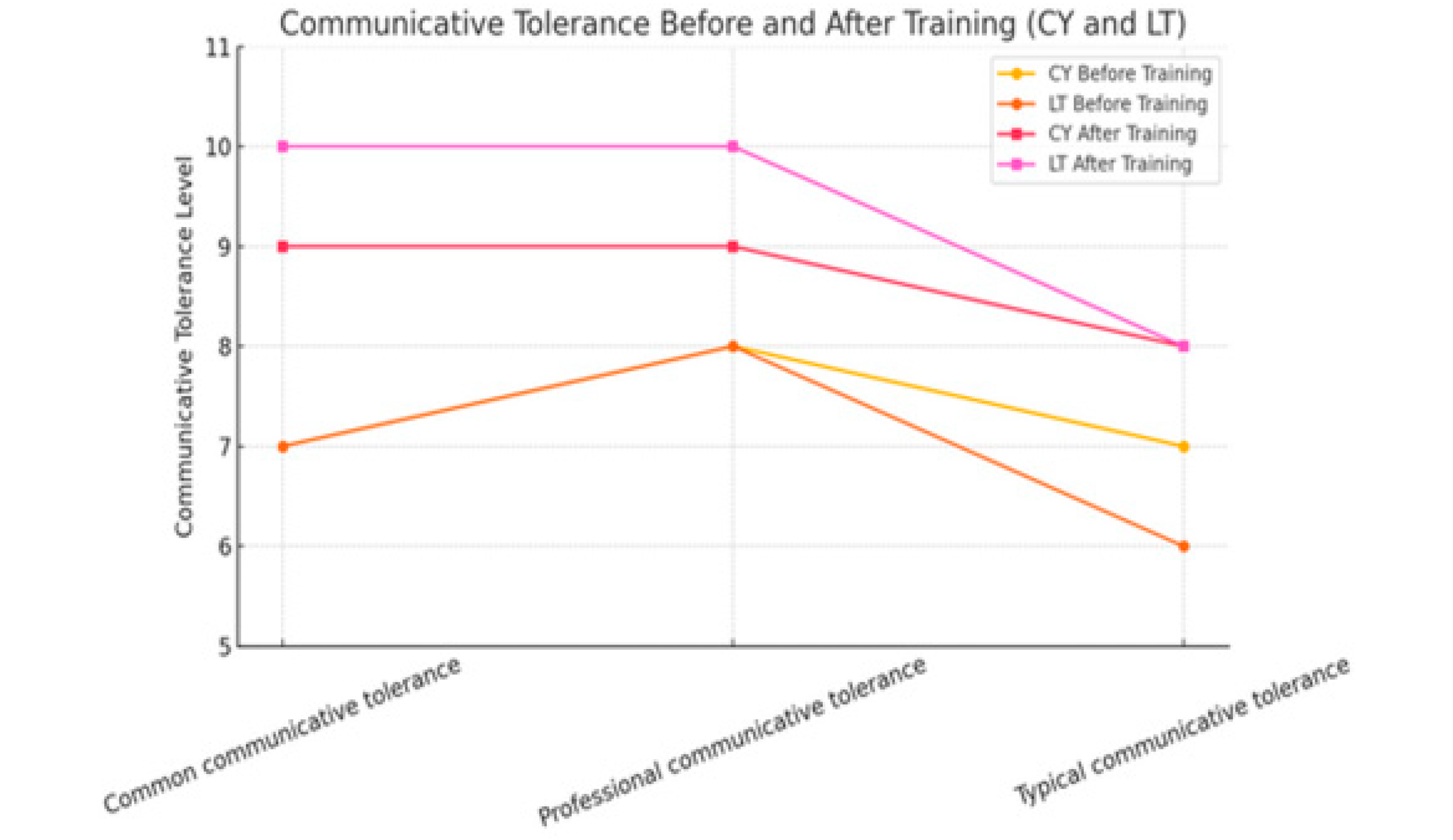
On the questionnaire, most participants in each country already showed above-average general tolerance before the training, meaning openness and acceptance in dealing with others. Afterward, nearly all of them did. Attitudes toward particular groups, such as immigrants or people of other nationalities, began at a moderate level, with a few participants showing negative views and ethnic stereotyping. By the end, negative views and stereotyping had decreased in both groups, with nearly every social worker now above a low level of tolerance. Dr. Demidenko’s team found no statistically significant differences between the countries. “This suggests that targeted experiential training may have a positive impact on communicative attitudes,” said Dr. Demidenko.
Participants’ reflections pointed to clear gains: stronger skills in communicating across cultures, a deeper understanding of trauma, and both professional and personal growth. Several described moving from knowing about trauma to understanding how past events shape a client’s daily life. Others said they now felt more confident using new methods, including one who had worried that a wrong reaction might harm a traumatized client.
Dr. Demidenko’s team note that the program’s separate elements are not new. What sets it apart is the combination of cross-cultural learning, learning by doing and trauma-informed care, an approach that recognizes the lasting effects of trauma and avoids causing further harm, all within a group spanning both countries. At the same time, the group was small and made up of motivated volunteers, so the results may not apply to all social workers. “Participants emphasized that experiential and collaborative learning—conducted alongside colleagues from different national and cultural contexts—enhanced both their competence and confidence in their practice,” Dr. Demidenko added.
Dr. Demidenko and Dr. Štuopytė conclude that lasting investment in training built on learning by doing and an understanding of trauma can help social workers offer responsive and humane support to people forced from their homes.
About the researchers

Dr. Valentina Demidenko
Dr. Valentina Demidenko is an Associate Professor at Kauno kolegija, Faculty of Arts and Education, Department of Social Work, and holds a PhD in Educational Sciences. She is also a professional psychologist with more than 20 years of experience in providing psychological counseling to trauma-affected refugees and migrants.… She is an expert on migrant integration in Lithuania and serves as Director of a Social Services Center. Valentina Demidenko conducts research in the fields of education, sociology and psychology, focusing on: the educational empowerment of socially vulnerable groups (migrants, older adults, persons with disabilities, etc.); integration processes of trauma-affected migrants and other socially vulnerable groups; experiential learning of social workers; and socio-educational activities of humanitarian and social organizations. She implements project-based activities introducing innovations in the integration of people experiencing social exclusion and in the professional development of social workers. She also develops experiential learning and internship mechanisms for specialists working in humanitarian and social organizations. EU-funded projects include: “Enhancing Intercultural Communication Skills and Competences for Social Workers in the Provision of Assistance to Forced Migrants” (project leader); “Mastering 9 Conversations: Helping Refugee Entrepreneurs Extend Their Network and Tell Their Business Story” (project partner); “Development and Organization of Social Services for Foreign Nationals Living in Jonava” No. 08.6.1-ESFA-T-927-01-0009 (project leader); and the Research Council of Lithuania-funded project No. P-SV-24-349 “The Role of a Social Worker in Empowering Ukrainian War Refugee Women to Seek Psychosocial Support” (project leader), among others. Valentina Demidenko is the author/co-author of more than 10 scientific publications (articles, books, studies, etc.). ORCID iD: 0009-0009-3736-2869.

Dr. Edita Štuopytė
Dr. Edita Štuopytė is an Associate Professor at the KTU Faculty of Social Science, Arts and Humanities, and holds a PhD in Educational Sciences.… Scientific activities are carried out in the following research topics in the field of education: educational empowerment of socially sensitive persons (migrants, the elderly, children, etc.); socio-educational activities of non-governmental organizations; teacher activities. While working at the university, Edita carried out project activities that implemented innovations in teacher qualification improvement, developed internship mechanisms for beginning teachers, and prepared future teachers for work (EU-funded TESK project). In recent years, she has led or implemented the following projects: COST project “International Cooperation on Bullying, Migration and Integration (TRIBES)” manager (2019-2023); Development of competences of Lithuanian and Ukrainian public sector employees using design-based thinking methodology (PubCom-DT) (2020-2021); implemented the Edu Balt ESD Regional ESD Course for Higher Education Change project (2017-2018) and COST (CA17114) “Interdisciplinary solutions to barriers to youth participation in various sectors (YOUNG-IN)” (2018-2022) activities. Edita Štuopytė has published more than 30 scientific publications (including articles, monograph chapters, studies, and other works). ORCID iD: 0009-0000-5073-2814.
Journal reference
Demidenko V., Štuopytė E. The Power of Training: Attitudinal Shifts Among Social Workers Supporting Forced Migrants in Cyprus and Lithuania. Social Sciences. 2025; 14:620. DOI: https://doi.org/10.3390/socsci14100620