Science FeaturedPeer-reviewed research, explained
Research highlight · Mind & Society

Pandemic Moves to the Countryside Strained Housing in Rural Northeast Towns

Dr. Omur Damla Kuru’s team found that when city dwellers moved to rural Northeast towns during the pandemic, housing could not keep up, prices climbed and lower-income residents bore the heaviest burden.

Read the original paper
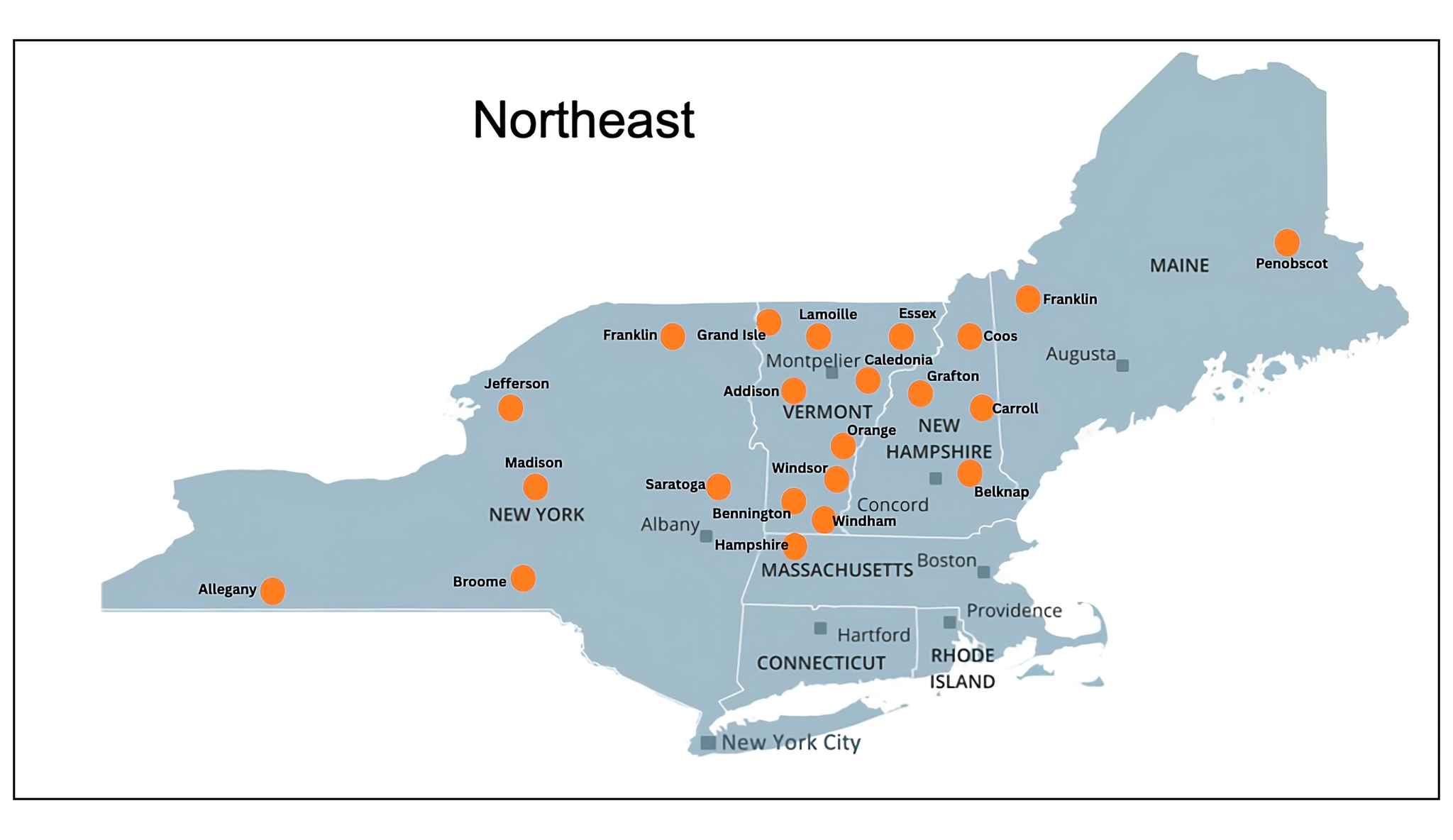
Map of the US Northeast marking the counties that received the highest rates of new residents during the COVID-19 pandemic
Image: Kuru et al., Land 2026 (CC BY 4.0) · View full size

When the COVID-19 pandemic struck, many city residents headed for small towns and the countryside. Little is known about what this shift meant for the American communities that took in the newcomers. Fresh arrivals can bring new energy, but a rapid influx can also strain housing and services in places with limited resources. The question matters beyond the pandemic: as climate change worsens, more people are expected to relocate to escape floods, heat and other hazards, and the northeastern United States is seen as a likely destination.

Dr. Omur Damla Kuru from the University of Utah, together with Professor Elisabeth Infield, Professor Henry Renski, Paromita Shome and Emily Hodos from the University of Massachusetts Amherst, examined who moved where in the Northeast during the pandemic and how receiving communities fared. Dr. Kuru’s team combined population data with the experience of local housing experts. The work is published in a special issue—Strategic Planning for Urban Sustainability (Second Edition)—of the peer-reviewed journal Land.

The team used federal tax records, which show when people file from a different county than the year before, to follow moves to the Northeast counties. Dr. Kuru’s team compared the pandemic peak with earlier years and identified rural, inland counties with unusually high inflows. There, they held online group discussions with local housing specialists, mostly real estate brokers, asking who was arriving, why, and with what effects.

The largely rural states of Maine, New Hampshire and Vermont saw a notable influx during the pandemic. Most newcomers to the main destination counties came from elsewhere in the Northeast, largely from a few populous counties around New York City and Boston. Counties rich in seasonal homes saw especially strong inflows, suggesting many people moved into second homes. According to the housing experts, movers sought cheaper housing, good schools, nature and room to work remotely.

Dr. Kuru’s team found that local housing experts saw communities used to little growth caught by surprise. All of the experts reported that housing supply could not keep up with demand, and nearly all pointed to a lack of affordable homes. They described wealthier newcomers, often cash buyers, outbidding locals, and short-term rentals eating into year-round housing. According to the experts, home and rental prices nearly doubled in some areas within a short time. They also pointed to aging infrastructure, patchy internet and crowded schools.

Most of the experts described displacement and gentrification, meaning longtime residents priced out as wealthier people move in. In their accounts, the burden fell hardest on lower-income households, some of whom ended up in affordable but flood-prone areas, and homelessness rose in some towns. “Big cities and metro areas, the traditional hubs of resources, are no longer the only attraction points,” said Dr. Kuru. To her team’s knowledge, this is the first United States study gathering empirical data from communities shaped by pandemic moves, and Dr. Kuru’s research points to challenges that may arise as people flee floods, wildfires and heat.

Table summarizing the focus group findings: housing, infrastructure and socioeconomic challenges in receiving counties and lessons for regional planning
Table: Focus group findings. Kuru et al., Land 2026 (CC BY 4.0)

Drawing on the experts’ recommendations, Dr. Kuru’s team calls for regional planning, which coordinates decisions across towns and counties, to tackle existing problems before growth makes them worse. The experts emphasized that regional planning should first address pre-existing deficits exacerbated by in-migration, notably by revisiting restrictive zoning and land-use regulations and by incentivizing affordable and rental housing through regulatory and financial tools. They further identified retrofitting aging infrastructure, including wastewater, transportation, internet, and stormwater systems, as essential to accommodating growth while enhancing resilience and limiting development in hazard-prone areas. Given the constraints of slow, fragmented, and growth-resistant local governance, participants underscored the need for long-horizon, multi-jurisdictional collaboration between state and local governments, appropriately timed policy action, and sustained community engagement to build public trust.

Dr. Kuru’s case-study findings rest mainly on the views of volunteer housing experts, and pandemic movers tended to be better off, so future migrations may unfold differently. Still, the study shows how quickly a wave of arrivals can test small communities. “COVID-19 was a unique moment, but it also brought a window into possible futures. Planning can use that window to prepare communities for a climate-changed future,” she added.

Diagram of the study's framework: disasters and push factors send movers to receiving communities, leading to housing shortage, pressure on infrastructure and growing social inequalities, and to lessons for planning
Graphical abstract: Kuru et al., Land 2026

About the researchers

OK

Omur Damla Kuru

Omur Damla Kuru has recently completed her postdoctoral fellowship at the NSF U.S.-Canada Center on Climate-Resilient Western Interconnected Grid (WIRED Global Center) and in the City and Metropolitan Planning (CMP) Department at the University of Utah.… Her research explores how environmental hazards are reshaping urban and rural systems and how planning can better address the pressures placed on affected households and communities. Specifically, she works at the intersection of climate adaptation and disaster planning, housing, land use, and environmental justice. Her work spans coastal adaptation and disaster-induced displacement in Monroe County, Florida; COVID-era population mobility and its housing-market implications across the Northeast; post–Hurricane Maria recovery and relocation in Puerto Rico; and wildfire resilience and insurability in Salt Lake City and Park City, Utah. She is also a senior expert on a Florida Sea Grant–funded project on the wind resilience of elevated coastal homes. Prior to joining CMP, she worked as a postdoctoral research associate in the Department of Landscape Architecture and Regional Planning at the University of Massachusetts Amherst. She holds a Ph.D. in Public Affairs from Florida International University. Her work has been published in Housing Policy Debate, Land, the Journal of Planning Literature, and the Elgar Encyclopedia of Climate Policy. More information about her research is available on her website.

EI

Elisabeth M. Infield

Elisabeth M. Infield is a Professor of Regional Planning in the Landscape Architecture and Regional Planning Department at the University of Massachusetts, Amherst.… She has been researching climate change, with particular attention to resilience, since 2007, and developed one of the first courses in sustainable cities (2003) and planning for climate change (2015) offered in planning programs in the U.S. She co-chaired the Associated Collegiate Schools of Planning Presidential Task Force on Climate Justice (2021-22), and has presented at UN World Urban Forums and related international and US conferences. She led development of the 2017 Planning for Climate Change: A Reader in Green Infrastructure and Sustainable Design for Resilient Cities (2017, Infield, Ryan and Abunnasr) and numerous articles on urban resilience, some under her previous last name of Hamin, and works with communities on their local plans. She has been PI on two NSF grants, including the 2022 “Sustainable Regional Systems Research Network: Preparing Receiving Regions for a Just and Sustainable Climate Migration – Systems and Scenarios for New England” with co-PI Henry Renski which funded this work. Her current research focuses on climate migration and the use of strategic retreat to increase resilience and well-being in communities under climate change.

HR

Henry Renski

Henry Renski is a Professor and Chair of the Department of Landscape Architecture and Regional Planning at the University of Massachusetts Amherst. He teaches courses in applied quantitative methods, Geographic Information Systems (GIS), regional economic and spatial analysis, and state and local economic development policy. Dr.… Renski’s research focuses on understanding the forces driving regional economic competitiveness and transformation and building upon this knowledge to improve the effectiveness of economic development policy. His specific interests include understanding the influence of technological change on spatial development patterns, regional migration, changing knowledge and skill requirement in the labor force, applied analytical methods, and the application of regional development theory to guide state and local economic development policy.

PS

Paromita Shome

Paromita Shome is a Ph.D. candidate in the Department of Landscape Architecture and Regional Planning at UMass Amherst. Her research examines environmental planning in the context of climate change, sustainability, and community development.… Her ongoing doctoral research examines how gender-responsive climate adaptation is planned and implemented in climate-vulnerable districts of Bangladesh, and how policies can be better designed to serve community interests. Some of her previous work has explored urban flooding-related loss and damage among affected residents, water and sanitation interventions in informal settlements, and sustainable planning for regions receiving climate migrants through an NSF-funded research project. Paromita holds bachelor’s and master’s degrees in Urban and Regional Planning from Bangladesh, where she also served as a faculty member.

EH

Emily Hodos

Emily Hodos is a mixed-methods researcher and regional planner based in western Massachusetts. She earned her Master of Regional Planning from UMass Amherst in 2026, focusing on community engagement, rural identity and belonging, and economic development.… During graduate school, she served as a research assistant on this study and contributed to a Climate Action & Equity Plan for New Haven County, Connecticut. Her master’s thesis, The Double Paradox of Belonging: Race, Rootedness, and Connection in Diversifying Rural New England, examined how BIPOC and white residents experience belonging in small towns. She is now developing this research into peer-reviewed articles. As a Research Analyst with FinePoint Associates, Emily conducts applied economic development studies for municipalities ranging from rural towns to cities, as well as civic engagement groups. Across her work, she is particularly interested in advancing racial and socioeconomic equity through research that draws on local knowledge, lessons from successful approaches elsewhere, and an understanding of each community’s needs.

Journal reference

Kuru OD, Infield E, Renski H, Shome P, Hodos E. Population Mobility in the Wake of COVID-19 in the US Northeast Region: Lessons for Regional Planning. Land. 2026; 15:3. DOI: https://doi.org/10.3390/land15010003

Funding: Sustainable Regional Systems Research Network: Preparing Receiving Regions for a Just and Sustainable Climate Migration – Systems and Scenarios for New England. E.M. Hamin Infield, H. Renski, PIs. NSF Award 016949-00002.

Cite this feature

Science Featured. (2026, November 4). Pandemic Moves to the Countryside Strained Housing in Rural Northeast Towns. Research highlight on Kuru et al., peer-reviewed paper 2026. https://sciencefeatured.com/2026/11/04/pandemic-moves-to-the-countryside-strained-housing-in-rural-northeast-towns/

Subscribe To Our Free Newsletter

New research, explained, in a short digest across all fields. No advertising; unsubscribe in one click.