Limestone Helped the Ancient Maya Flourish
Professor Barbara Voorhies and Dr. George Michaels argue that abundant limestone gave the ancient Maya lime for preparing maize, access to water through cenotes, and stone for building.


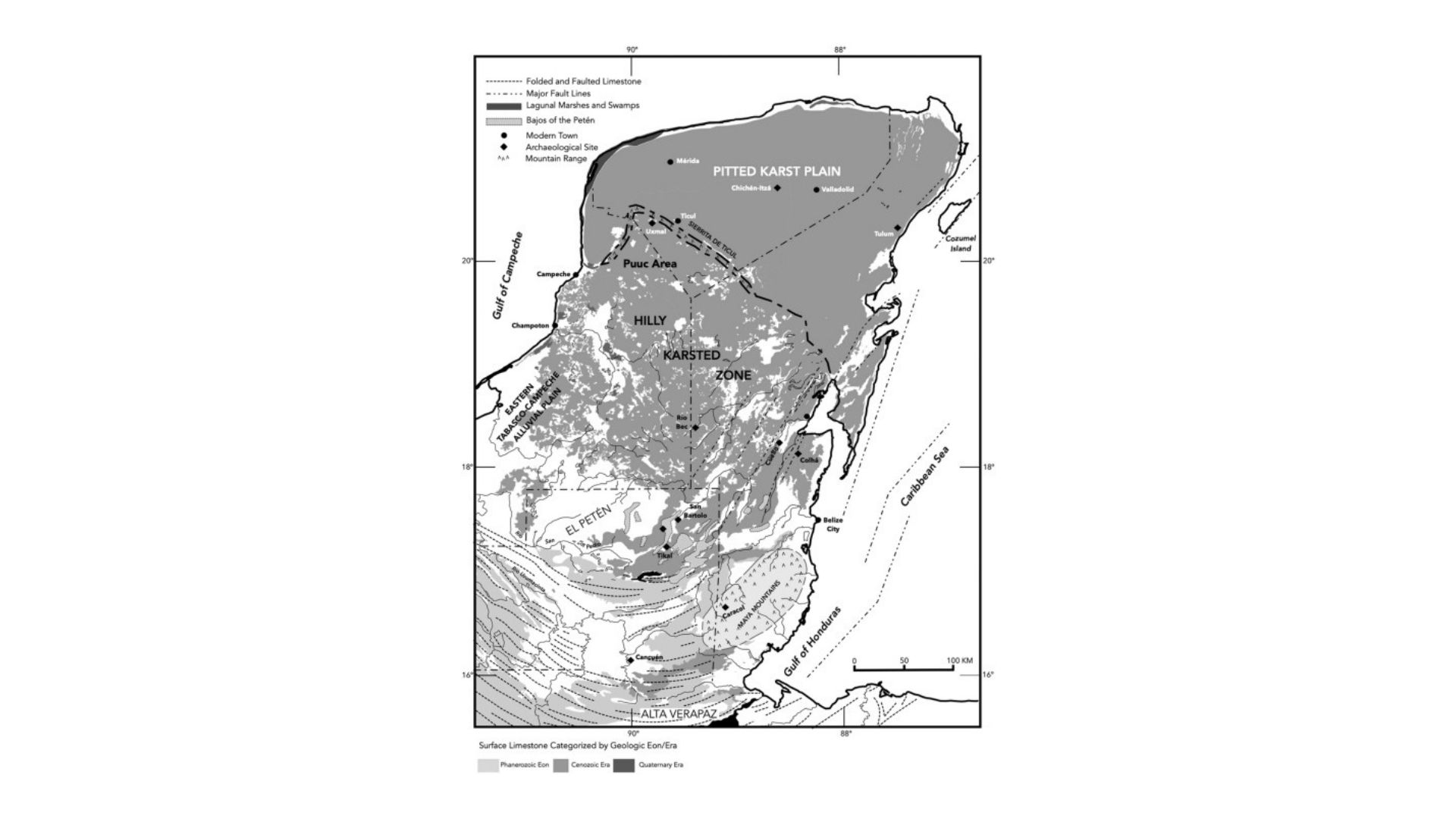
The ancient Maya civilization flourished in the Yucatán Peninsula, a region rich in surface limestone. While at first this type of rock may not seem significant, new research reveals that it played a vital role in the Maya’s success. Professor Barbara Voorhies and Dr. George Michaels from the University of California-Santa Barbara explain that limestone provided a significant benefit that helped the ancient Maya develop a complex society. Their findings are published in the journal Quaternary Environments and Humans.
The most important benefit of limestone is its role in nixtamalization, a method of preparing dried maize, or corn, prior to cooking, by soaking it in an alkaline solution. This greatly improves the nutritional value of the maize by increasing the availability of essential vitamins and proteins. The ancient Maya made the alkaline solution from burned limestone, which was abundant in the region. This process made maize, formerly only one of many crops, become the most dominant crop grown and eaten. Maize supported a large growing ancient Maya population, which in turn permitted significant societal advances. Lacking limestone, other ancient Mesoamerican societies had to import lime or rely on another source for alkaline.
Limestone also shaped the Maya landscape and their access to water. The porous nature of the rock helped form cenotes, which are natural sinkholes that provided fresh water by providing access to underground rivers. Since surface water was scarce in the region, these cenotes were essential for survival. Researchers suggest that access to water likely influenced where Maya cities were built, ensuring that large populations could be sustained despite environmental challenges.
Limestone was equally important for construction. The Maya used it to build their iconic temples, palaces, and public buildings. “The abundance of easily worked limestone enabled the Maya to develop their signature architectural style, featuring massive pyramids and intricately carved facades,” Professor Voorhies explains. A facade is the front of a building, often adorned with carvings and sculptures. They also used a type of plaster made from limestone, called stucco, to create the background of colorful murals and decorative elements that enhanced the beauty of their structures.
While much attention has been given to the cultural and intellectual achievements of the ancient Maya, this research highlights how the natural environment played a key role in their development. “Our study suggests that the geological setting of the Yucatán Peninsula provided an unexpected but critical advantage for the ancient Maya, enabling them to develop advanced agricultural, architectural, and water management systems,” the authors state. Water management refers to how societies collect, store, and distribute water to support daily life and agriculture.
Beyond the ancient Maya civilization, this study sheds light on how the environment influences human societies. By examining the connection between natural resources and civilization, researchers gain a deeper understanding of how people adapt to their surroundings. Professor Voorhies and Dr. Michaels’ findings emphasize the importance of studying both nature and culture together, revealing how resources like limestone can shape history.
About the researchers

Dr. Barbara Voorhies
Dr. Barbara Voorhies is Professor Emerita and Research Professor in the Department of Anthropology at the University of California Santa Barbara (UCSB) USA. She received her Ph.D. from Yale University in 1969. She is an archaeologist who works on ancient societies in Mesoamerica.… Her research focuses principally on the pre-agricultural period of the southwestern coast of Mexico, but she has also researched the ancient Maya in both Guatemala and Belize. She has edited, co-edited, or written ten books and many articles and chaired the departments of anthropology at UCSB and the University of Colorado, Boulder.

Dr. George H. Michaels
Dr. George H. Michaels is the retired Executive Director of Instructional Development at the University of California, Santa Barbara, USA. He received his B. A. and M. A. in Anthropology from Texas A&M University in 1980 and 1987 respectively and received his Ph.D. in Anthropology from the University of California, Santa Barbara in 1993.… His research focused on lithic craft specialization, quantitative methods in archaeology, and computer applications in archaeological data management and analysis. He made significant contributions to developing computer aided instructional materials for teaching archeology at the undergraduate level. Dr. Michaels has authored, or co-authored, over 30 publications in archaeology and computer aided instruction, and was on the editorial board of the Oxford Companion to Archeology (1996 ed.). In addition, he served on, and chaired, many University and UC systemwide academic committees during his career.
Journal reference
Voorhies B., Michaels G.H. “The Ancient Maya and Limestone.” Quaternary Environments and Humans, 2024. DOI: https://doi.org/10.1016/j.qeh.2024.100028