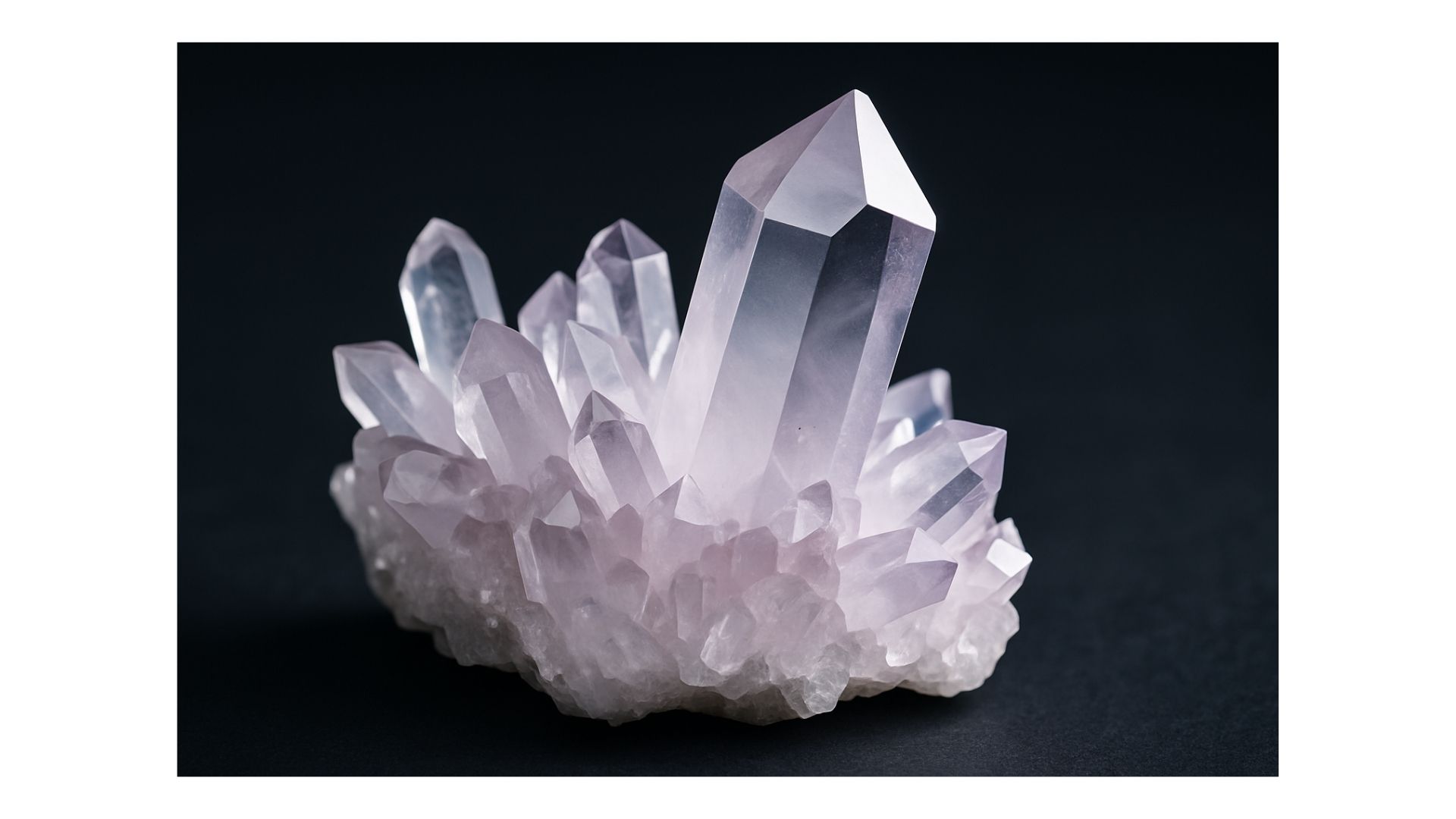
3D Mystery Hidden in Crystal Structures
Dr. Emanuel Indrei and Dr. Aram Karakhanyan prove that, under broad conditions on the forces involved, three-dimensional crystal shapes that minimize energy are convex, at least for small masses.


Understanding the natural geometry of crystals has long fascinated scientists, especially when studying how materials behave at different temperatures and pressures. One major question in this area is whether the shapes that form when energy is minimized are always curved outward—what scientists call convex, meaning that no part of the surface caves inward. This question becomes even more interesting when you look at shapes in three dimensions, where things get much more complex.
Dr. Emanuel Indrei from Kennesaw State University and Dr. Aram Karakhanyan from the University of Edinburgh have taken on this challenge by studying a well-known mathematical problem related to crystal formation. Their findings, published in the journal Mathematics, explore whether crystals formed through energy balancing—that is, finding the most efficient shape for a given mass—naturally take on convex shapes when certain general rules are followed.
At the center of their study is a detailed mathematical demonstration—a step-by-step proof—showing that, under specific conditions, the shapes that use the least energy are indeed convex in three dimensions. Dr. Indrei and Dr. Karakhanyan looked at situations where the forces involved push outward evenly and the total energy stays within a set limit. They found that either all the optimal shapes are convex or at least the ones formed with smaller amounts of material are. They came to this conclusion using known results about stability, meaning how resistant a shape is to changes, obtained by Dr. Indrei and recently published in the journal Calculus of Variations and Partial Differential Equations, as well as mathematical tools that deal with how changes in energy relate to shape.
Their results matter because they help clarify which types of forces and energy patterns guarantee convex crystal shapes. In cases where the pulling forces are the same in all directions and the potential energy increases with distance from the center—known as radial symmetry—their findings show that convex shapes will always result. As the researchers explained, “Our theorem implies convexity for a large collection of potentials; our argument is also inclusive of non-convex potentials.”
A particularly interesting part of their work involves a new way to test for convexity by looking at how the shape bends, or curves. The researchers discovered that, under a regularity assumption on the energy, if a crystal flattens out at one point, it has to be flat everywhere in a neighborhood—meaning the shape can’t curve in at some parts and out at others. This provides a useful tool for predicting when and where a crystal might lose its outward curve and gives a clearer picture of how consistent the shape remains.
Summing up their research, Dr. Indrei and Dr. Karakhanyan pointed to the importance of consistent outward curvature and resistance to small changes for smaller amounts of material. When these factors are present, the resulting shapes not only remain convex but also don’t easily lose their form. Their findings suggest that the shapes of crystals follow underlying rules that are more orderly than they may appear. “Our new idea for the three-dimensional Almgren problem is to utilize a stability theorem…and the first variation in the free-energy PDE with a new maximum principle approach,” said the researchers.
Here, PDE refers to a partial differential equation, a kind of equation often used to describe how physical quantities like energy or heat change in space and time. The maximum principle is a mathematical rule that helps predict how a function behaves based on boundaries.
This study marks an important step forward in understanding how and why crystals form the shapes they do when energy is minimized. It continues a long tradition of using mathematics to explain the physical world—a tradition dating back to pioneers like Gibbs and Curie. This new research could help guide both future theoretical studies and practical efforts to model and design materials with specific shapes and properties.
About the researchers

Emanuel Indrei
Emanuel Indrei is an Assistant Professor of Mathematics at Kennesaw State University. He received his Ph.D. in Mathematics from the University of Texas at Austin in 2013. His doctoral thesis was selected for the Frank Gerth III Dissertation Award.… He was a 2012 NSF EAPSI Fellow, a Postdoctoral Fellow at the Australian National University, a Huneke Postdoctoral Scholar at the Mathematical Sciences Research Institute in Berkeley CA, and a PIRE Postdoctoral Associate at Carnegie Mellon University. The main themes in his research are nonlinear PDEs, free boundary problems, and geometric & functional inequalities. In the past few years, he proved the non-transversal intersection conjecture, solved Almgren’s problem in two dimensions (also in one dimension), and made progress on the Polya-Szego conjecture for the first eigenvalue of the Laplacian on polygons.

Aram Karakhanyan
Aram Karakhanyan is an Associate Professor of Mathematics at the University of Edinburgh, where he explores nonlinear partial differential equations and geometric analysis. His research spans capillary and K-surfaces, the Monge–Ampère equation, reflector surfaces, phase transitions, and free boundary problems.… Notably, he solved the near-field reflector problem—once listed among Yau’s 100 open challenges—and has advanced understanding of obstacle problems and nonlinear elasticity. His contributions extend to homogenization theory, examining the regularity of minimizers under complex constraints. Karakhanyan has secured multiple multi-year grants, including EPSRC fellowships and a Polonez award, and he leads interdisciplinary teams tackling analytic challenges. He regularly collaborates internationally and mentors graduate students at the forefront of mathematical analysis.
Journal reference
Indrei, E., Karakhanyan, A. “On the Three-Dimensional Shape of a Crystal.” Mathematics, 2025; 13(4): 614. DOI: https://doi.org/10.3390/math13040614
Indrei, E. “On the equilibrium shape of a crystal.” Calc. Var. Partial. Differ. Equ. 2024, 63, 97. DOI: https://doi.org/10.1007/s00526-024-02716-6