The Shocking Truth About Why Professors Resist Better Teaching Methods
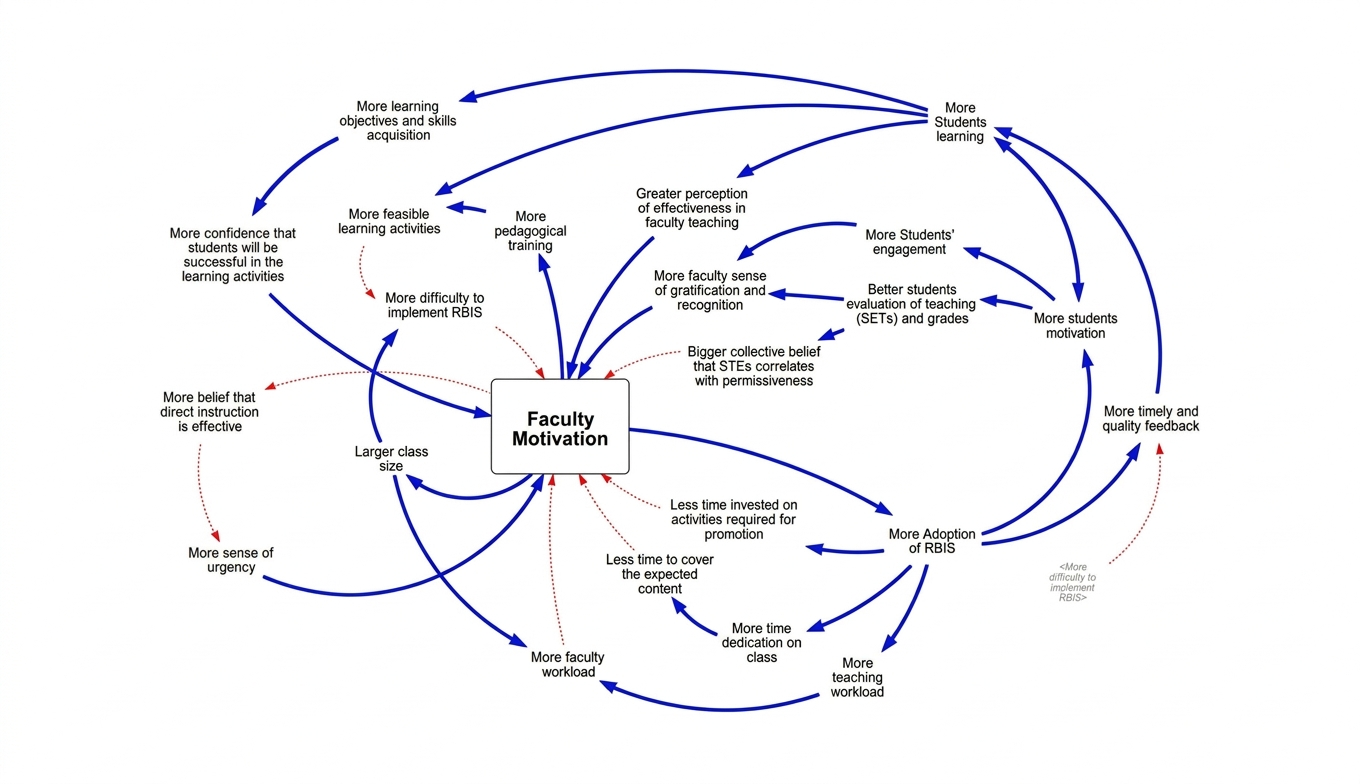
Dr. Juan Cruz's team built a conceptual systems model showing how promotion priorities, workload, training and student engagement interact to support or block faculty adoption of research-based teaching methods.


Understanding what motivates faculty to use new teaching methods is crucial for improving education quality in universities. Many institutions introduce programs to improve teaching, yet their success varies. Research by Dr. Juan Cruz from Rowan University, Dr. Stephanie Adams from the University of Texas at Dallas, and Dr. Flor Bravo from Universidad Nacional de Colombia examines how different factors influence faculty motivation to adopt research-supported teaching methods. Their findings are published in the journal Education Sciences.
Unlike traditional views that see instructional change as a simple process, this study uses a Conceptual Systems Dynamics Model, a method that examines how different elements in a system influence each other over time, to analyze how various factors interact to influence faculty motivation. “By understanding faculty motivation as part of a system, we can see the patterns that either support or block change,” explained Dr. Cruz. The research identifies thirteen cause-and-effect cycles, which are patterns where one action leads to another, often creating either a reinforcing or opposing effect, including seven that encourage faculty to adopt research-supported teaching methods and six that create obstacles.
One major finding is the effect of workload. Professors often struggle to balance research, teaching, and administrative duties, leading to time constraints. Dr. Cruz and his colleagues’ study shows that when universities focus on research output, meaning the number and quality of research publications produced by faculty, for promotions, they unintentionally discourage faculty from improving their teaching. As one professor explained, “There is a clear career path: publishing is the priority. Even if you enhance your teaching, it does not count as much as publishing a research article.” This situation leads faculty to focus more on research than on adopting new teaching methods.
Another key factor is whether faculty feel that research-supported teaching methods are practical. Professors are more likely to use these strategies when they receive training and institutional support. The study found that faculty who took part in professional development programs, training sessions designed to help faculty improve their teaching and stay updated on new educational methods, and discussed teaching approaches with colleagues felt more confident in using research-supported teaching methods. Additionally, smaller class sizes and assistance, such as teaching aides, help make these methods easier to implement.
Student engagement, which refers to how actively students participate in their learning and classroom activities, and learning outcomes also influence faculty motivation. Professors who see students responding positively to research-supported teaching methods are more likely to continue using them. The study emphasizes that when students participate actively and show better understanding, faculty feel more encouraged. “Seeing students excited about learning through interactive methods strengthens my commitment to these strategies,” said one participant.
Dr. Cruz and his team’s study highlights the challenges of improving teaching in universities. By addressing key barriers—such as outdated promotion policies, heavy workloads, and limited training—universities can create an environment that supports lasting improvements. The research provides useful insights for university leaders and policymakers who want to enhance teaching quality through faculty-driven initiatives.
About the researchers

Juan M. Cruz-Bohorquez
Juan M. Cruz-Bohorquez, Ph.D., is an associate professor and Research Program Chair in the Experiential Engineering Education program at Rowan University’s Henry M. Rowan College of Engineering. With a diverse academic background that includes a Ph.D.… in Engineering Education from Virginia Tech, a Master’s in Education, and a Bachelor’s in Electronic Engineering from Universidad Javeriana in Colombia, Dr. Cruz brings a rich blend of technical expertise and educational insight to his work. Dr. Cruz’s research focuses on understanding and improving the dynamics of engineering education through a systems perspective. He is passionate about exploring how academic environments influence faculty motivation to adopt innovative instructional practices, enhance student motivation and learning, and support doctoral student retention and success. A significant strand of his work addresses equity and inclusion, particularly through initiatives designed to bolster persistence for underrepresented students in doctoral programs. At Rowan, he leads efforts to advance pedagogical innovation and to disrupt inequalities in engineering education, striving to equip both students and educators with the tools they need to thrive in a rapidly evolving academic landscape.

Dr. Stephanie G. Adams
Dr. Stephanie G. Adams is an engineering education thought leader who has served as the fifth dean of the Erik Jonsson School of Engineering and Computer Science since 2019. She is also a professor of systems engineering. Adams is a pioneer in engineering education.… In 2003 she received a National Science Foundation (NSF) Faculty Early Career Development (CAREER) award to research effective teaming in the engineering classroom. In addition to teamwork and team effectiveness, her other areas of research expertise include broadening participation in STEM (science, technology, engineering and mathematics), faculty and graduate student development, global education, and quality control and management. Adams is an honors graduate of North Carolina A&T State University, where she earned a Bachelor of Science in mechanical engineering. She earned a Master of Engineering in systems engineering from the University of Virginia, and a PhD in interdisciplinary engineering and management from Texas A&M University, where she concentrated on industrial engineering and management.
Journal reference
Cruz-Bohorquez J.M., Adams S.G., Bravo F.A. “The Academic System Influence on Instructional Change: A Conceptual Systems Dynamics Model of Faculty Motivation to Adopt Research-Based Instructional Strategies.” Education Sciences, 2024. DOI: https://doi.org/10.3390/educsci14050544