Could Every Natural System and Every Network Be Built From a Few Simple Interactions?
Julian Hart proposes that a small set of basic interaction types, defined by energy, information and timing, could serve as shared building blocks for gases, solids, living things and societies.


“We’ve discovered fundamental particles. Could there also be fundamental interactions?”
Scientists study systems everywhere, from clouds and cells to businesses and galaxies. When systems thinking, the study of how parts combine into working wholes, became a science, its founders hoped for a classification of system types that would hold across every discipline. That goal was never reached. Earlier schemes rarely defined what truly separates one type from another, seldom used mathematics and stayed within single fields, so similar patterns risk being rediscovered under different names.
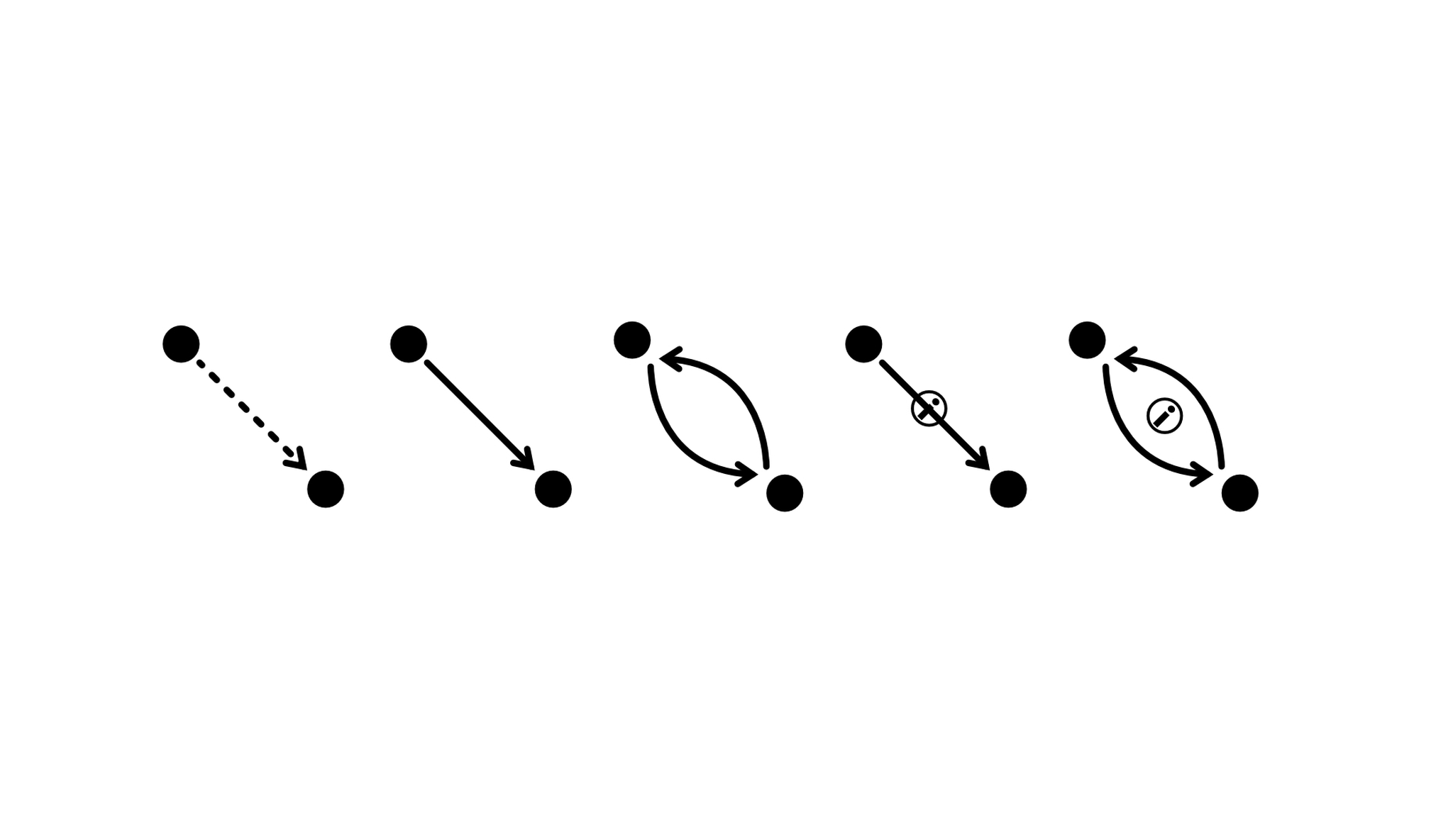
Working independently from Marlow in the United Kingdom, Julian Hart has proposed a way to give systems science the common foundation it has lacked. Hart’s proposal starts from the smallest possible unit: a single interaction between a pair of parts. He argues that only a small, fixed set of five basic interaction types exists, and that every naturally occurring system and every network, from atoms to societies, is assembled from this quintet. The work is published in the peer-reviewed journal, Philosophies.
The reasoning starts with graph theory, the mathematics of networks, which pictures any system as a collection of points (or parts) joined by lines. Physics adds that every real interaction between any two points transfers energy, and some transfers also carry information that a receiving part can register. Once time is taken into account, a pair of parts can be linked in only a few ways: a one-off event, a lasting one-way relationship, or a cycle in which energy loops back. Pairing these patterns with both kinds of transfer (energy and information), then restating the result in category theory, a branch of mathematics that studies how structures relate, leaves a short list of five building blocks that cannot be reduced to each other. One-off events carrying information are excluded, because a single event cannot reliably pass on a message.
Hart then pictures idealised systems each made entirely of one of these interaction types. Those built only from one-off collisions behave like gases, those held together by lasting links form solids, and those based on loops of energy resemble liquids. “The well-versed distinction between gases, solids and liquids can be understood not because of differences in material density or bonding strength but arising from fundamentally different interaction typologies,” explained Hart. When information travels along one-way links, systems can regulate themselves, as a thermostat does. When information circulates in loops, systems can learn.
These pure systems are abstractions, where all real systems represent compositions of interaction types. In Hart’s account, a living organism uses one-off energy exchanges for its metabolism, lasting links to grow structure, cycles to drive internal cyclic processes and ultimately reproduce, one-way information links for self-regulation and the senses, and information loops for memory and intelligence. A business shows exactly the same layers, manifesting in terms of cash flow, a contractual hierarchy, unionization, market-driven processes and information management, while systems studied in the social sciences such as marketplaces, bureaucracies and communities correspond respectively to the gas-like, solid-like and liquid-like types.
Hart reports that no earlier thinker appears to have explicitly proposed such a small, fixed set of fundamental interaction types. The scheme could offer a single vocabulary for physical, biological and social systems, a firmer basis for computer models of many interacting agents, and might help better explain why phase changes between solid, liquid and gas occur at specific temperatures rather than gradually. “The framework does not replace existing domain-specific theories, nor unify the sciences under a single set of laws,” he said. But the approach “would make it easier to explore whether apparently similar phenomena in different domains are structurally homologous or merely analogous”.
Hart presents the proposal as a falsifiable hypothesis, one that evidence could prove wrong. It would fail if someone found another stable kind of interaction outside the set, such as information passing back and forth without any lasting energy link, or a property like liquidity without cyclic interactions. “The claim is a hypothesis about nature and would be falsified by another stable, physically distinct mode,” he added. He invites others to search for such counterexamples and take up the challenge of proving it wrong. If evidence supports it, he argues, the approach could break down barriers between scientific fields and reveal that systems and networks once treated as being dissimilar and unrelated might actually work in very similar ways.
About the researcher

Julian Hart
Julian Hart obtained a Bachelor of Science in Chemistry at Bristol University (UK) and a Masters of Science in Environmental Pollution Science from Brunel University (London). He spent his early career working in environmental consultancy and undertook research towards an Engineering Doctorate in Environmental Technology, focusing on formulating indices for sustainable development.… He has been a visiting lecturer on sustainable design and urban regeneration at Harvard, MIT, University College London and Oxford University. His subsequent career has progressed into urban regeneration and property development, where he has been instrumental in delivering over 10,000 new homes across the London region, including several major estate regeneration projects. He is a published author on urban design theory – Towns and Cities: Function in Form. He is an independent researcher with a keen interest in finding better metaphysical and scientific explanations for some of sciences’ major conundrums, such as unifying the physical and life sciences, understanding the role of cooperation in evolution theory, and deducing the origins of human personality.
Journal reference
Hart J. Towards an Ontology of Interaction: Universal Building Blocks for Naturally Occurring Systems. Philosophies. 2026; 11(5):188. DOI: https://doi.org/10.3390/philosophies11050188