Enigmas of gender and cooperation in social dilemmas
Professor Andrew Colman's team found that cooperation did not steadily decline over many rounds of Prisoner's Dilemma games, and that male pairs cooperated far more than female pairs.


When the classic Prisoner’s Dilemma (PD) game is played repeatedly over many rounds, is cooperation maintained? And do male pairs cooperate almost twice as much as female pairs? Both findings were reported in a very large US experiment published over half a century ago. Now, an experimental study using more rigorous methodological and statistical techniques and much larger financial incentives have corroborated both major findings in a UK population, despite major shifts in the status of women and gender attitudes over the intervening decades. A research group from the University of Leicester, UK – Andrew Colman, Briony Pulford, and Eva Krockow – investigated cooperation in a computer-controlled experiment in which 150 men and women played 300 rounds of two different PD games in fixed pairs. The work is published in the journal Acta Psychologica.
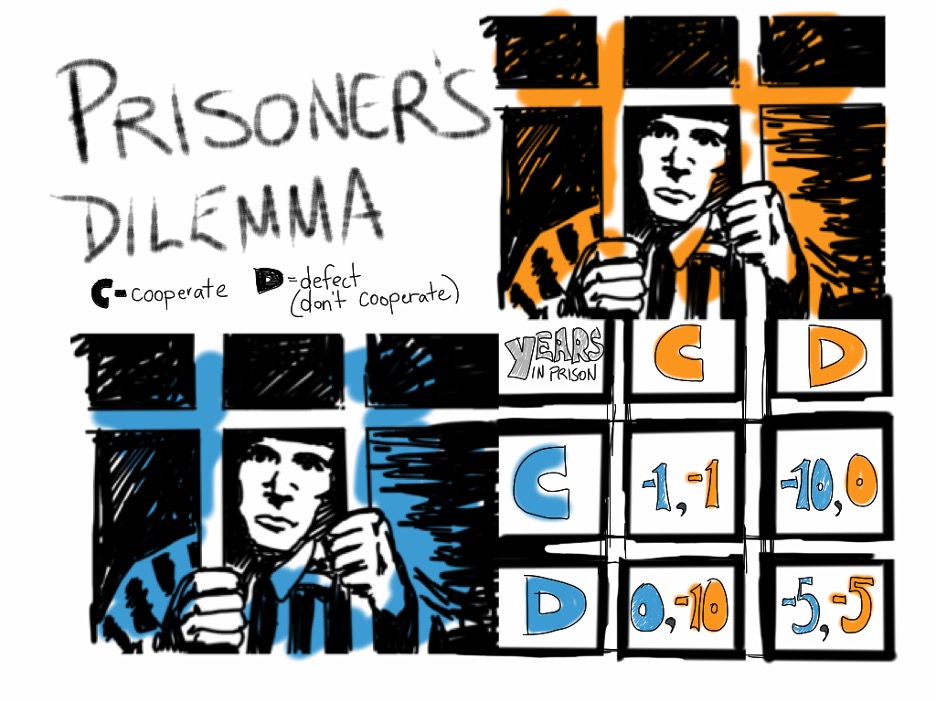
The PD game represents the strategic structure of any interaction in which two people do better by both cooperating than by both defecting (not cooperating) but are each tempted to defect to get the best possible payoff for themselves and leave the other person with the worst possible payoff. According to game theory, rational players who know in advance the number of rounds that they will be playing should defect on every round, because defection pays better than cooperation whether the other person cooperates or defects but experiments invariably find high levels of cooperation.
It has been widely reported in the literature that cooperation declines in repeated PD, but in most experiments, only a small number of repetitions were used. The apparent declines were not confirmed by statistical time-series analysis and may have been simple endgame effects. It was established many years ago that players tend to cooperate less in the last few rounds, when they see the end approaching, and this can be mistaken for cooperation declining steadily over repetitions. The Leicester researchers confirmed the endgame effect in all six groups that they studied (see the attached graphs), although time-series analysis confirmed that there was no significant overall decline in any of the groups.
The US scientists reported an initial decline in cooperation followed by steadily increasing cooperation, but this can be attributed to an unintentional quasi-endgame effect in their study, according to the Leicester researchers. The US participants were asked to calculate their losses and gains at the end of 25 rounds, and this may have created a quasi-endgame effect, reducing cooperation.
The Leicester researchers also replicated the huge gender difference originally found in the US in the 1960s: women paired with women cooperated much less than men paired with men, with mixed-gender pairs showing intermediate levels of cooperation. This gender difference is a puzzle.
It is much larger than most psychological gender differences and runs counter to conventional sex-role stereotypes. It cannot be explained by players adapting their levels of cooperation to the genders of their co-players, because in the UK experiment, players had no way of knowing the genders of their co-players.
Professor Colman commented to Science Featured: “Our most important finding was that the frequently claimed decline in cooperation over repetitions appears to be a misconception, perhaps driven by an expectation that there ought to be a steady convergence toward the game-theoretic equilibrium of joint defection as players come to understand the game better through experience. That is clearly not the case.” On the gender difference in cooperation, Professor Colman said: “Some researchers have attributed this to risk aversion in women, but that can’t be right, because the same difference occurs in repeated Chicken games, where greater risk aversion would make women more cooperative than men. In PD, cooperation risks the worst payoff, but in Chicken, it is a defection that risks the worst payoff.” How, then, can the gender difference be explained? According to Professor Colman: “It may possibly be related to women being more socially oriented and therefore more concerned than men about relative rather than absolute payoffs. In the PD and Chicken, defecting is the only way of guaranteeing not to come off worse than your co-player.”
Image Credit
Giulia Forsythe, Flickr

About the researchers

Andrew M. Colman
Andrew M. Colman is a Professor of Psychology at the University of Leicester, a Fellow of the British Psychological Society, and a Fellow of the Higher Education Academy.… He graduated from the University of Cape Town, where he was appointed to his first lecturing position, and he then lectured at Rhodes University before moving to Leicester. His main research interests are in judgment and decision making, game theory and experimental games, cooperative reasoning, the evolution of cooperation, and psychometrics. His is the author of over 160 peer-reviewed journal articles and several books, including the Oxford Dictionary of Psychology (4th edn, 2015), A Crash Course in SPSS for Windows (4th edn, co-authored with Briony D. Pulford, 2008), Game theory and its Applications in the Social and Biological Sciences (2nd edn, 1995), What is Psychology? (3rd edn, 1999) , and Facts, Fallacies and Frauds in Psychology (1987). He edited the Routledge Companion Encyclopedia of Psychology (1994), the 12-volume Longman Essential Psychology Series (1995).

Briony Pulford
Briony Pulford is an Associate Professor of psychology at the University of Leicester where she has worked since 2004. She has led the multidisciplinary Leicester Judgment and Decision Making Research Group since 2010. Her interests lie in both social and cognitive psychology.… Briony’s research spans many areas of judgment and decision making, with particular interests in cooperation, team reasoning, game theory, overconfidence, the communication and perception of confidence, trust, moral judgment, and ambiguity aversion. Her Ph.D. concerned how overconfident people are in their judgements, but since then she has been working on how people perceive and interpret confidence and uncertainty in communication and how this affects decision-making. She has been involved in testing the confidence heuristic and examining how people make use of information about other people’s confidence. In her game theory research, Briony says that one of her most exciting research moments was finding out that there was no decline in cooperation in repeated Prisoner’s Dilemma games and that Rapoport and Chammah’s classic findings were most likely due to methodological problems and quasi-endgame effects only appearing to cause a decline.

Dr. Eva Krockow
Dr. Eva Krockow is a Lecturer (Assistant Professor) in Psychology at the University of Leicester, and the Leader of the Department of Neuroscience, Psychology and Behaviour’s Health & Wellbeing Research Group. Her research focuses on understanding core principles of cooperation and defection, which she studies by modelling human choices in abstract, experimental games.… More recently, Eva has been applying this theoretical knowledge to the area of medical decision making including antibiotic use. She is particularly interested in perceptions of risk and uncertainty underlying antibiotic treatment choices and in collective intelligence approaches for optimizing health-related decisions. Part of Eva’s work also involves the analysis of cross-cultural differences in decision-making. Most recently, her international research has taken her to Japan, Sri Lanka and South Africa. Eva uses a variety of methodological approaches in her research including qualitative interviews, quantitative experiments and computational modelling. Eva is passionate about science communication and writes regular blogs featuring decision-making research for Psychology Today (https://www.psychologytoday.com/gb/blog/stretching-theory).
Journal reference
Colman, Andrew M., Pulford, Briony D., and Krockow, Eva M. “Persistent cooperation and gender differences in repeated Prisoner’s dilemma games: some things never change.” Acta Psychologica, 187 (2018): 1–8. DOI: https://doi.org/10.1016/j.actpsy.2018.04.014