Bioengineered Salivary Glands Could End Dry Mouth Suffering
Professor Susan Sharfstein's team reviewed progress in salivary gland bioengineering, from stem cells and gene therapy to bioprinted scaffolds, as possible routes to lasting treatment for dry mouth.


Salivary gland dysfunction affects millions of people worldwide, leading to conditions such as xerostomia, or dry mouth, which significantly impacts quality of life. This condition is prevalent among the elderly and patients undergoing radiation therapy for head and neck cancers. Xerostomia can cause difficulties in speaking, eating, and swallowing, and can lead to oral infections and dental decay due to reduced saliva production. Currently, available treatments provide only temporary relief and often come with side effects. These treatments include saliva stimulants and substitutes, but they do not address the underlying glandular damage. However, promising new research in tissue engineering offers hope for more effective and lasting solutions by focusing on regenerating the damaged tissues and restoring normal gland function.
Researchers from the University at Albany, led by Professor Susan Sharfstein, along with Stephen Rose, Professor Melinda Larsen, and Professor Yubing Xie, have conducted an extensive review of current advancements in salivary gland tissue engineering. This review, published in the journal Bioengineering, highlights the latest developments and future directions in this rapidly evolving field.
Salivary gland bioengineering focuses on restoring the gland’s ability to produce saliva through innovative techniques such as gene therapy, stem cell-based therapy, and the use of supportive biomaterials and scaffold fabrication methods. The researchers explored a range of cells suitable for tissue engineering, including cell lines, primary salivary gland cells, and stem cells. These cells are essential for enhancing salivary gland cell survival, differentiation, and engraftment.
Professor Sharfstein explained, “Our study delves into the impact of fibrosis and cellular senescence on salivary gland pathologies and evaluates innovative engineering strategies to improve vascularization, innervation, and engraftment of engineered salivary gland tissue.” The review underscores the potential of bioprinting, microfluidic hydrogels, mesh electronics, and nanoparticles in advancing salivary gland tissue regeneration.
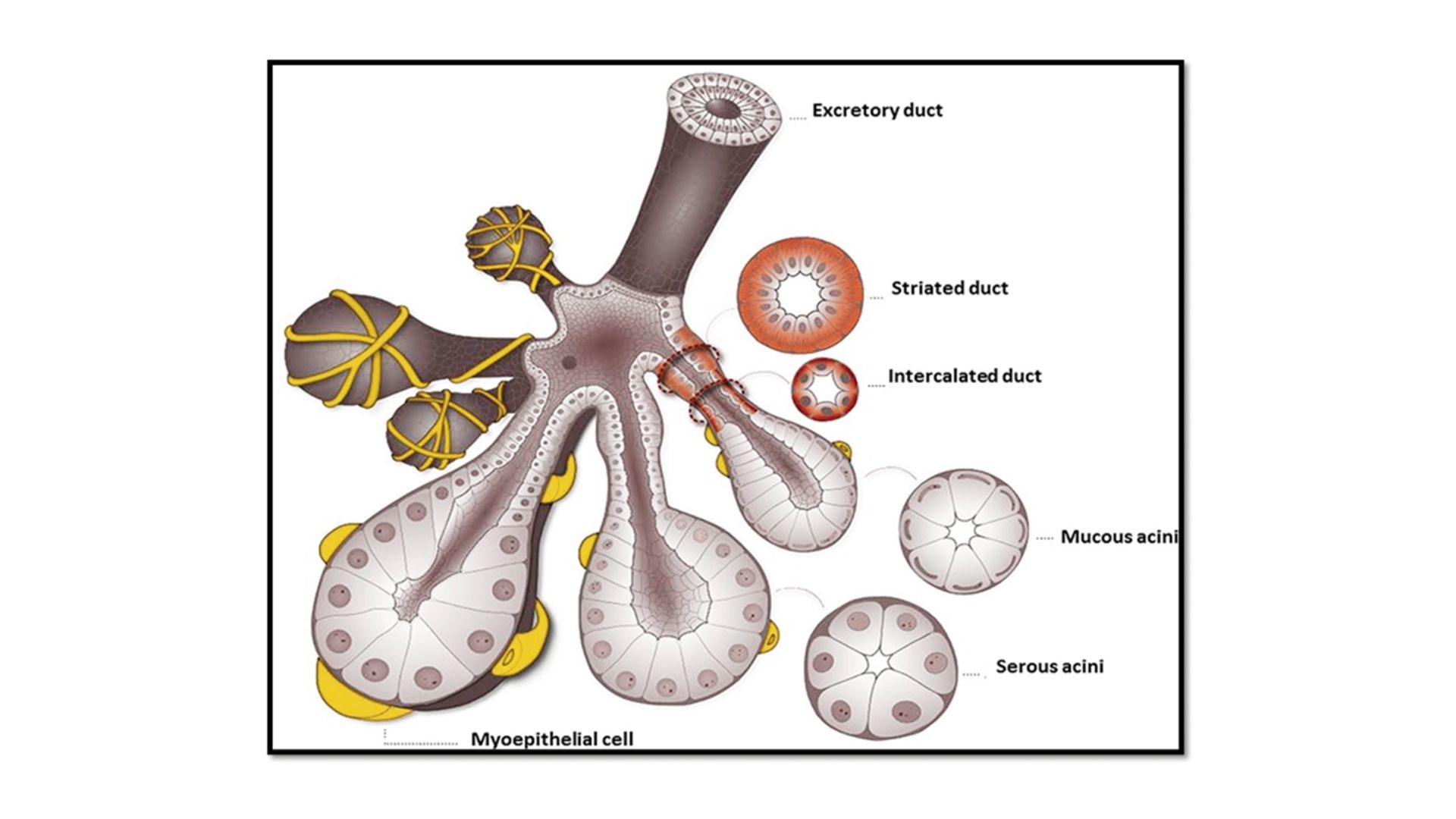
The study also discusses the importance of understanding the molecular mechanisms behind salivary gland development and function. Salivary glands are composed of three major types: parotid, submandibular, and sublingual glands, each producing different components of saliva. The coordinated efforts of multiple cell types, including acinar, myoepithelial, basal, and ductal cells, are crucial for saliva production.
Professor Sharfstein noted, “Fibroblast growth factors (FGFs) and other morphogens play a pivotal role in the development and branching morphogenesis of salivary glands. Understanding these molecular cues is essential for creating effective tissue engineering strategies.”
The review highlights the challenges posed by fibrosis and cellular senescence in salivary gland pathologies. Conditions like Sjögren’s syndrome and radiation-induced damage lead to an increase in senescent cells and fibrosis, further complicating the regeneration process. The researchers emphasize the need for tissue replacement and the creation of a host tissue environment conducive to regeneration.
Professor Sharfstein stated, “Senescent cells produce secreted factors that can drive neighboring cells to senescence, creating a cycle that impedes tissue regeneration. Our review suggests strategies to mitigate or reverse these effects, which is crucial for successful salivary gland bioengineering.”
In conclusion, Professor Susan Sharfstein and her colleagues highlight the potential of regenerative medicine and tissue engineering in providing more effective treatments for salivary gland dysfunction. By leveraging advanced techniques and a deeper understanding of salivary gland biology, these innovative approaches hold promise for improving the quality of life for millions of individuals suffering from xerostomia and related conditions.
About the researchers

Professor Susan T. Sharfstein
Professor Susan T. Sharfstein is a leading academic in the College of Nanoscale Science & Engineering at the University at Albany (SUNY). She holds a PhD in Chemical Engineering (UC Berkeley, 1993) and a BS with honors in Chemical Engineering (Caltech, 1987).… Her research centers on optimizing mammalian cell systems—particularly focusing on protein and carbohydrate production—in biomanufacturing contexts, including the use of omics tools to enhance heparin and monoclonal antibody production in CHO cells. She has received notable recognition such as a 2023 SUNY Chancellor’s Award for Excellence in Scholarship and multiple fellowships. Her lab also recently secured an NSF SBIR grant to support AI-driven drug discovery.

Stephen Christopher Rose
Stephen Christopher Rose is a researcher affiliated with the Sharfstein Lab at the University at Albany. His work emphasizes advancing healthspan through bioengineering and nanotechnology. He develops innovative 3D in vitro models to study fibrosis and cellular senescence, working extensively in mammalian stem cell culture and bioreactor technology.

Professor Melinda Larsen
Professor Melinda Larsen is the Williams-Raycheff Endowed Professor in the Department of Biological Sciences at the University at Albany (SUNY). Her research investigates the cell and molecular mechanisms underlying branching morphogenesis, particularly in salivary gland development, with the goal of applying this knowledge to tissue regeneration and repair.… Her work addresses epithelial–mesenchymal interactions, extracellular matrix signaling, and the engineering of regenerative medicine approaches for salivary hypofunction. She has also recently been inducted as a Fellow of the American Institute for Medical and Biological Engineering.

Dr. Yubing Xie
Dr. Yubing Xie is a Professor in the College of Nanoscale Science & Engineering at the University at Albany (SUNY) and Director of the Functional and Integrative Tissue Regeneration Center.… She completed her BS in Chemical Engineering at Dalian University of Technology, and her MS and PhD in Chemical Engineering at the Dalian Institute of Chemical Physics, Chinese Academy of Sciences, followed by postdoctoral training in stem cell biology and tissue engineering at Ohio State University. Her expertise spans nanobiotechnology, bioengineering, stem cell therapy, tissue engineering, and regenerative medicine. In 2025, she was inducted into the AIMBE College of Fellows—one of the highest honors in biomedical engineering.
Journal reference
Rose, Stephen C., Melinda Larsen, Yubing Xie, and Susan T. Sharfstein. “Salivary Gland Bioengineering.” Bioengineering, 11 (2024): 28. DOI: https://doi.org/10.3390/bioengineering11010028