The Key to Cholangiocarcinoma Treatment Lies in SERPINE1
Professor Paul Higgins's team reviewed evidence that the protein made by the SERPINE1 gene helps bile duct cancer grow and resist treatment within the dense tissue around tumours.


Cholangiocarcinoma, a rare but highly aggressive cancer of the bile ducts, represents one of the most challenging battles in the fight against cancer. This stealthy disease often goes undetected until it reaches an advanced stage, making it difficult to treat and leading to a poor prognosis for many patients. As the complex environment surrounding these tumors is explored further, hidden forces that allow cholangiocarcinoma to thrive and resist treatment are being uncovered. At the heart of this discovery is a protein that could hold the key to new, more effective therapies.
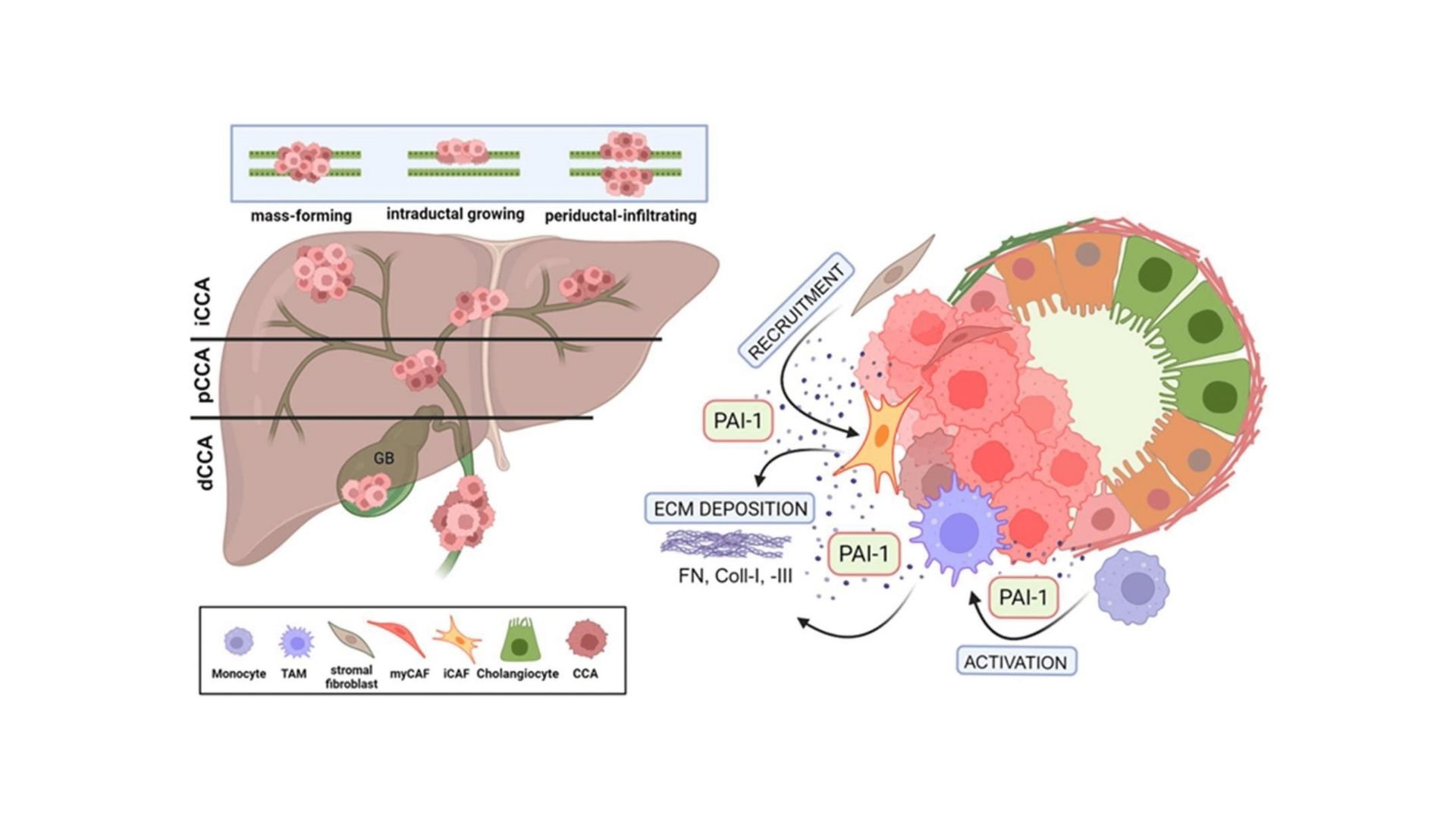
Researchers from Albany Medical College, led by Professor Paul Higgins and in collaboration with Dr. Ralf-Peter Czekay, Dr. Hasan Aydin, Dr. Rohan Samarakoon, Dr. Nusret Subasi, Dr. Hwajeong Lee, Craig Higgins and Stephen Higgins, recently reviewed current data to provide crucial insights into the role of SERPINE1 in the progression of cholangiocarcinoma (CCA). Their study, published in Cells, sheds light on how the tumor microenvironment (TME) in CCA is shaped by cancer-associated fibroblasts (CAFs) and how this, in turn, drives tumor progression and resistance to treatment.
The researchers emphasize that the desmoplastic reaction—a process involving the accumulation of a dense, fibrotic matrix around the tumor—is a key factor in the poor prognosis and resistance to chemotherapy seen in cholangiocarcinoma. Within this fibrotic environment, CAFs play a central role by remodeling the extracellular matrix (ECM), promoting tumor cell survival, and fostering a milieu conducive to cancer growth and spread.
SERPINE1, a gene that encodes plasminogen activator inhibitor-1 (PAI-1), is identified as a significant player in this process. The study reveals that PAI-1 is heavily involved in ECM remodeling, enhancing the fibrotic nature of the TME. PAI-1 not only supports the physical structure of the tumor’s surroundings but also contributes to cancer cell invasion, metastasis, and resistance to cell death. “PAI-1’s multifunctional role in CCA progression makes it a potential therapeutic target, especially given its contribution to the aggressive and drug-resistant nature of these tumors,” explained Professor Higgins in a discussion about the findings.
The team explored the complex signaling pathways that facilitate the interplay between CAFs and tumor cells. The TGF-β pathway, particularly through its interaction with SERPINE1, was highlighted as a major driver of the desmoplastic reaction in CCA. This pathway not only enhances the fibrotic environment but also promotes the stemness and plasticity of cancer cells, making them more adaptable and resistant to therapies.
In an effort to disrupt this harmful interaction, the study suggests that targeting PAI-1 or its associated pathways could prove beneficial. Experimental knockdown of PAI-1 in cholangiocarcinoma cells led to a significant reduction in cell motility, indicating that inhibiting PAI-1 could potentially slow down or prevent the spread of the cancer. “Our findings suggest that targeting PAI-1 in the tumor microenvironment could offer a new therapeutic approach for treating cholangiocarcinoma, particularly in cases where the tumor is resistant to conventional therapies,” added Professor Higgins.
This research by Professor Higgins and his colleagues not only enhances our understanding of the molecular mechanisms driving cholangiocarcinoma but also opens new avenues for therapeutic intervention. By targeting the components of the TME that facilitate tumor growth and resistance, their work offers the potential to improve outcomes for patients suffering from this challenging disease.
About the researchers

Paul J. Higgins
Paul J. Higgins received his Ph.D. degree in molecular biology from New York University in 1976. He joined the faculty of the Memorial Sloan-Kettering Cancer Center and the Cornell University School of Medicine in 1977, where he was a member in the Cell Biology/Genetics and Molecular Biology/Virology Programs. Dr.… Higgins is currently a Professor and Chair of the Department of Regenerative and Cancer Cell Biology at the Albany Medical College in Albany, New York. He was the founding Vice President of the Albany Research Institute (ARI) and currently serves on the ARI Board of Directors. He has served as Chairman of numerous National Institutes of Health and Department of Defense Review Panels, is a member of a number of federal and international study sections and received several prestigious awards including the Moyer Award and the 2008 Excellence Award in Molecular Medicine. Dr. Higgins is a member of several journal editorial boards, edited books on cancer biology, and published more than 300 peer-reviewed scientific papers.

Ralf-Peter Czekay
Ralf-Peter Czekay received his Ph.D. degree in physiology at the Max-Planck-Institute of Molecular Physiology in Dortmund, Germany, in 1991. He performed his postdoctoral training at the University of California - San Diego and The Scripps Research Institute, La Jolla, California, under the mentorships of Drs. Marilyn Farquhar and David Loskutoff, respectively. During the period, Dr.… Czekay developed a strong interest in the multilayered functions attributed to the serine proteinase inhibitor plasminogen activator inhibitor type 1, PAI-1, especially as they drive tumor progression in human malignancies by regulating the proteolytic landscape in the tumor microenvironment. At the time, several research groups highlighted the unexpected clinical observation that elevated expression of PAI-1 somewhat paradoxically presented as a strong marker for poor prognosis in breast cancer and shorter overall survival. Through his own research, he described a novel mechanism supporting this notion in which PAI-1 regulates tumor cell adhesion to extracellular matrix structures and overall cell motility by modulating activity of integrins, a class of cell adhesion molecules. In 2004, Dr. Czekay joined the faculty of the Department of Regenerative & Cancer Cell Biology at the Albany Medical College in Albany, New York, where he began and continues expanding his investigations of PAI-1 functions into prostate and ovarian cancer models. Currently, he is spearheading the formation of an integrative interdisciplinary research team with his colleague Dr. Paul Higgins and members of the AMC Department of Pathology of Laboratory Medicine, to design new therapeutic approaches targeting PAI-1 functions in human malignancies and pathologic fibrotic environments. Dr. Czekay published his research in peer reviewed scientific journals and presented at numerous national and international scientific conferences.

Hasan Basri Aydin
Hasan Basri Aydin graduated from Istanbul University Cerrahpasa Medical School in 2017, where he developed a strong interest in pathology. After briefly working in Turkey, Dr. Aydin moved to the United States and began pathology residency training at Albany Medical Center in 2021, focusing on gastrointestinal, liver, and pancreaticobiliary pathology.… This focus led to his acceptance into a gastrointestinal pathology fellowship at Northwell Health. Dr. Aydin’s research interests have led him to contribute to numerous publications centering around digestive system tumors and benign and malignant conditions of the liver and pancreas. Dr. Aydin is a member of The New York Pathological Society (NYPS), Rodger C. Haggitt Gastrointestinal Pathology Society (GIPS), Hans Popper Hepatopathology Society, and Pancreatobiliary Pathology Society. He has participated in nationwide pathology conferences as a presenter, including USCAP, ASCP, and CAP annual meetings. Dr. Aydin’s latest manuscript, titled “A Metastatic AFP-Producing Carcinoma of Gastric Origin Masquerading as Hepatocellular Carcinoma on Liver Biopsy,” has been published as the GIPS Case of the Month for July 2024.

Hwajeong Lee
Hwajeong Lee is a Professor of Pathology and Laboratory Medicine and the Vice Chair of Academic Affairs in the Department of Pathology of Laboratory Medicine at Albany Medical College in Albany, New York.… She completed her medical education at Yonsei University College of Medicine in Seoul, South Korea, and finished her residency training in combined anatomic and clinical pathology at Henry Ford Hospital in Detroit, followed by oncologic surgical pathology fellowship and subspecialty pathology fellowship (gastrointestinal, liver and pancreaticobiliary pathology) at Memorial Sloan Kettering Cancer Center in New York, and Cleveland Clinic in Cleveland, respectively. Her research interests focus on identifying morphological and immunohistochemical biomarkers that can aid in diagnosis, prognostication and therapy of variable neoplastic and non-neoplastic conditions of gastrointestinal tract, liver and pancreaticobiliary tract.

Nusret Bekir Subasi
Nusret Bekir Subasi is a Post Graduate Year (PGY) -1 pathology resident at Albany Medical Center in Albany, New York. After graduating Gaziantep University School of Medicine in Turkey in 2018, Dr. Subasi has had various clinical and research experiences in pathology before his current position. He is enthusiastic about possible future translational and collaborative research projects.
Journal reference
Czekay, R.-P., Higgins, C.E., Aydin, H.B., Samarakoon, R., Subasi, N.B., Higgins, S.P., Lee, H., & Higgins, P.J. (2024). “SERPINE1: Role in Cholangiocarcinoma Progression and a Therapeutic Target in the Desmoplastic Microenvironment.” Cells, 13, 796. DOI: https://doi.org/10.3390/cells13100796