Breathe Easy: Non-Invasive Gene Therapy for Anxiety and Memory Boosting
Dr. Troy Rohn's team found that a nasal spray delivering gene-silencing material to lower a serotonin receptor in brain cells reduced anxiety-like behavior and improved memory in rodents.


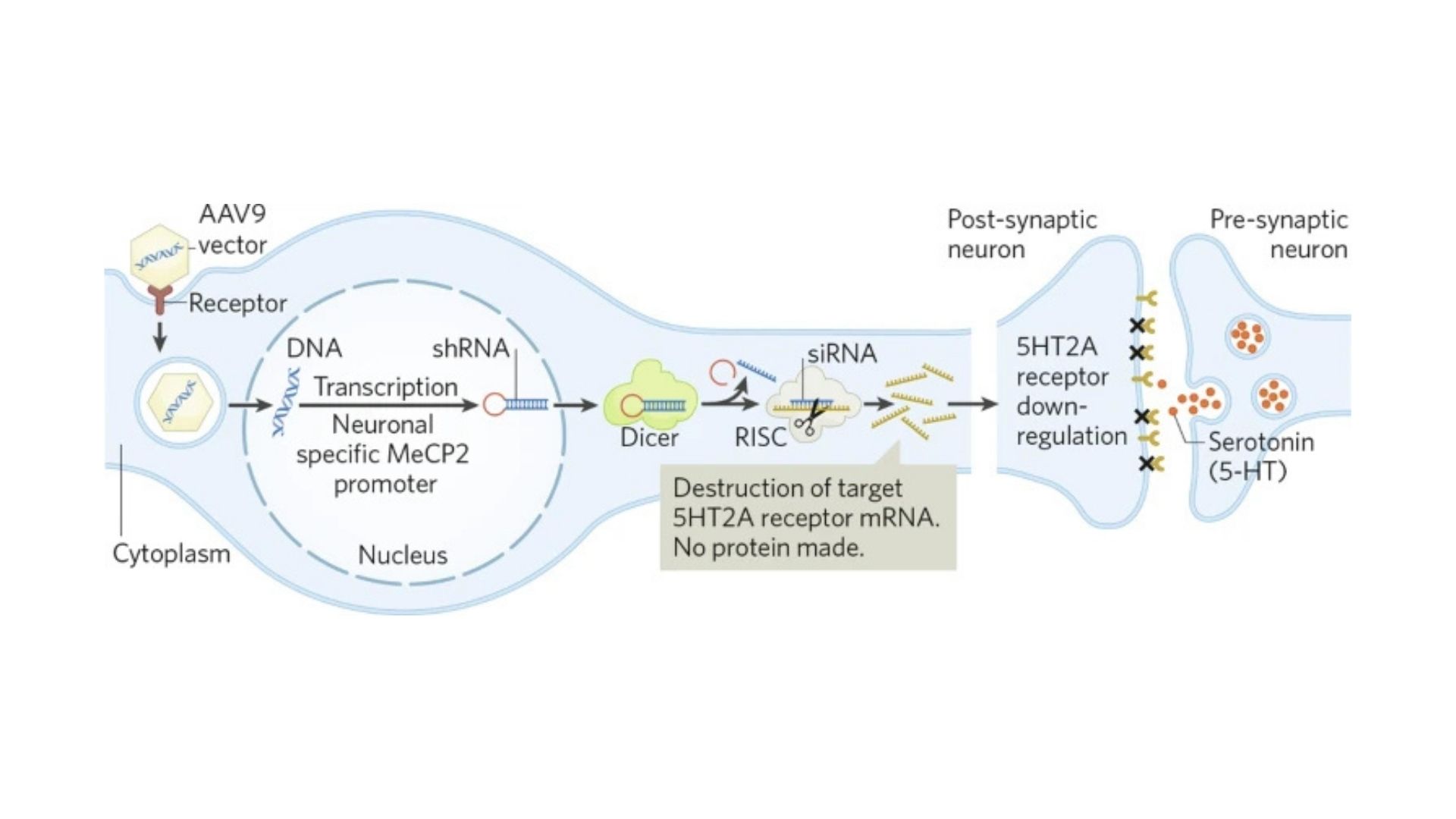
New research has revealed a promising nasal spray treatment that could help reduce anxiety and improve memory. Published in Translational Psychiatry, the study was led by Dr. Troy Rohn and colleagues from Cognigenics Inc. The Cognigenics team developed a method that delivers genetic instructions to brain cells without invasive procedures. This innovative approach uses specially designed viral particles, tiny biological carriers often used in gene therapy, to transport a small piece of genetic material known as short-hairpin ribonucleic acid. This molecule can silence specific genes, which reduces the activity of a specific brain receptor involved in anxiety and memory functions.
Dr. Rohn and colleagues focused on the HTR2A gene, which provides the instructions for making the serotonin receptor 5HT-2A. This receptor, a protein found in brain cells that helps regulate mood and memory, is a key player in these functions. By reducing its activity, the treatment aims to address issues such as chronic anxiety and age-related memory loss. In preclinical studies, the researchers showed that the treatment successfully lowered the activity of the receptor in brain cells, and tests on rodents revealed striking improvements in both memory and anxiety-related behaviors.
“By observing both the behavioral changes and the effects on brain activity, we’ve shown that this therapy has the potential to improve mental health and memory significantly,” Dr. Rohn explained. “It also highlighted the effectiveness of our non-invasive delivery method as a major advancement, offering an easier and safer alternative to treatments that require direct brain interventions.”
To test the therapy, the scientists conducted numerous experiments. For anxiety, they used a light-dark box test, a behavioral test where rodents naturally avoid brightly lit areas due to instinctive fear. After treatment, the animals spent much more time in the lit area, indicating reduced anxiety. For memory, they used a maze test and a task involving recognizing objects. In these tests, rodents must remember the layout of a maze or distinguish between familiar and unfamiliar objects. In both cases, the treated animals significantly outperformed those not receiving the therapy, showing clearer memory and quicker problem-solving abilities.
The results suggest that this therapy could be a game-changer for conditions like anxiety disorders and memory decline in individuals. The intranasal delivery system is especially notable because it avoids the need for invasive procedures while efficiently targeting the brain directly through the nasal passages, which are connected to the brain by a thin barrier. Dr. Rohn stated, “This method represents not just a treatment but a completely new way of approaching brain disorders. Its ease of use could make it accessible to many patients.”
In addition to its effectiveness, the study highlights the potential of precision medicine, an approach that tailors treatments to an individual’s unique genetic and biological profile. Cofounder Dean Radin is optimistic about the therapy’s future, emphasizing its ability to address multiple mental health issues simultaneously. “We are now designing further studies to explore the long-term effects of this therapy and the protocols for conducting clinical trials,” he said.
Dr. Rohn underscores the importance of innovative approaches in brain science. By developing a nasal spray that reduces the activity of a specific brain receptor, scientists have taken a major step toward safer and more effective treatments for mental health and cognitive disorders. Future studies will focus on refining this approach and ensuring its benefits are sustainable and widely applicable.
Image Reference
Troy T. Rohn and Dean Radin (2024). “Long-lasting genetic therapeutics for debilitating neurological conditions.” Nature Biopharmdeal, March 2024.
About the researchers

Dr. Troy T. Rohn
Dr. Troy T. Rohn received his Ph.D. in pharmacology from the University of Washington in 1994 and completed postdoctoral research at INSERM (Paris, France), Montana State University, and the Institute for Memory Impairments and Neurological Disorders at UC Irvine.Dr. Rohn is a professor in the Department of Biological Sciences at Boise State University.… He has taught and researched for the past twenty years and has published over 80 peer-reviewed articles. His research focuses on the role that specific proteases play in promoting the pathology associated with different neurodegenerative diseases. More recently, his research has focused on how the APOE4 gene contributes to late-onset AD risk.Director of Preclinical Studies, Troy.rohn@cognigenics.io

Dean Radin
Dean Radin is cofounder and chairman of Cognigenics, Chief Scientist at the Institute of Noetic Sciences, and Associated Distinguished Professor at the California Institute of Integral Studies. He earned an MS (electrical engineering) and a PhD (psychology) from the University of Illinois, Urbana-Champaign, and previously held appointments at Princeton University and University of Edinburgh.
Journal reference
Troy T. Rohn et al., “Intranasal delivery of shRNA to knockdown the 5HT-2A receptor enhances memory and alleviates anxiety.” Translational Psychiatry, 2024. DOI: https://doi.org/10.1038/s41398-024-02879-y