Immune Cells’ Role in Vaccine Development for Skin and Mucosa
Professor Andrew Harman's review explains that dendritic cells, not only Langerhans cells, capture viruses in skin and mucosal linings, with implications for designing vaccines that work at these surfaces.


Every day, countless new infections occur globally, and a significant portion of sexually active individuals are likely to contract a sexually transmitted infection by the age of 25. Viral infections like Zika, Dengue, mpox, Herpes Simplex Virus (HSV), and Human Immunodeficiency Virus (HIV) often enter the body through the skin and mucosa. The best defense against these infections is vaccination. However, to design effective vaccines, it is crucial to understand the immune cells in these tissues and how they interact with these viruses. Recent research has shed light on the complex roles of these cells, which could lead to significant advancements in vaccine development.
Researchers at the Westmead Instutute for Medical Research, University of Sydney led by Professor Andrew Harman, have made significant strides in understanding the immune cells that inhabit the stratified squamous epithelium (SSE) of the skin and mucosa. The team, including Erica Vine Dr Kirstie Bertram, Associate Professor Paul Austin, Dr Thomas O’Neil, Dr. Najla Nasr, and Professor Anthony Cunningham, have published their findings in the journals Nature Communications, PLoS Pathoges, Immunity and most recently Cell Reports, offering new insights that could revolutionize the design of mucosal vaccines.
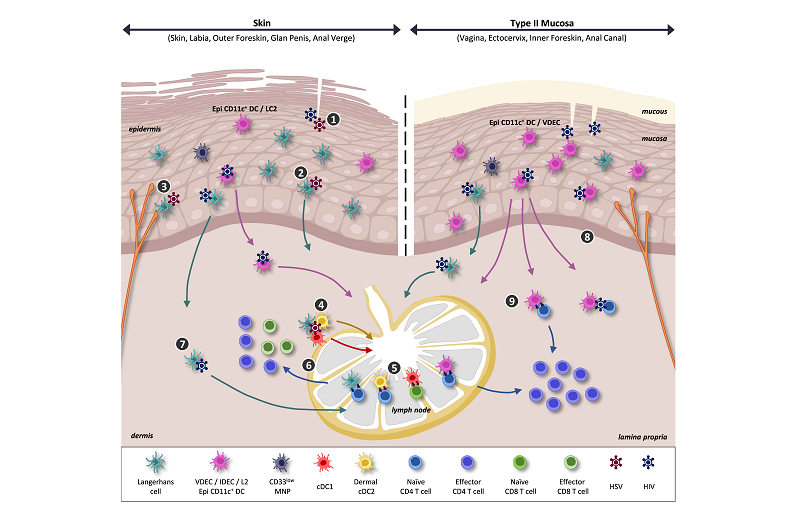
The SSE, which forms the outermost layer of the skin and certain mucosal tissues, is a critical barrier against pathogens. Historically, Langerhans cells (LCs) were considered the sole antigen-presenting cells (APCs) within the SSE. However, recent research has identified another key player: dendritic cells (DCs). These findings have profound implications for the development of next-generation vaccines that target the skin and mucosal surfaces.
Professor Harman explained, “Our research highlights the distinct roles of LCs cells and DCs in pathogen uptake and immune activation. This distinction is crucial for designing vaccines that can effectively utilize these cells’ unique capabilities.” The study underscores the importance of correctly identifying and characterizing these APCs to enhance vaccine efficacy.
One of the study’s key revelations is the functional differences between LCs and DCs. While both cell types are involved in detecting and processing pathogens, they exhibit different mechanisms for pathogen uptake and T cell activation. Notably, DCs have been shown to be more effective in certain immune responses, although their role in neuroimmune interactions remains to be fully understood.
The implications of these findings are particularly relevant for mucosal vaccines, which aim to induce immunity at the sites of pathogen entry, such as the genital and respiratory tracts. Given that sexually transmitted infections (STIs) and other viral infections like mpox, herpes simplex virus (HSV), and human immunodeficiency virus (HIV) often enter the body through these routes, optimizing vaccine delivery to these areas is critical.
The research team has also highlighted the historical evolution of our understanding of APCs in the SSE. Initially, LCs were the primary focus, but the identification of epithelial DCs has expanded the landscape of immune defense mechanisms in these tissues. This evolution underscores the dynamic nature of immunological research and the continuous need to update our knowledge base with new findings.
Professor Harman noted, “The identification of DCs in the SSE opens up new avenues for vaccine development. By leveraging the unique properties of these cells, we can design more targeted and effective vaccines that provide robust protection against a range of pathogens.” This approach could be particularly beneficial in creating vaccines that elicit strong local immune responses at the site of infection.
Furthermore, the study sheds light on the neuroimmune interactions within the SSE. The presence of nerve endings that interact with immune cells suggests a complex interplay that influences immune responses. Associate Professor Austin remarked that “we are just at the beginning of unravelling these bidirectional interactions, and they represent a new and untapped frontier in vaccinology”. Understanding these interactions can inform the development of vaccines and therapies that modulate immune activity through neural pathways.
In conclusion, the research conducted by Professor Harman and colleagues marks a significant advancement in our understanding of the immune landscape within the SSE. By delineating the roles of LCs and DCs, this study provides a foundation for the development of more effective mucosal vaccines. As the global community continues to combat infectious diseases, such innovations are essential for improving public health outcomes.
Other References
Bertram KM, Botting RA, Baharlou B, Rhodes JW, Rana H, Graham JD, Patrick E, Fletcher J, Plasto TM, Truong NR, Royle C, Doyle CM, Tong O,Nasr N, Barnouti L, Kohout MP, Brooks AJ, Wines MP, Haertsch P, Lim J, Gosselink MP, Ctercteko G, Estes JD, Churchill MJ, Cameron PU, Hunter E Haniffa MA, Cunningham AL, Harman AN. Identification of HIV Transmitting CD11c+ Human Epidermal Dendritic Cells Nature Communications 2019 PMID: 31227717.
Bertram KM, Truong NR, Smith JB, Kim M, Sandgren KJ, Feng KL, Herbert J, Rana H, Danastas K, Miranda M, Rhodes JW, Patrick E, Cohen RC, Lim J, Merten S, Harman AN*, Cunningham AL*. Herpes Simplex Virus type 1 infects Langerhans cells and the novel epidermal dendritic cell, Epi-cDC2s, via different entry pathways PLOS Pathogens 2021. PMID: 33905459. * equal last author
Bertram KM, O’Neil TR, Vine EE, Baharlou H, Cunningham AL, Harman AN. Defining the landscape of human epidermal mononuclear phagocytes. Immunity 2023. PMID: 36921567.
About the researcher

Andrew Harman
Andrew Harman carried out his PhD at the University of Cambridge studying how Herpes Simplex Virus enter cells and establishes epidermal infection.… He moved to the Westmead Health Precinct in 2002 and is now a Professor of Virology and Immunology in the School of Medical Sciences at the University of Sydney and the Co-Director of the Centre for Virus Research at the Westmead Institute for Medical Research. He has driven partnerships with over 30 clinicians making him globally unique in his privileged access to a wide range of human tissues freshly discarded from surgery, affected by a range of disease conditions. He holds two NHMRC Ideas Grants as CIA, which fund his two research groups that investigate sexual transmission of HIV and Inflammatory Bowel Disease. Importantly, he has identified new dendritic cell populations that inhabit the stratified squamous epithelium in addition to Langerhans’s cells.
Journal reference
Vine, E. E., Austin, P. J., O’Neil, T. R., Nasr, N., Bertram, K. M., Cunningham, A. L., & Harman, A. N. (2024). “Epithelial dendritic cells vs. Langerhans cells: Implications for mucosal vaccines.” Cell Reports, 43. DOI: https://doi.org/10.1016/j.celrep.2024.113977